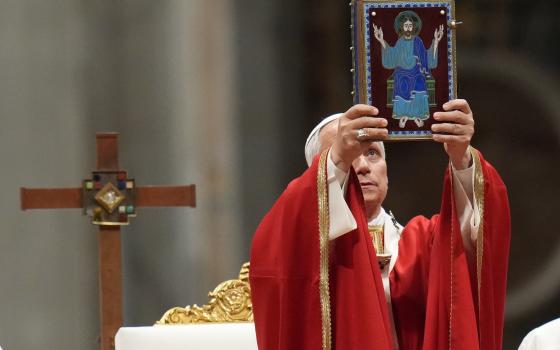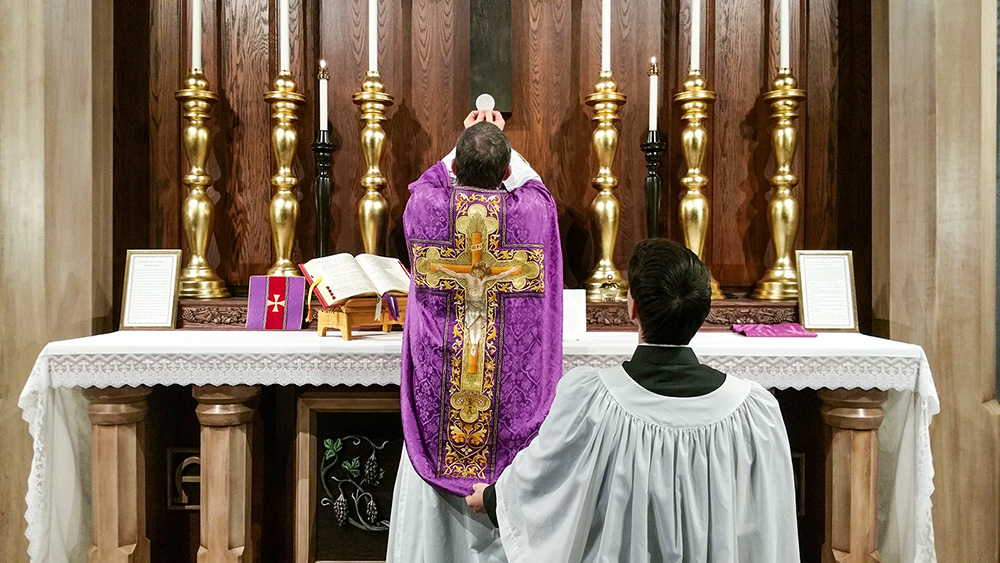
A priest elevates the Eucharist during a Latin Mass. (RNS/Andrew Gardner/Creative Commons)

Religion News Service
Join the Conversation
Send your thoughts to Letters to the Editor. Learn more
Penitent: Bless me, Father, for I have sinned. It has been a week since my last column, I mean my last confession. Since that time, I have expressed hatred toward the old Latin Mass, aka the Traditional Latin Mass (TLM), aka the Tridentine Mass, aka ...
Priest: Yes, yes, I know what you are talking about. The Mass that was celebrated in the Catholic Church before the Second Vatican Council.
Penitent: The old Latin Mass is like a zombie. When we went from Latin into English in 1964, we thought it was dead, but it keeps coming back. We thought it would fade away or people would be satisfied with going to a Latin version of the new liturgy. Not so.
Priest: Hatred is a sin. Jesus told us to love one another as he has loved us.
Penitent: I know. Actually, I don't hate the people who go to the old Latin Mass. Many of them are nice, pious people. They find spiritual nourishment in their Mass. With better catechesis, I think they would appreciate the new liturgy.
On the other hand, I do hate the ideologues who say the new Mass is blasphemous and who reject the teachings of the Second Vatican Council on things like ecumenism, social justice and the role of the laity in the church.
Priest: Didn't you grow up with the old Mass? Did you hate it then?
Penitent: No, I loved it. I went to daily Mass in grammar school and high school. When I entered the novitiate in 1962, the Mass was in Latin. I thought it was going to be in Latin the rest of my life. Even though I was bad in languages, I could follow the Mass in my missal, which had Latin on one side of the page and English on the other. After four years of Latin in high school and four years in the seminary, even I could follow the Mass in Latin.
Priest: If you liked the old Latin liturgy, didn't you find the change traumatic?
Penitent: No, not really. We had a very traditional Jesuit novitiate that stressed obedience. If the church said the Mass should be in English, we saluted and did it without questions.
This is another reason I have problems with the so-called conservatives. If they want to be traditionalists, they should be obedient to the council and the popes who have promoted the liturgy in the vernacular. Obedience was the most important virtue in the old church.
Priest: So, you only accepted the new liturgy because of obedience?
Advertisement
Penitent: At the beginning; but once we got into the new liturgy, I loved it. Not only were the Scripture readings in English, but we got a greater variety of readings with the three-year cycle on Sundays and the two-year cycle during the week.
I was sick of hearing the parable of the wise and foolish virgins, which we could hear a couple of times a week in the old liturgy on the feast days of virgins. There are a lot of virgin saints in the liturgical calendar.
The new Eucharistic prayers are also wonderful, although I also confess getting angry at priests who rush through the Eucharistic prayer as if they were racing to finish Mass. Sometimes the opening and closing songs are longer than the Eucharistic prayer.
Priest: Didn't all these changes bother you?
Penitent: No, not really. I had read Joseph Jungman's Mass of the Roman Rite, which is a comprehensive history of the Mass, and it makes clear that the Mass was constantly changing through history. Our tradition is to change. This book should be mandatory reading in the Catholic seminaries.
Priest: Has your understanding of the Eucharist changed?
Penitent: Before Vatican II, I saw the Mass as renewing the sacrifice of Jesus. Our role was to accept the redemption that comes from this sacrifice and unite our lives with his offering.
I still believe that, but my understanding has been enriched by recognizing the roots of the Eucharist prayer in the Jewish Passover prayer. Both prayers are addressed to the Father. In the Eucharist, we pray with Jesus, not to him. Like the Jews, we remember God's actions in the world. We thank and praise him for creation and for his actions on behalf of his people.
We especially thank him for sending Jesus. We remember his life, death, resurrection and sending of the Spirit. We pretty much ignored the Spirit in the past, but he is central in transforming us into disciples of Christ. In receiving Communion, we become the body of Christ, continuing his mission in the world today.
Priest: Enough with the sermon, let's get back to your sins.
Penitent: Well, I guess I am also jealous of the TLM promoters. They are so well organized that, even though they are few in numbers, they get a huge amount of attention from the bishops and the media.
Those of us who want to see further reforms in the liturgy are ignored. We can't get anyone's attention.
Priest: What further reforms do you want?
Penitent: For starters, a better English translation of the Mass. There is an excellent translation done in 1998 by the International Commission on English in the Liturgy. It was approved by the English-speaking bishops' conferences around the world but rejected by Cardinal Joseph Ratzinger, who wanted a more literal translation. It still frosts me that a native German speaker was able to tell English speakers how to pray in their own language.
I would not change the people's parts, but allowing priests to use the 1998 translation for their parts would not be disruptive.
Second, we need better connections between the Liturgy of the Word and the Liturgy of the Eucharist. The 1998 ICEL sacramentary does this in a minor way by having the opening presidential prayer pick up themes that we are going to hear in the Scripture readings.
But why could we not have a unique preface for each Sunday in the three-year cycle that would pick up on the themes and vocabulary of the readings?
We also need Eucharistic prayers that are more biblically themed — for example, a Eucharistic prayer based on the theology of John's Gospel. We could have a Eucharistic prayer based on each Gospel that could be used when that Gospel is read. Also, we could use Eucharistic prayers based on the Pauline letters.
Priest: Enough already. I have a good understanding of your sins. You are clearly full of anger and arrogance. I am not sure you are even sorry for your sins, but since you confessed them, I will give you absolution.
For your penance, go to the traditional Latin Mass that I will be celebrating next week.
Ego te absolvo a peccatis tuis in nomine Patris, et Filii, et Spiritus Sancti.
Penitent (sotto voce): I knew I should have gone to a Jesuit parish.