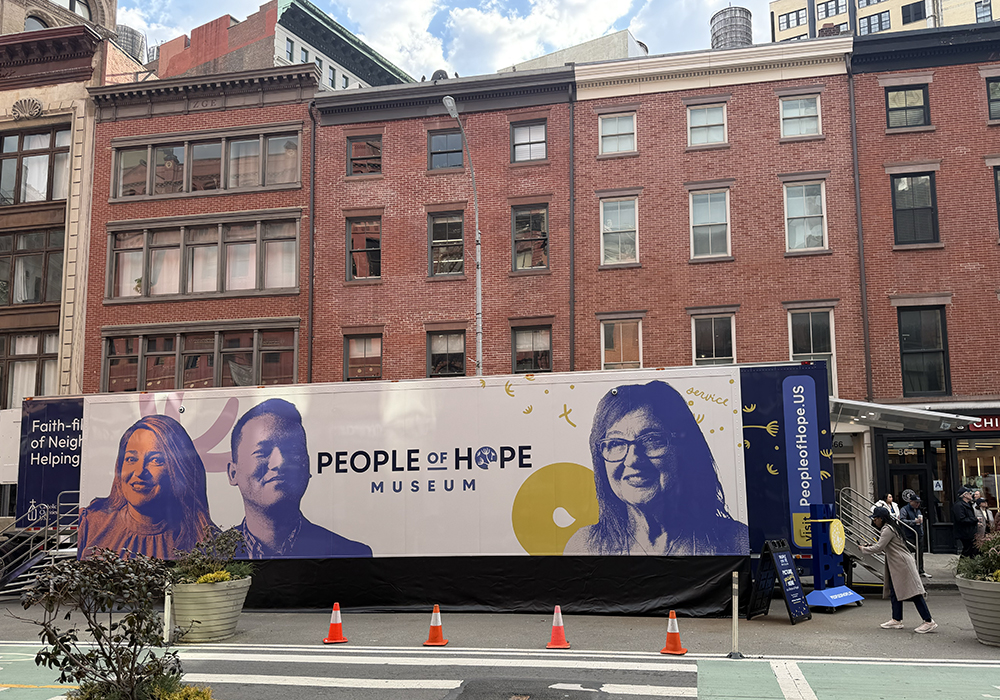
The People of Hope Museum is pictured in New York City on March 26, 2026. (Christopher White)

by Michael J. O'Loughlin
NCR executive editor
Join the Conversation
Send your thoughts to Letters to the Editor. Learn more
Can hopeful stories be an antidote to the perpetual outrage machine that seems to fuel modern life in the United States?
Kerry Alys Robinson, the president and CEO of Catholic Charities USA, sure hopes so.
Robinson believes that human beings are programmed for good. She was in New York City this week (March 25) to celebrate the launch of the People of Hope Museum, a storytelling museum that chronicles dozens of hopeful stories told by volunteers and staff at local Catholic Charities agencies across the country.
"The People of Hope Museum is predicated on the belief that we are not as divided as we are being forced to think, that we are hardwired for generosity, particularly when we know that there is a face, a name and a story behind human suffering," Robinson told me. "People want to be good and they want to be generous."
People may be divided, but they seem pretty united in their frustration with the state of affairs in the United States.
A Politico poll from November found that 59% of Americans said they believe polarization is worse than five years earlier and an overwhelming 79% of Americans described our politics in negative terms according to a Pew poll from 2023, with divisive, corrupt, messy and polarized as some of the most cited words. Gallup found last month that 72% of Americans are dissatisfied with the way things are headed in the country.
At the museum's launch party on March 25 in New York, Timothy Shriver, Special Olympics board chair and co-creator of The Dignity Index, said "a contempt industrial complex" contributes toward all this negativity.
"There's a massive business model designed around conflict entrepreneurs and outrage," Shriver said. "It's designed to make you devotionally angry and it's designed to bring you back repeatedly."
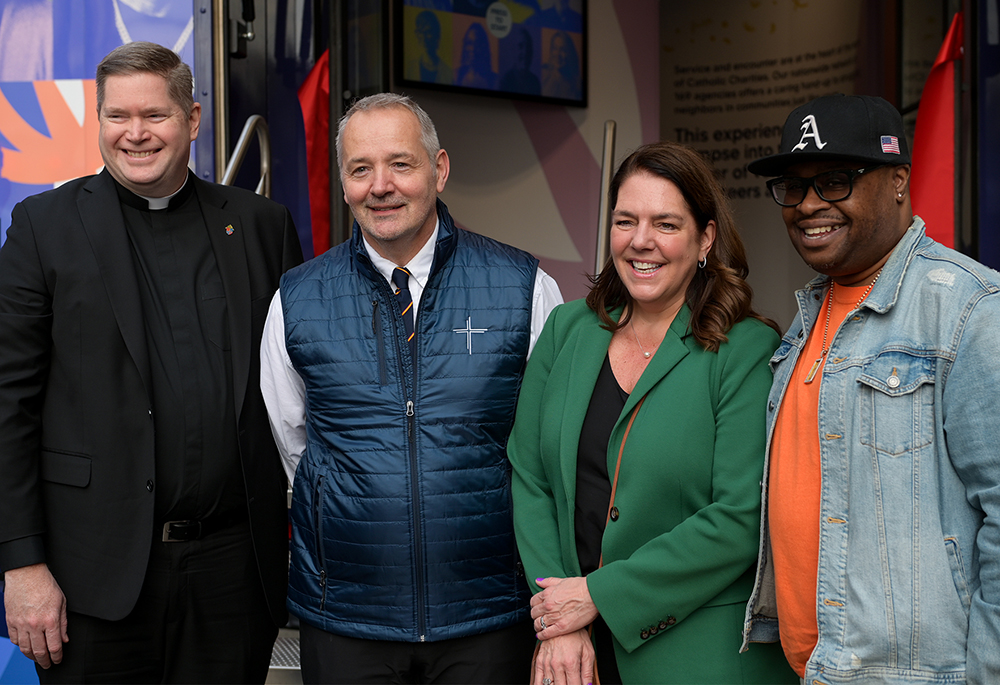
At the ribbon cutting for the launch of the People of Hope Museum in lower Manhattan, March 26, 2026, CCUSA President and CEO Kerry Alys Robinson was joined by, from left, the Very Rev. Patrick J. Keating, deputy CEO of Catholic Charities Brooklyn & Queens; J. Antonio Fernández, CEO of Catholic Charities Archdiocese of New York; and Jamar Carr, a substance abuse counselor at Catholic Charities Brooklyn & Queens. Carr's video testimonial of service to a resilient client is one of 42 featured in the museum, which has begun a national tour. (Courtesy of Catholic Charities USA)
Even with her optimism in people, Robinson knows more than most the dangers of the toxic sludge emanating from all that divisiveness.
Catholic Charities workers in recent years have endured violent threats from a far-right influencer and others, as well as harsh rhetoric from members of Congress because of their work to support migrants. She said the work she sees at Catholic Charities offers a different perspective and she's hopeful that visitors to the museum will be inspired.
"In this moment of time, particularly in the United States, we're almost conditioned to see everything through the lens of political divisiveness," Robinson said. "The beautiful thing about the People of Hope Museum is that it is not political. It's human. It's faith-filled. And anyone at any point on the theological or political spectrums experiencing these stories will identify with both the one needing mercy and the one providing it."
While most museums are stuck in place, People of Hope is on the move.
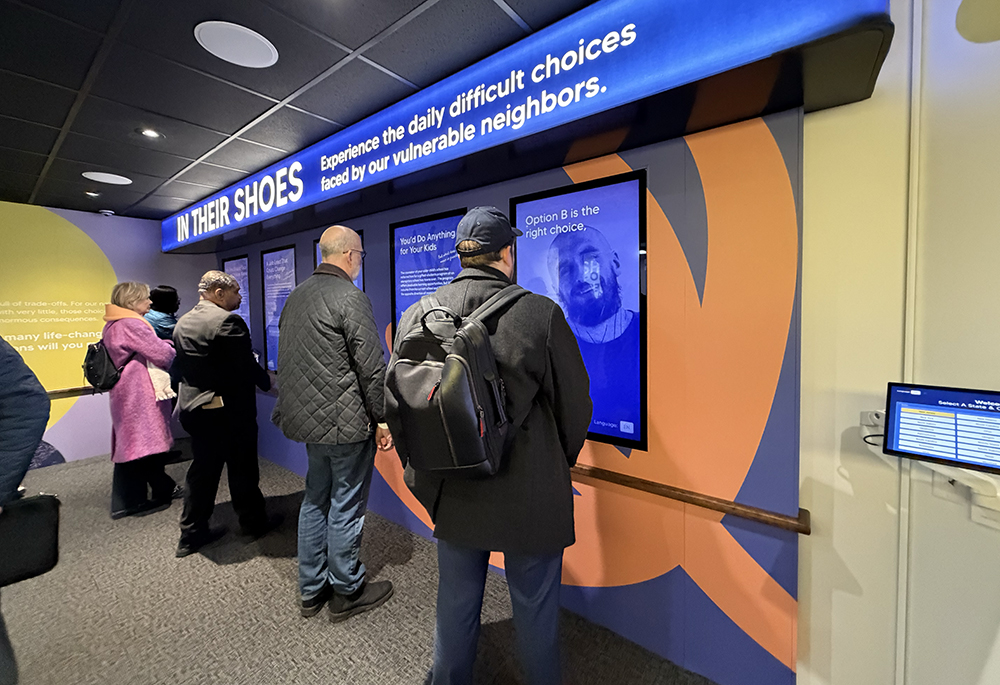
Attendees are pictured inside the People of Hope Museum. (Courtesy of Catholic Charities USA)
It's housed in a retrofitted tractor trailer, which will spend the next couple of days parked in Manhattan, inviting the public in for the first time before traversing up and down the East Coast over the next several months and then winding its way through the rest of the country, eventually making more than 150 stops.
There are even plans to figure out how to bring a version of the museum to Hawaii, overseas U.S. territories and perhaps even Rome. Each stop is hosted by a local agency, which partners with other civic institutions and community leaders. As for the goal of the museum, Robinson said it exists to build empathy and to encourage people to get involved in their local communities.
"You've learned about poverty, you've been moved by these stories," Robinson said of museum visitors. "What does it mean for you? What does it compel you to want to do as part of a solution? How can you be a good neighbor?"
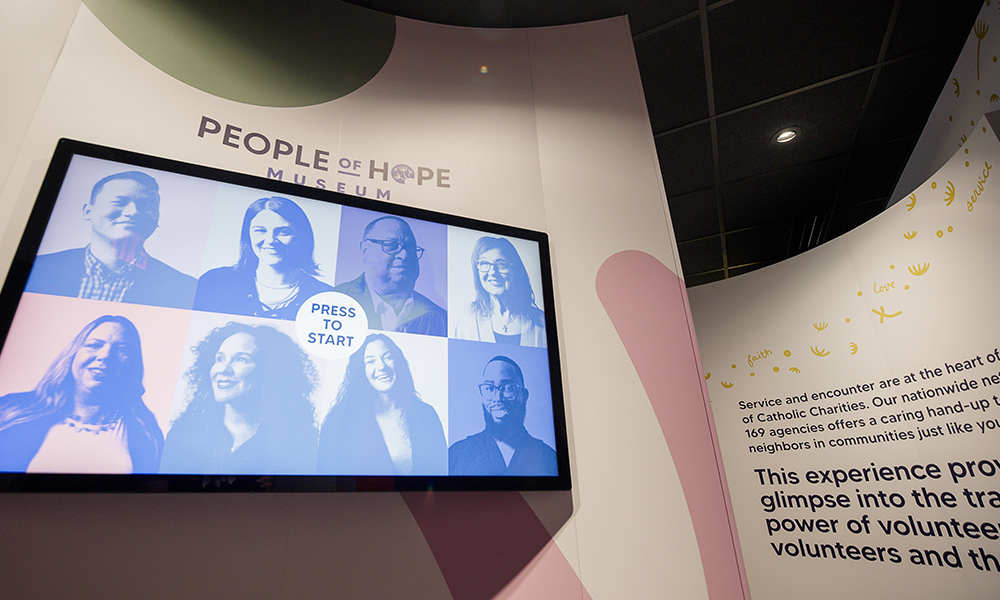
Entry view of the People of Hope Museum (Courtesy of Catholic Charities USA)
At the launch event in New York, volunteers featured in the museum were on hand to share their stories.
Peter Greenland moved to the United States from Jamaica and with nowhere to go, turned to a men's shelter affiliated with Catholic Charities in Philadelphia. Once he was back on his feet, Greenland returned to help out and today he's on staff at Catholic Charities of Philadelphia.
Greenland said that seemingly simple acts can mean the world to someone struggling in life.
"Small acts of kindness can change their whole outlook, even if it's just for that day," he said. "Sometimes it's just a matter of stopping and having a conversation."
Visitors to the museum encounter video testimonials recalling individuals they met through their work at Catholic Charities, a library of books about service and empathy and interactive exhibits about poverty in the United States. At the end, they can record their own one-minute testimonials.
"We're deeply aware that what gets in the news in this age is all of the bad things that happen," Robinson said. "We wanted to amplify the millions and millions and millions of examples of neighbors helping neighbors."
Advertisement
One of the goals of the museum is to build empathy between neighbors.
Abigail Marsh, a psychology professor in the interdisciplinary program in neuroscience at Georgetown University and an expert in human empathy, said during a panel presentation, "The most powerful source of empathy is a single human being, because empathy is a one-on-one experience."
That's why stories are so powerful – and could perhaps inspire others toward service.
"Generosity has an infectious quality to it," Robinson said. "When you witness it, when you witness these stories, you want to be a better person."
Here's hoping Robinson is right.