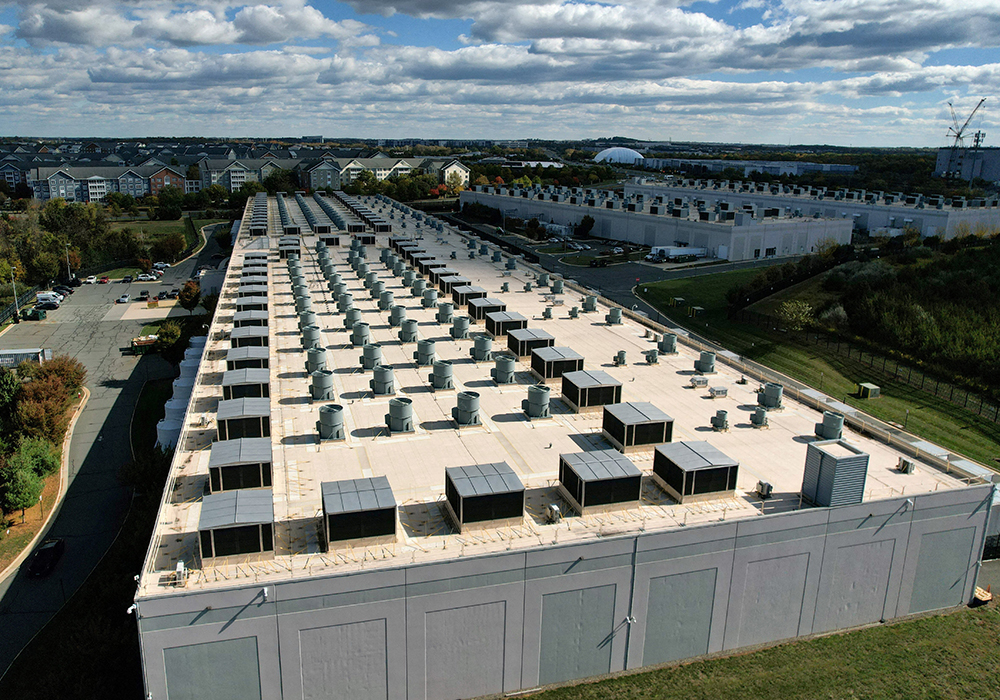
An aerial view shows an Amazon Web Services Data Center known as US East 1 in Ashburn, Virginia, Oct. 20, 2025. (OSV News/Reuters/Jonathan Ernst)

Join the Conversation
Send your thoughts to Letters to the Editor. Learn more
As the artificial intelligence boom drives a rapid expansion of data centers across the United States, server facilities are becoming an increasingly visible issue in the 2026 midterm elections — including for Catholic and other faith-based voters concerned about energy costs, water consumption, environmental stewardship and the impact on vulnerable communities.
Opposition to new data centers has surfaced in campaigns across the country, with candidates in both parties responding to concerns over electricity demand, land use, tax incentives and the costs of expanding the power grid.
For people of faith involved in environmental and social justice work, those debates also raise questions rooted in Catholic social teaching: Who benefits from development? Who bears its costs? And what obligations do communities have toward creation and the poor?
In Munster, Indiana, Kevin Foy, executive director of the U.S. Catholic Mission Association, has been involved in a local debate over roughly 60 acres that had been considered for data center development. A petition has been tabled, but Foy said the matter is not settled. He also said the discussion reflects a broader unease in communities familiar with the environmental legacy of previous waves of industrial development.
"We have communities here that still have lead in their water from factories that closed 40 years ago," Foy told the National Catholic Reporter. "We have watersheds that we've been actively working to restore, and we've seen the promises of factories, steel mills — things that, once those go away, the jobs disappear, and we're left with the environmental impact and the other impacts."
That history, he said, makes residents more wary when corporations arrive promising jobs and investment.
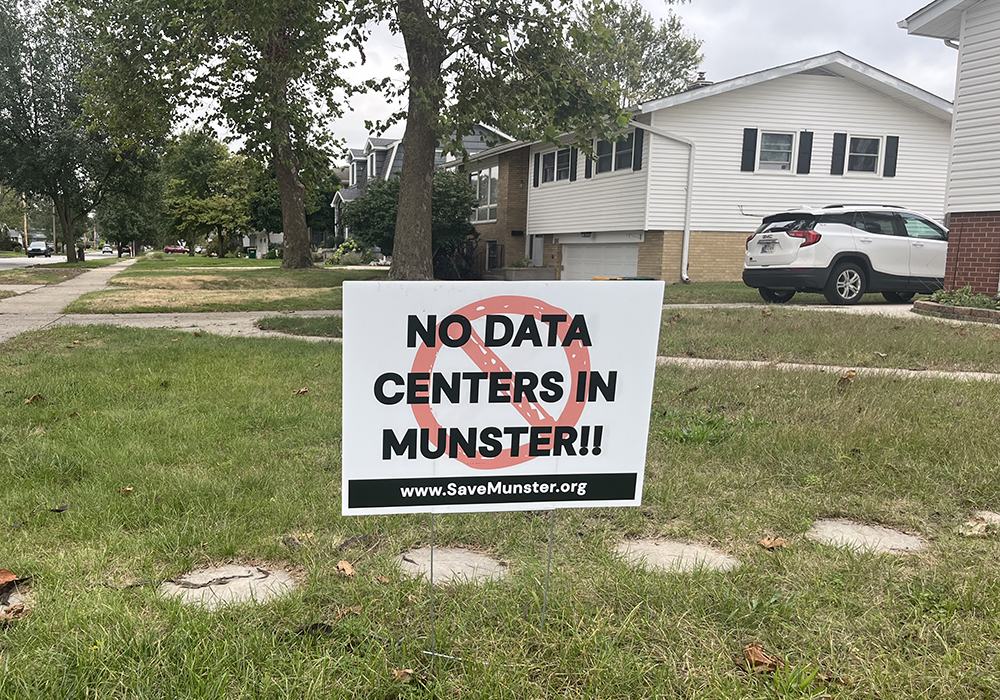
A yard sign in Munster, Indiana, opposes the construction of a new data center in the area, in September 2026. (Courtesy of Kevin Foy)
From a Catholic perspective, Foy said the fundamental questions should be, "How is this going to affect and impact the most vulnerable in our community and how is it going to impact our environment?"
“The church has been consistent for years that we have to think about creation when we're thinking about the economy," he said.
For Foy, the issue extends beyond the communities where data centers are physically built. He pointed to the global labor behind the AI industry, including low-paid workers who train algorithms or review disturbing online material, as well as workers whose call center jobs may be displaced by artificial intelligence.
"There are all sorts of downstream impacts that we don't think about in terms of the services we're using here and who's affected in the most vulnerable parts of our world," he said.
Locally, however, the questions are immediate. Foy said residents in northwest Indiana have raised concerns ranging from noise to water consumption, electricity demand and the resilience of the power grid.
Those concerns became particularly tangible after severe storms on Aug. 11 knocked out electricity across the area. Foy said his own home was without power for nine days, while some residents waited as long as two weeks.
"It raised a lot of questions about: Do our grids, as they stand, have the capacity to handle this massive ramp-up of energy usage?" he said.
"A lot of this is about slowing things down, discerning, and what regulations are in place," he said. "Is the data center something we want for our community? Is that the economic path and environmental path we want for our community?"
Opposition to data centers is cutting across traditional party lines ahead of the 2026 midterm elections. A September PBS News/NPR/Marist poll found that 58% of U.S. voters believe new data centers will have a mostly negative effect on the country, while 65% oppose having one built in their own community.
PBS reported that the opposition is strong (greater than 60%) in "big cities, suburbs, small towns and rural areas alike," saying that more than 80% of Democrats oppose local construction, while Republicans are almost evenly split. Self-described MAGA supporters are the main exception, with more than half saying they would support a data center in their community.
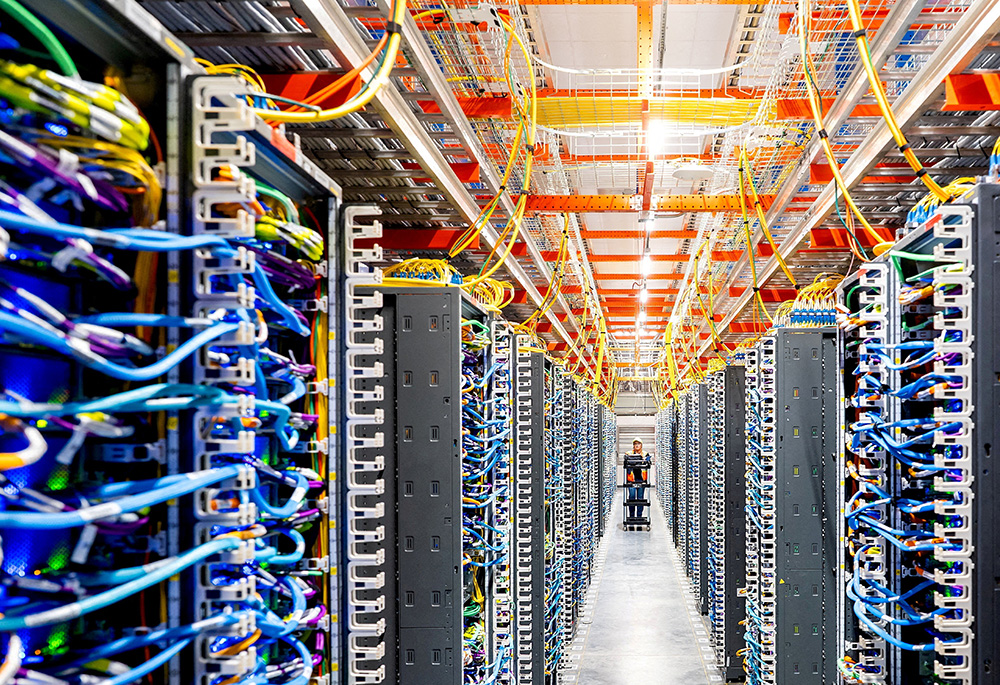
A technician works at an Amazon Web Services AI data center in New Carlisle, Indiana, Oct. 2, 2025. (OSV News/Reuters/Noah Berger for AWS)
Similar concerns are emerging in North Carolina.
Chris Hardin, a professional geotechnical and environmental engineer who is Catholic, has spent more than 35 years working in areas dealing with groundwater remediation, renewable energy, waste management and sustainable agriculture. He currently serves as managing director of the Energy & Environment Innovation Foundation.
Hardin said concerns about data centers in the Carolinas cross conventional political lines.
Working with the Catawba Riverkeeper and local farmers, he said he has encountered residents frustrated not only by environmental questions but also by what they see as a lack of transparency surrounding proposed developments.
"A lot of farmers were very upset because they see this massive data center going out in farmland, and no one even knew who it was being sold to," Hardin told NCR. "Both sides were saying, 'Wait a second, we didn't hear about this at all.' And that's the big item that caught people off guard."
Hardin said one of his priorities is greater transparency during negotiations between companies and local governments, including restrictions on nondisclosure agreements.
Microsoft announced earlier this year that it would stop using nondisclosure agreements with local governments during data center development, saying it wanted to increase transparency with host communities.
Hardin also argued that companies should bear more of the costs associated with expanding the electricity infrastructure necessary to serve them.
"They need to be treated like a large commercial customer and pay for the full upgrade of the grid," he said. "That should not be spread across citizens."
In Texas, the conversation is also increasingly focused on water and electricity.
Lisa Brenskelle, a Houston-based advocate who works for the Texas chapter of the Laudato Si' Movement, said the debate resonates strongly in a state already accustomed to concerns about water availability.
"For many people in Texas, the water consumption by data centers or by the power-generation facilities that are created to power data centers are a major issue," she said.
But Brenskelle said electricity affordability may be even more important from a faith perspective.
Advertisement
When the cost of new generation and grid infrastructure is passed along to consumers, she said, "that's a much bigger issue for people who live in energy poverty, for people who struggle to pay their electric bill."
"For the poor, it's a much bigger issue than it is for the rest of us," she said. "It's not just about the cry of the earth; it's also about the cry of the poor."
Brenskelle said elected officials considering data centers should examine their potential effects on air quality, water, public health, land and nearby vulnerable populations, including children, older people and those with existing health conditions.
But, like Foy, she stopped short of arguing that data centers should simply be rejected.
"Does that mean we don't build any data centers? Probably not," Brenskelle said. "Does it mean we need to be very thoughtful about how they're designed, how they're constructed, and how they operate? Absolutely."
The political pressure in Texas has become difficult for elected officials to ignore. On Sept. 21, Gov. Greg Abbott ordered a halt to new state-issued permits for data centers pending an audit of their effects on the electric grid and other resources, amid growing public concern over costs, water and infrastructure.
Brenskelle said the intensity of the reaction she has observed is itself forcing politicians to pay attention.
"The public in Texas is up in arms over data centers," she said. "Politicians of all stripes, whether it's Republican, Democrat or independent, are paying attention because the public is very, very, very not happy."