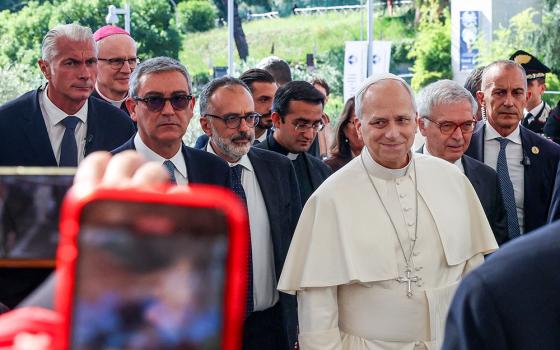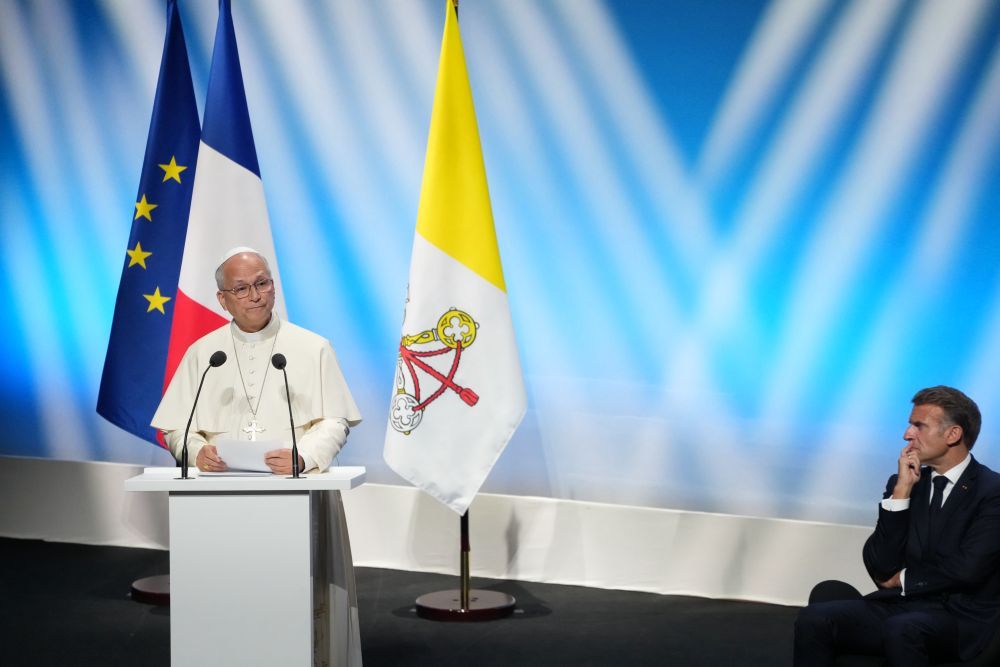
French President Emmanuel Macron, right, listens to Pope Leo XIV delivering his speech at the meeting At the Roots of Europe for Peace and Unity, Monday, Sept. 28, 2026, in Metz, France. (AP/Gregorio Borgia)

Join the Conversation
Send your thoughts to Letters to the Editor. Learn more
Catholics are still processing Pope Leo XIV's amazing trip to France. The images of the crowds lining the Champs-Élysées, of the excited young people at the Stade de France and the thousands singing the "Salve Regina" outside Notre Dame cathedral, of the Holy Father at the grotto in Lourdes, all these form a profound impression of the continued significance of Catholicism to French culture and of this pope's ability to harness that significance.
On Wednesday, I looked at his address to the bishops of France meeting in Lourdes, and how that reflected his approach to the governance of the church. Today, I want to step back a bit and look at the emerging Leonine style of pastoral leadership as seen by surveying his other talks.
Leo's religious sermons emphasized spiritual themes. At the huge Mass at the Place de la Concorde, the Holy Father's theme was a very Augustinian one: God as the answer to human restlessness and desire.
"What is my deepest thirst? What am I really seeking in life? We all long for happiness, love and fulfillment. But from what source do we seek to quench our thirst?" the pope asked. "Are we content with material goods, immediate satisfactions, the countless little idols that promise us everything but leave our hearts empty? We have been baptized and received the living water of which the Gospel speaks, but have we truly encountered Christ personally? In essence, the human person is a being of desire, and only God can fill the emptiness within us."
In his sermon at Lourdes, Leo highlighted another side of his Augustinian roots. In speaking of the promise of eternal life of which the Blessed Mother spoke to St. Bernadette, Leo said, "For the obstacle to grace and eternal life — the only obstacle to this love — is sin, whereby we turn in upon ourselves, refusing God and shutting ourselves up in our own darkness. … We must therefore use our freedom to say yes to Christ, relying on his grace, like Mary. This is a yes that we renew until our final breath — 'now and at the hour of our death' — as we say in the Hail Mary." He devoted several paragraphs to the theme of repentance, but always linked it to the ongoing call to conversion and the hope of eternal life. Very Augustinian.
Only in his sermon at Metz did the pope link the spiritual quest to larger social questions, in this instance, his insistent calls for peace.
"Metz and Moselle bear witness to the whole world that reconciliation is only possible when one has the courage to break the chains of resentment. It takes strength and great integrity not to be overwhelmed by evil, especially when the wounds inflicted are deep," the pope said. "However, in the face of injustice, humanity's only path to salvation is a love that cares for others and seeks to give trust regardless of the circumstances, even when confronted with the most difficult behavior to accept (cf. Mt 5:42). Thus, law, justice and peace are stages on a path of conversion that begins as a personal journey and becomes increasingly communal, leading to a civilization that respects human beings and their Creator."
Advertisement
The visit to France was bookended by two major talks to political leaders. In his visit to UNESCO, Leo delivered a powerful and profound speech on human dignity. "Before all else, the human person is someone who is conceived and born," the pope said. "Thus, first of all, to be human means to be a child. None of us chose to be so. None of us decided from whom, when or where to be born."
"Secondly, we are all born naked and in need," Leo continued. "We are poor by birth, in need of bread and words, of care and affection — that is, of all that nourishes body and spirit. We know this well, and yet, as we become adults, we risk forgetting it."
Francis was a master at the powerful, even extravagant metaphor. The tango was born in Buenos Aires, not Chicago. But in these simple, powerful images, Leo captured some of the late pope's rhetorical giftedness. I had expected this to be one of the more dull talks on the trip, but it was profound and was well received as such by his audience.
At Metz, in a speech to civil leaders, the pope invoked the often troubled history of the region, strategically located on the Moselle River and, therefore, one of the three main points of attack for those seeking to invade France. Out of this region, however, came the city's most famous son, Robert Schuman, one of the architects of postwar Europe, whom Leo quoted:
Christianity taught the equality of all people by nature, as children of the same God, redeemed by the same Christ, without distinction of race, color, class or profession. It taught the dignity of work and the duty of all to undertake it. It recognized the primacy of those inner values which alone ennoble the human person. The universal law of love and charity made every person our neighbor, and it is on this that social relations in the Christian world have since been founded.
Leo added his own addition to Schuman's words: "Far from being an exclusively religious criterion, recognizing Europe's debt to Christianity helps us understand more clearly that openness to the transcendent is always a constitutive part of the human person and a living source of civilization."
In his different talks, Leo dealt with specific issues occasioned by the venue and the audience. He did not mix and match spirituality and social ethics, apart from the sermon in Metz noted above. There was also no "seamless garment" imagery, which might help a young generation of converts better understand how the demands of our Catholic faith make claims different from those suggested by partisan political alignments. Leo does connect the dots when he gives his weekly catechesis and some of his other talks at the Vatican.
When Leo spoke about assisted suicide, which was recently legalized in France, his words were strong and condemnatory, rightly labeling the practice an example of "false compassion." One wishes he had been in Paris before the vote to legalize assisted suicide. He might have tipped the balance against it.
The crowds were massive and the excitement palpable. Leo was never an actor, like his predecessor St. John Paul II, and he lacks the Polish pontiff's dramatic sense of timing and connecting with a crowd. Yet connect he did. Why? As one Parisian said to my colleague Justin McLellan at the Mass in Paris: "He is a pope who is young, 71, and he moves the young people forward; he is calm, a good listener and he has very precise ideas and is able to express them clearly and in an engaging way — all the young people and the crowds here show that."
In a noisy and confusing culture, Leo's clarity and precision, as well as his obvious authenticity, break through. The response he received in France gives hope at a time when the world so desperately needs hope.