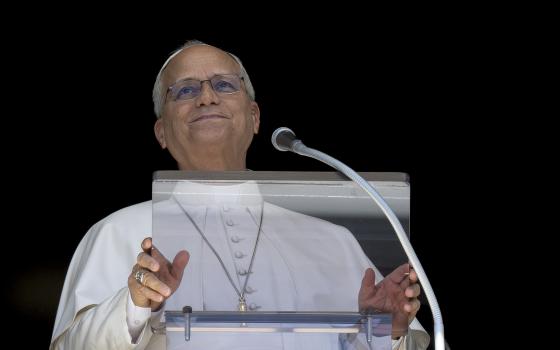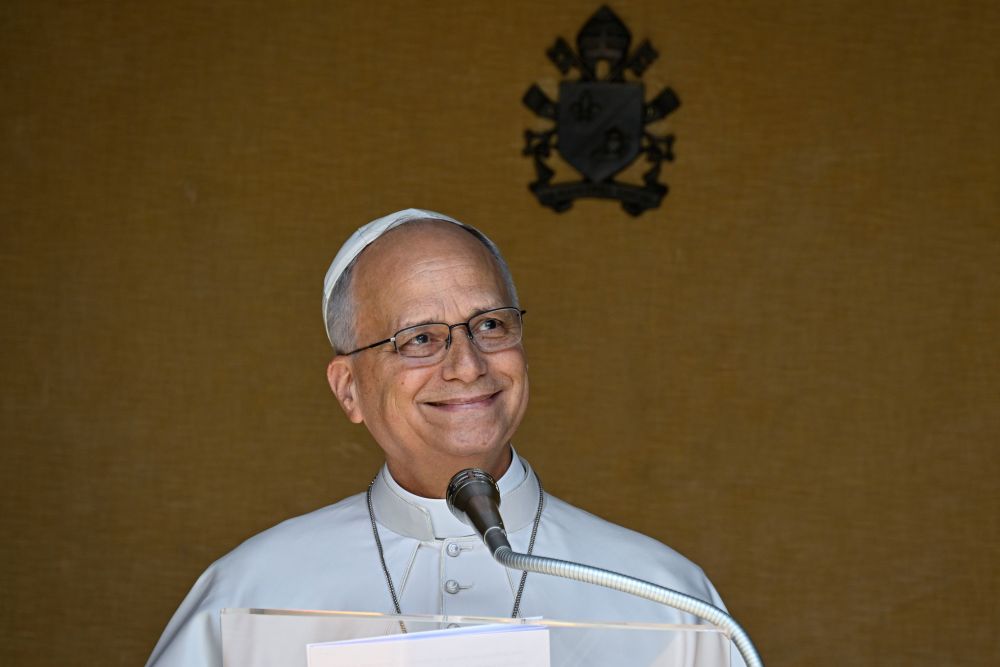
Pope Leo XIV smiles as he leads the Angelus prayer in Piazza della Liberta in Castel Gandolfo near Rome Aug. 30, 2026. (OSV News/Vatican Media)

Join the Conversation
Send your thoughts to Letters to the Editor. Learn more
In his short address to the Society of St. Vincent de Paul on Aug. 28, Pope Leo XIV said something that should be unremarkable but isn't: "Saint Vincent de Paul demonstrated that prayer and social justice are not merely complementary but are in fact inseparable."
In our polarized culture, many secular advocates of social justice learn their ideology in college classrooms where "prayer" is often seen as an example of what Karl Marx called "the opiate of the people," something necessarily conservative and opposed to progress.
On the other hand, if you watch Fox News on any given night, you will know that "social justice" functions as a cuss word, an insult to rugged individualism and meritocracy, something anti-American and probably communist.
Yet the pope said prayer and social justice are inseparable, and so they are. Leo went on to recall the joint encyclical Dilexi Te that Pope Francis had begun and he finished, saying, "as I recalled in Dilexi Te, Saint Augustine taught the Christocentric nature of care for the poor and held that God will not be outdone in generosity to those who serve them. We therefore believe that caring for others, when motivated by love, not only helps those in need, but also opens the heart of the giver to God's grace (cf. no. 46)."
I confess that when Dilexi Te first came out, I read it quickly, too quickly. Paragraph 46, which the pope cited last week, did not make a huge impression on me. Returning to the document now, it is worth considering the paragraphs that precede 46 as well, which draw on the writings of St. Ambrose and, unsurprisingly, St. Augustine, who was Ambrose's star pupil.
Leo recalls one of St. Ambrose's most famous sayings: "What you give to the poor is not your property, but theirs. Why have you appropriated what was given for common use?" That isn't communism or socialism, both of which have roots in a materialistic understanding of the human person and society. It is radical Christian witness, a call to conform ourselves to Christ. That also makes Ambrose's words the exact opposite of the expressive individualism that characterizes so much of the activism and thought on the contemporary left.
Turning to Augustine, the pope wrote that the great saint "realizes that true ecclesial communion is expressed also in the communion of goods," and that "For Augustine, the poor are not just people to be helped, but the sacramental presence of the Lord."
Advertisement
Pope Benedict XVI understood this profound relationship between conforming oneself to God, the life of prayer and the works of charity to the pursuit of justice. He opened his magnificent encyclical Caritas in Veritate, which is more radical in some ways than any other papal text, with these words: "Charity in truth, to which Jesus Christ bore witness by his earthly life and especially by his death and resurrection, is the principal driving force behind the authentic development of every person and of all humanity. Love — caritas — is an extraordinary force which leads people to opt for courageous and generous engagement in the field of justice and peace."
Later, in that same document, Benedict writes: "As the objects of God's love, men and women become subjects of charity, they are called to make themselves instruments of grace, so as to pour forth God's charity and to weave networks of charity." The St. Vincent de Paul Society, Catholic Charities, Catholic Relief Services, our Catholic hospitals and nursing homes, these are all "networks of charity," arms of the church outstretched into our hurting world.
It is precisely the ecclesial, sacramental and Christological quality of Catholic concern for the poor that distinguishes it from secular advocacy for social justice. It is the ecclesial, sacramental and Christological quality that puts the Catholic back into Catholic social doctrine. I fear that too often, Catholic social teaching jumps right into the social ethics and, in recent years, to a kind of political theology that leaves ecclesiology, sacramentality and Christology by the side of the road.
Here in the United States, our forebears understood the connection between prayer and good works at a practical level. My bedtime reading lately has been Thomas Duggan's history The Catholic Church in Connecticut. During the tenure of Bishop Michael Tiernay in Hartford from 1894 to 1908, the Diocese of Hartford, which then covered the entire state, grew from 98 parishes to 167 parishes. Five Catholic hospitals, all staffed by religious sisters, opened in the last 10 years of his episcopate. The Little Sisters of the Poor opened a house for those who were poor and infirm in New Haven while the Congregation of the Good Shepherd opened a house for so-called "fallen women" in Hartford. Several religious orders began schools. The ministries of the Sisters of Mercy were many and varied. And, of course, the Knights of Columbus spread from St. Mary's Church in New Haven to virtually every part of the world.
Our wonderful pope seems to me to bring the best of our tradition, and the insights of his immediate predecessors, to the Catholics of today, and to make that tradition fresh again. He also, clearly, understands the need for the church to find unity within herself if it is to help heal the polarization of the ambient culture. Will the Catholic Church in the United States heed his call to prayer, social justice and unity?
You are reading a selection from Michael Sean Winters' weekly newsletter. To get the full edition — including the "In the News" link roundup — delivered 24 hours before it appears online, sign up here!