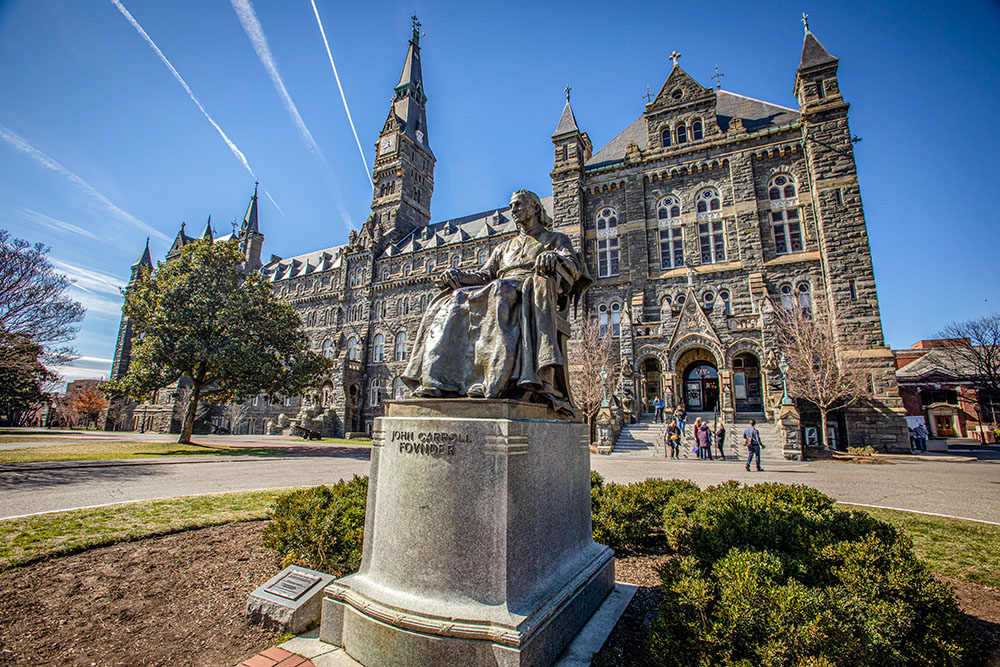
A statue of Baltimore Archbishop John Carroll, the first Catholic bishop in the United States and founder of Georgetown University, is seen on the Jesuit-run school's Washington campus March 3, 2022. (OSV News/Chaz Muth)

Join the Conversation
Send your thoughts to Letters to the Editor. Learn more
Last week, I wrote about Catholic higher education, examining both a recent papal sermon and relating some of the themes that emerged at a conference for mission officers at Catholic colleges and universities. Today, I wish to continue the discussion, focusing on a talk by Jesuit Cardinal Michael Czerny at a three-day conference celebrating the 100th anniversary of the theology faculty at Sankt Georgen in Frankfurt, Germany, and on Eduardo Peñalver's inaugural address as president of Georgetown University.
Czerny, who served as prefect of the Dicastery for Integral Human Development and is now the president of the Vatican Commission on Artificial Intelligence, focused at first on the ecclesial nature of theology. "Theology, classically, is sacra doctrina, our participation in God's self-knowledge, through whose eyes we see the world on our knees." The footnote the cardinal provides is equally worth noting: "Balthasar's Kniende Theologie. Theology is not a social science, but a divine one."
Since the close of the Second Vatican Council in 1965, theology has engaged the social sciences, and Pope Leo XIV even commended such engagement in his encyclical, Magnifica Humanitas. We have all learned a great deal from the engagement, but it is also time for a reckoning with the ways our understanding of theology has been distorted by that engagement. This was Balthasar's worry: that the effort to understand reality without reference to the divine results in a misunderstanding of reality.
Czerny applied this insight. Having catalogued some of the principal social encyclicals, and the crises to which they responded, the cardinal observed: "At each moment the context can be quite different but the music is the same: the inalienable dignity of the human person. 'The task today,' says Pope Leo, 'is to dare to pursue an integral humanism that addresses the questions of our time without losing sight of its source.' "
It is also true that theology faculties have insufficiently attended to the devotional life of Christians as a locus theologicus. "The guiding motto of the Sankt Georgen graduate school of philosophy and theology is Pietati et Scientiae. This expresses the Jesuit intellectual tradition: Faith, spirituality, pietas and praxis underlie, sustain and orient rigorous philosophical, scientific, humanistic and theological scientia, with research, writing and teaching in an increasingly contextual and interdisciplinary style."
The cardinal sounded very much like Pope Benedict XVI when he reminded his audience: "Theology is a gift from God, finding its origin in communion with God, lived out in the church. From the communion of saints who preceded us, we inherit a deposit and a living tradition; with the communion of saints that surrounds us, we reflect on it; and to the communion of saints to come, we transmit it. So theology is ecclesial yesterday and today and forever." The best theology, like the experience of grace itself, begins with the reception of a gift, requires a thankful examination of the gift, and issues in the command to pass it on.
The church is called to attend to the "signs of the times," which was a key theme of the book Siblings All, Sign of the Times: The Social Teaching of Pope Francis, which Czerny co-wrote with Fr. Christian Barone. In it, they explained that the "signs of the times" is not a sociological construct, but a theological one, referencing signs of grace in the world around us. In this talk, the cardinal refined and applied that concept of attending to the signs of the times, evidencing what is meant by the moral formation of students in Catholic education:
True attention inevitably takes the form of compassion, letting oneself be inwardly touched by the oppressed life many live, nearby or far away; touched by the forms of slavery at work today (cf. MH 173-79); scandalized by the social wounds, the violence, the wars and the enormous injustices suffered everywhere.
Anyone can study poverty or war, but the Christian scholar and student must do more. They must allow their studies to reflect the compassion to which they are called by their baptism. There is no dualism here. No one should leave their baptismal vocation at the classroom door.
Advertisement
Finally, the cardinal called for "pedagogy of discernment and synodality" and defeated some of the most common misconceptions of what synodality is. It is "not the practice of self-expression! It is about learning the art and spreading a culture of mutual trust and understanding," he said. "It is not about replacing the bishop with a democratic chamber. It is about a shift in the way bishops and their flock relate to each other and how genuine authority is exercised (not like the scribes! (Cf. Mt 7:29)"
The cardinal's talk deserves wide circulation throughout the academy and we can hope his insights on synodality will reach every diocese and parish too!
I should also like to commend the inaugural address of the new president of Georgetown University. Peñalver masterfully organized his vision of what a university must achieve around the need to restore our ability to "have a good argument." And his analysis of several threats to higher education warrants attention.
Turning to the role of religion in higher education, Peñalver quoted Harvard Divinity School's Jon Levenson' s concern "about the sustainability of the modern secular model of education that limits itself to ... the acquisition of skills and knowledge and ignores the soul." Peñalver promised:
Remaining firmly rooted in our Jesuit, Catholic tradition, Georgetown will help our students in that essential human search for purpose and fulfillment. We will sustain our commitment to both faith and reason as complementary paths towards the same truth, utraque unum. We will demonstrate to our colleagues in secular higher education that faith is not a departure from the rigorous search for truth but an invaluable partner in that project.
Georgetown's future is in good hands.
All of our Catholic schools can and should see the challenges of our times as so many opportunities for which the particular gifts of Catholic higher education are ideally suited. All of us Catholics should do what we can to promote Catholic education. The church needs it. And the world needs it even more.
Editor's note: You are reading a selection from Michael Sean Winters' weekly newsletter. To get the full edition — including the "In the News" link roundup — delivered 24 hours before it appears online, sign up here!