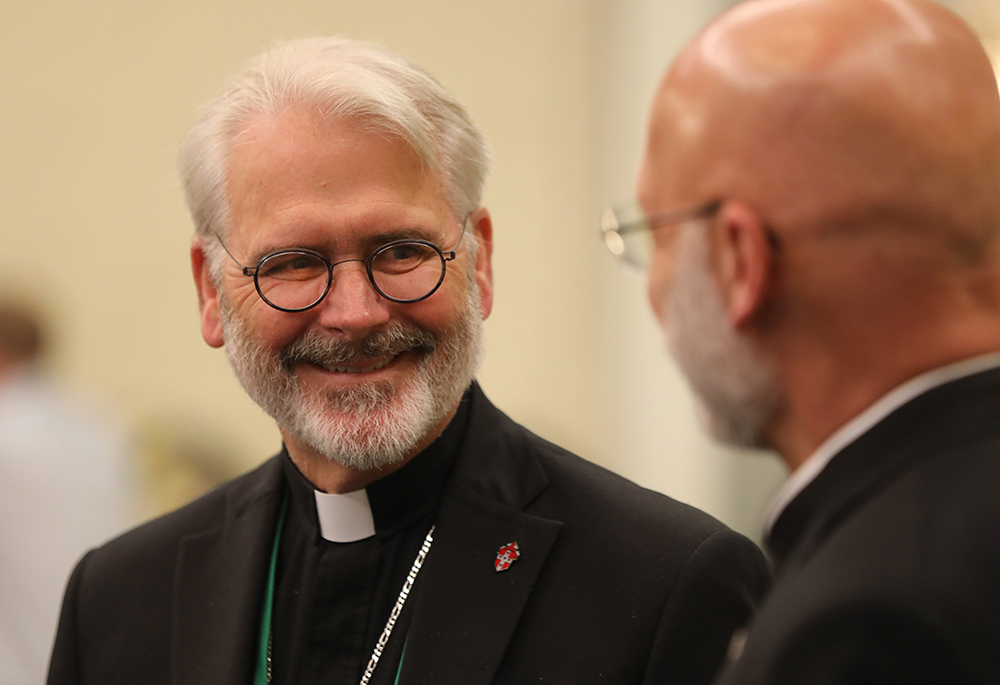
Archbishop Paul S. Coakley of Oklahoma City, now president of the U.S. Conference of Catholic Bishops, and Bishop James S. Wall of Gallup, New Mexico, share a light moment during a break June 16, 2023, at the bishops' spring plenary assembly in Orlando, Florida. The conference's 2026 spring assembly will be held in Orlando June 10-12, with public sessions scheduled for June 10 and 11. (OSV News/Bob Roller)

Join the Conversation
Send your thoughts to Letters to the Editor. Learn more
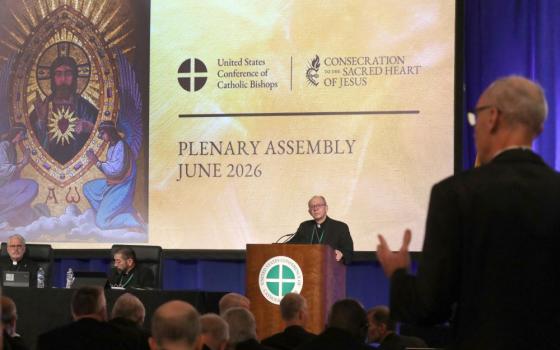
The U.S. bishops are gathering in Orlando, Florida, but they aren't going to Disney World. They are holding their annual spring meeting and, at a special Mass, consecrating our country to the Sacred Heart of Jesus.
The agenda has some interesting items on it, such as a revision of the "Charter for the Protection of Children and Young People." But a major point of interest for church observers will be three speeches at the meeting.
First, the bishops will hear from Oklahoma City Archbishop Paul Coakley who is set to deliver his first presidential address, having been elected last November to lead the conference. That election was surprisingly close, with Coakley winning 128 votes to 109 for Bishop Daniel Flores of Brownsville, Texas. Some bishops complained that Coakley had never retracted his statement praising the former nuncio, then-Archbishop Carlo Maria Viganò, when Viganò called on Pope Francis to resign. Some were more worried about his close connection with the conservative Napa Institute, where Coakley serves as ecclesiastical advisor.
The question is: Will Coakley's speech indicate he intends to be a bridge builder or will he use the conference's often opaque decision-making processes to stack the deck in favor of conservative causes? Will his speech embrace synodality, for instance, or will it pretend that the U.S. church is already an exemplar of synodality, as his predecessor, Archbishop Timothy Broglio did in his 2023 presidential address? Given the narrow margin by which Coakley won and the fact that we now have a young, healthy pope, everyone hopes he will opt to be a bridge builder.
Advertisement
Interestingly, Coakley joined a panel discussion about the new encyclical sponsored by Georgetown's Initiative on Catholic Social Thought and Public Life last week (June 2). The other panelists were Emilce Cuda from the Pontifical Commission for Latin America, Bishop Paul Tighe from the Dicastery for Culture and Education, Meghan Sullivan from the University of Notre Dame and Daniel Daly from the Center for Theology and Ethics in Catholic Health. You won't run into any of them at a Napa Institute cigar party. Coakley's contribution to the discussion was not especially lively and he seemed almost nervous. Still, kudos to him for participating.

Archbishop Gabriele G. Caccia, the Holy See's permanent observer to the United Nations, is pictured in a 2023 photo addressing the General Assembly at U.N. headquarters in New York City. Pope Leo XIV named Archbishop Caccia as the new papal nuncio to the United States March 7, 2026. He succeeds Cardinal Christophe Pierre, who turned 80 in January and had served in the post since 2016. (OSV News/Rick Bajornas, courtesy United Nations)
This week will also witness the first address to the U.S. bishops from our new nuncio, Archbishop Gabriele Giordano Caccia, who was appointed to the post March 7. Unlike most previous nuncios, Caccia is familiar with the U.S., having served as the Holy See's ambassador to the United Nations in New York for more than six years. He is very close to the Vatican secretary of state, Cardinal Pietro Parolin, both of them products of the Villa Nazareth, a home for Italian clerical students to live and study in Rome. It was overseen for many years by Cardinal Achille Silvestrini, who shepherded the careers of many more progressive future archbishops and cardinals.
We know that Caccia will, like all nuncios, speak about the need to maintain close bonds between the U.S. hierarchy and the Holy Father. That is his job. The questions are more of style. Caccia's predecessor, Cardinal Christophe Pierre, had a flair for delivering speeches that were all velvet on the outside but with more edge upon closer inspection. Will Caccia display a similar ability to call for allegiance to the pope from those who have grave misgivings about the direction of the last pontificate and, therefore, the current one?
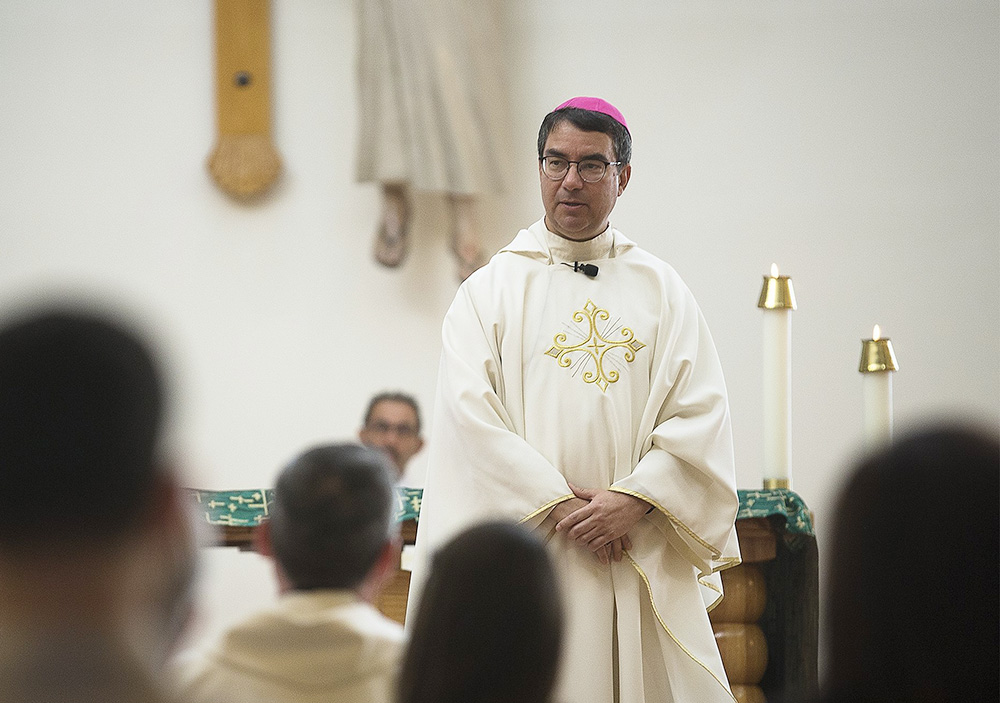
Bishop Oscar Cantú of San Jose, California, is seen in a Sept. 24, 2019, file photo. (CNS/Tyler Orsburn)
Finally, Bishop Oscar Cantú of the Diocese of San Jose, California, will speak to the bishops about his participation earlier this year in the Theological-Pastoral Congress on the Guadalupan Event, held at the Basilica of Our Lady of Guadalupe in Mexico City. The path of evangelization for the church today is Guadalupe, not the conquistadores and it is a path blazed by the poor, attentive to appropriate inculturation, one that requires participation, and always rooted in the incarnate Son of God.
A year earlier, Cantú gave what we call the "summation and altar call" at our fourth Way Forward gathering, touching on key points of the discussions and encouraging his brother bishops to bring what has been discussed to life in their ministry. Cantú touched on the theme of Our Lady of Guadalupe as a model for evangelization, but I also remember him commenting on the icons of the Eastern churches, and how their faces are glowing with peace, confidence and joy. This glow emanated from a heart on fire from dialoguing with God. The image stuck with me and, of course, points to the real objective of synodality, which is not to simply arrive at better decision-making processes but to reignite the fire that comes from dialoguing with God. Cantú is one of the brightest stars in the episcopacy and it is providential that he is the bishop whose diocese includes Silicon Valley while we all work on receiving Magnifica Humanitas.
These three talks, and the reception they receive, will tell us a great deal about the direction of the bishops' conference in the coming years. In recent years, the leadership of the conference has been one, big wet blanket, seemingly delighting in stifling initiatives, resisting Pope Francis' leadership, content to cozy up to the Republican Party even as that party has been descending into a cult. The Catholic Church in this country deserves a new direction. Will we start to see it this week in Orlando?