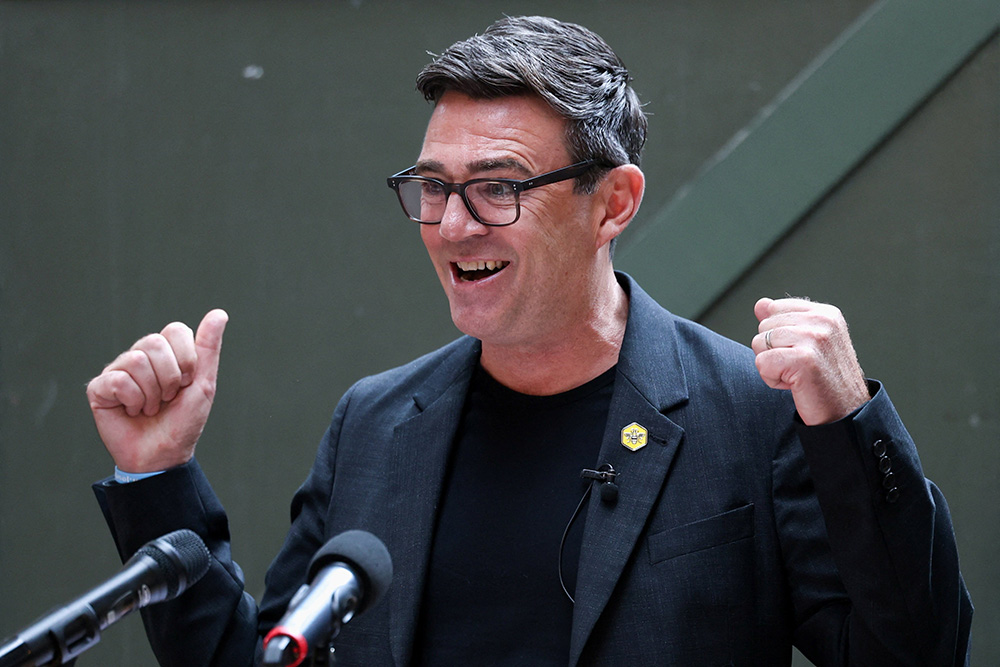
Andy Burnham, a British member of Parliament for Makerfield, England, delivers a speech at the People's History Museum in Manchester June 29, 2026. (OSV News/Reuters/Temilade Adelaja)

Join the Conversation
Send your thoughts to Letters to the Editor. Learn more
Is there something good stirring in the fires of populism?
Recent news reports from Georgia, Kansas, Nevada and elsewhere indicate popular hostility to the placement of AI-related data centers in local communities.
In Ohio, Sherrod Brown is leaning into this opposition to data centers as part of his bid to return to the U.S. Senate. Other prominent Democrats who have supported building the data centers are getting serious pushback.
The New York Times' opinion writer David Wallace-Wells and contributing writer Robinson Meyer recently discussed the issue. "This is an insanely polarized country, which means it isn't very often that you see a political supermajority on any issue, let alone one that emerges almost out of nowhere to announce itself as a major new front in our politics," Wells noted. Yet, that is what is happening. People are fighting back. Some people say they are concerned about water usage. Others note the potential drain on the supply of electricity. Underneath the particular concerns, however, is a deeper issue: Who gets to decide?

An aerial view shows an Amazon Web Services Data Center known as US East 1 in Ashburn, Va., Oct. 20, 2025. The explosion of massive data centers to handle the increasing generative demands of artificial intelligence have placed high demands on both power and the water used in cooling systems -- millions of gallons per day -- and low-income communities have typically endured the brunt of the air pollution they create. (OSV News/Reuters/Jonathan Ernst)
Since the 1980s onward, as new technologies and globalization took their toll on the working classes in Western countries, prevailing opinion in elite circles and across the political spectrum was that these changes were inevitable, that opposing them amounted to imitating King Canute ordering the waves to recede. Neoliberalism rested on the claim that economics was a science, rooted in human nature, and that its conclusions could not be rationally challenged.
The claim was always nonsense.
Philosopher Jason Blakely's book We Built Reality explained — and debunked — the argument first articulated by Milton Friedman that economics was like physics. The one predicted economic growth and recessions and the other predicted solar and lunar eclipses. Alas, even Friedman's most conspicuous and consequential disciple, Alan Greenspan, had to admit that he was mistaken in believing self-interest alone could regulate the markets.
Even as more Americans incorporate AI into their daily lives, many people remain worried. They know they have little influence over how it is developed or what guardrails are put in place. The one thing they can protest is the location of a data center in their neighborhoods. They are standing up and saying, "No" to the corporate overlords.
Monday, the new British Prime Minister Andy Burnham stood in front of 10 Downing Street and said, "In the 1980s, Britain took some wrong turns. Political power was centralized, economic power privatized. Large parts of the country de-industrialized and they still haven't recovered." Earlier, he promised "to end 40 years of neoliberalism." It won't be easy. In the UK as in the US, neoliberalism has made many, many people very rich and very powerful. Neoliberalism has been great at creating millionaires while real household income stagnated for the rest of us.

(Unsplash/Frankie Cordoba)
On both sides of the Atlantic, the ravages of neoliberalism have resulted in new forms of nativist, authoritarian politics. President Donald Trump has mastered the art of appealing to the working class but he is not actually doing anything to better their lives. They are beginning to see that.
It is time for the left to step up and reclaim the mantle of populism. Not with an authoritarian edge. Not with anti-immigrant scapegoating. But with policies that actually help working class people and restrict the power of the moneyed class to control the common destiny of the nation. That is what the fight over data centers is about.
At its most basic, the fight is about stopping huge, powerful corporations from having their way with the things we should all share: water, the climate, electricity. In the UK, the fight extends to healthcare and housing, and Democrats need to find intelligent ways to make the case for placing those two enormous expenses in the category of "things we all have a say about."
As Burnham said in his address to the Labour Party meeting that elected him leader, "if we don't have sufficient public control over the cost of the essentials, how can we have control over inflation, public spending and the rest of the economy? The right used the phrase 'take back control' — but they are the ones who gave it away in the first place."
Advertisement
The US is not the UK and the Democrats are not Labour. But in these stirrings of opposition to data centers, we see the possibility of a better politics for the left, one that moves past the crippling identity politics of recent decades and returns to the understanding of liberalism so clearly articulated by Arthur Schlesinger Jr. in his book The Age of Jackson:
American democracy has come to accept the struggle among competing groups for the control of the state as a positive virtue — indeed, as the only foundation for liberty. The business community has been ordinarily the most powerful of these groups, and liberalism in America has been ordinarily the movement on the part of the other sections of society to restrain the power of the business community.
Schlesinger published those words in 1946. Back when America was beginning a period of sustained economic growth, high marginal tax rates, increasing union membership and decreasing levels of income inequality. And back when Democrats won elections.
You are reading a selection from Michael Sean Winters' weekly newsletter. To get the full edition — including the "In the News" link roundup — delivered 24 hours before it appears online, sign up here!