(Dreamstime/Pascal Deloche)

by Karen E. Park
Join the Conversation
Send your thoughts to Letters to the Editor. Learn more
Shortly after securing the Republican Senate nomination, Texas Attorney General Ken Paxton called his Democratic opponent James Talarico a vegan: "He's a vegan who thinks God is nonbinary and that there's actually six biological sexes." In the same May 26 speech, Paxton also referred to "Tofu Talarico" and "Low-T Talarico," short for "low testosterone."
Several days prior to the primary election, Donald Trump made a similar charge, calling Talarico "a very defective candidate" and claiming, "He's a vegan in Texas, and you can't get elected as a vegan in Texas."
The implication is that "vegan" is not just a dietary choice. Being vegan, or being labeled as vegan, is meant to imply that Talarico is insufficiently masculine as well as weak. Not only does Talarico eat tofu, says Paxton, but he also has low testosterone. And by the way, he doesn't think of God in sufficiently masculine terms either.
That pairing is revealing. Paxton's criticism of Talarico's alleged veganism is immediately linked to his statements about God and masculinity because both his theology and his diet are framed as part of the same problem. In Paxton's theological world, meat-eating, testosterone, traditional gender roles, and an exclusively masculine conception of God all belong together. Conversely, veganism and theological language that might complicate the idea that God is literally a man become signs of weakness.
The issue is not really diet. It is a broader cultural vision in which a narrowly defined masculinity functions as a measure of both political and religious legitimacy.

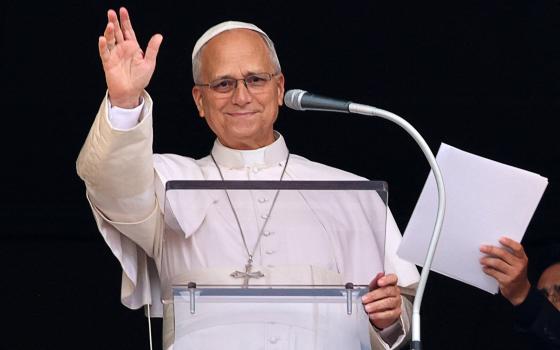
Left: James Talarico attends a rally in Houston May 27, 2026 (AP/Joel Angel Juarez). Right: Ken Paxton speaks at AmericaFest in Phoenix Dec. 20, 2025 (Wikimedia Commons/Xuthoria).
Meanwhile, the Talarico campaign has made several statements denying the "charge" of veganism, and walking back the "God is nonbinary" language. One statement on X from campaign spokesman JT Ennis features a photo of Talarico taking a bite of a huge turkey leg.
But "proving" Talarico is an omnivore is not the point. The more interesting question is why this charge of veganism would be cast as an essential weakness or a lack of masculinity by Christians like Paxton in the first place.
Paxton has long described himself as a devout Christian. He currently attends Prestonwood Baptist Church, a multicampus Baptist megachurch in Plano, Texas, with more than 45,000 members. Jack Graham, longtime pastor of Prestonwood, served twice as president of the Southern Baptist Convention and is a popular author and podcaster as well as a spiritual adviser to and supporter of Donald Trump. By all accounts, Prestonwood is one of the most politically powerful and influential congregations in the nation.
James Talarico is also a devout Christian. Raised in the Presbyterian Church, he is unusual among contemporary politicians in that he does not just proclaim his Christian faith; he studies it. Talarico is currently a seminarian at Austin Presbyterian Theological Seminary preparing for ministry.
Advertisement
Within this framework of demonstrable Christian commitment, Paxton's and others' attempts to insult Talarico by labeling him a vegan reveal a very narrow, and very recent, understanding of strength.
For almost all of Christian history, the ability to deny oneself — to fast, abstain and master bodily desires — was not evidence of weakness or frailty but of strength in the form of spiritual and physical discipline. The Christian tradition is full of figures whose authority rested on their ability to endure hunger, discomfort and deprivation. Christians were, in fact, more likely to distrust appetite than celebrate it.
One of Christianity's foundational images of spiritual strength is of course Jesus fasting in the wilderness for 40 days, a story told in all three of the synoptic Gospels. In Matthew 4:1-4, we read:
Jesus was led by the Spirit into the desert to be tempted by the devil. He fasted for forty days and forty nights, and afterwards he was hungry. The tempter approached and said to him, "If you are the Son of God, command that these stones become loaves of bread."
He said in reply, "It is written: 'One does not live by bread alone, but by every word that comes forth from the mouth of God.' "
Jesus was hungry. But the first great act of Christ's public ministry was not satisfying that hunger. It was more fasting.
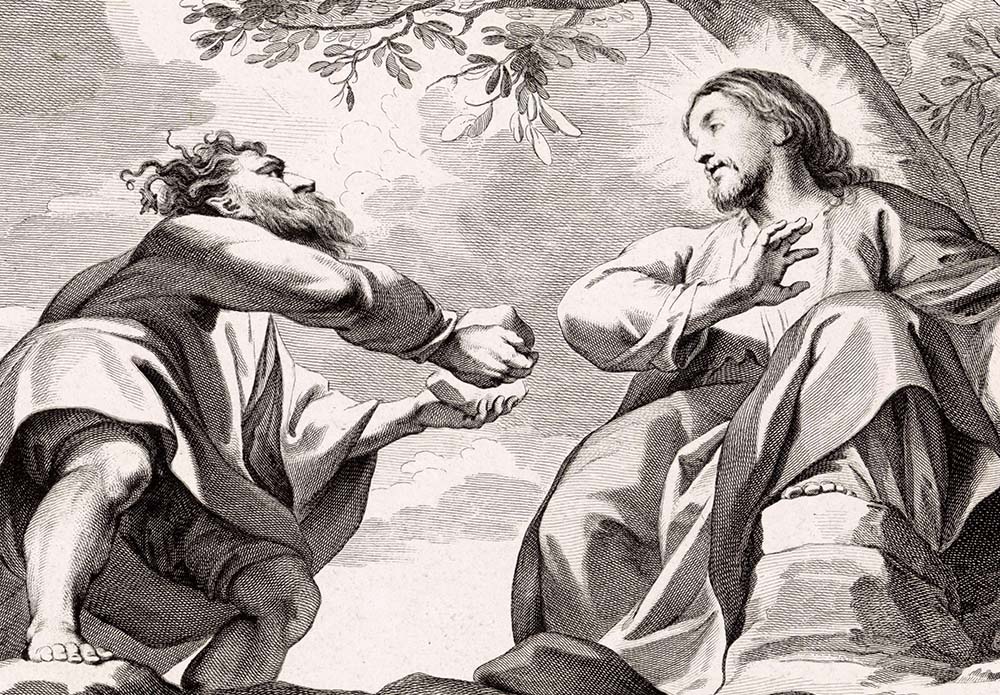
Detail of an 18th-century print, after a 17th-century painting by Peter Paul Rubens, depicts the Temptation of Christ. (Wikimedia Commons/Rijksmuseum)
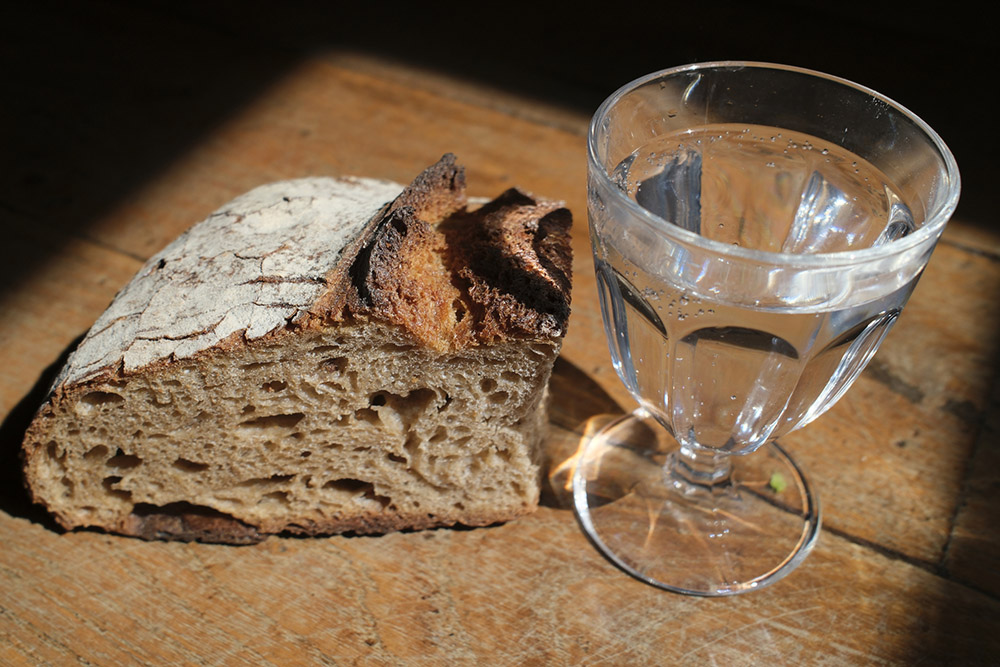
The same pattern appears throughout Christian history. The Desert Fathers who withdrew into the Egyptian wilderness survived on what today would be described as essentially vegan diets of bread, dates, lentils and water. Athanasius' Life of Anthony describes Anthony the Great's diet this way: "His food was bread and salt, his drink, water only."
The Benedictine monastic tradition likewise treated restraint from meat as part of ordinary Christian discipline. The Rule of St. Benedict states, "Let all except the very weak and the sick abstain altogether from eating the flesh of four-footed animals." Medieval monastic diets across Europe were also built around bread, legumes, fish, porridge and garden vegetables.
Abstaining from meat was not seen as weakness, much less effeminacy. It was assumed to be an essential part of the Christian virtues of humility, obedience, fortitude and temperance.
These ideals are not only Catholic or monastic. One of the most beloved Protestant religious images in American history, Eric Enstrom's famous Minnesota photograph "Grace" depicts an elderly man seated before a meal of bread and soup, his Bible beside him and his head bowed in prayer. The image became iconic across Midwestern Lutheran culture precisely because it represented a Christian ideal rooted in humility, gratitude and simplicity rather than indulgence or appetite. There is no meat in this image, only simple "vegan" fare.
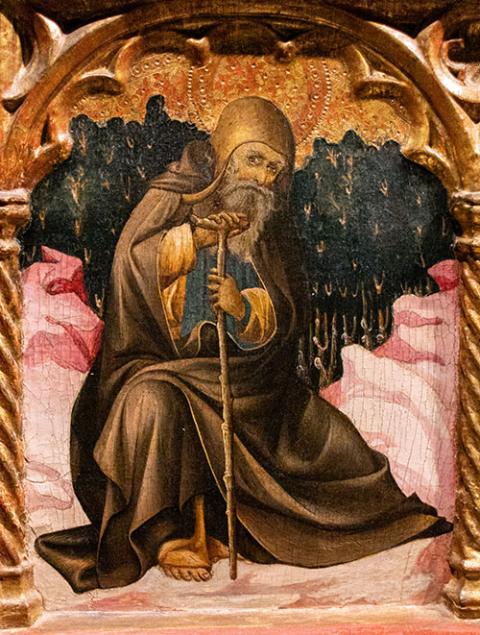
St. Anthony the Great is depicted on a panel of a 15th-century Spanish altarpiece. (Teresa Malcolm)
Well into the 20th century, fasting and abstinence from meat remained normal features of Christian life across traditions. Catholics abstained from meat every Friday, and throughout the Lenten season. Orthodox Christians likewise maintained rigorous fasting calendars, eliminating meat, dairy and animal products for large portions of the year. Protestant temperance movements linked bodily restraint to moral seriousness and spiritual discipline. And during both World Wars, the government framed meat rationing and dietary sacrifice in moral and even religious terms.
All of this makes the current conservative Christian fixation on whether or not Talarico eats meat revealing. In the political world inhabited by Paxton and Trump, appetite itself, including for meat, has become a signifier. Steak, barbecue and what might be called "aggressive carnivorousness" function symbolically as proof of masculinity, strength and a type of macho "virtue."
Rather than "proving" that Talarico eats meat, we need to acknowledge the "Tofu Talarico" insult for what it is: a profound inversion of traditional Christian assumptions about strength and virtue. Historically, Christianity has treated appetite as something to be controlled, not indulged, while consistently associating holiness with both restraint and self denial.
In the end, the question is not whether James Talarico eats tofu or Texas barbecue. The question is why a tradition that spent 2,000 years admiring fasting, abstinence and self-mastery now treats appetite as a sign of strength.
The Christian saints who survived on bread and water, the monks who abstained from meat, and the believers who saw self-denial as a path to holiness would likely find the Texas primary controversy baffling. They might even conclude that the problem is not that Talarico is insufficiently masculine or somehow weak, but rather that modern Christians have forgotten what Christian strength is really about.