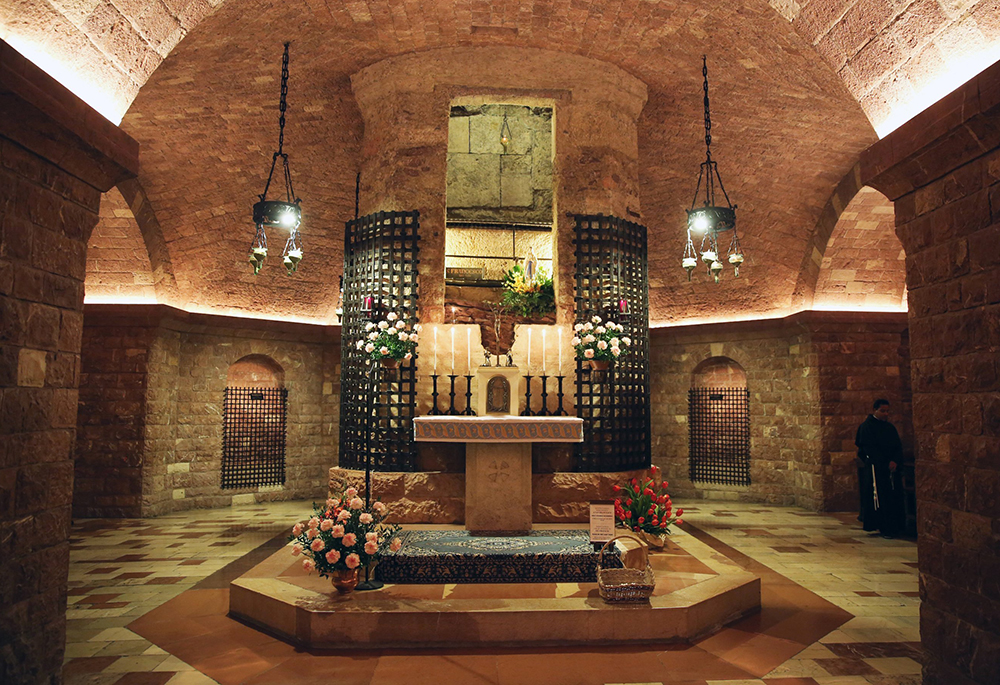
The tomb of St. Francis of Assisi in Assisi, Italy, is seen as it is accessible to pilgrims year-round. (OSV News/Courtesy of Basilica of St. Francis of Assisi)

by Daniel P. Horan
Join the Conversation
Send your thoughts to Letters to the Editor. Learn more
In 2014, the surgeon and author Atul Gawande published a book titled Being Mortal: Medicine and What Matters in the End, which draws on his years of practicing medicine to reflect on how we can both live and die better. One of the significant themes he addresses is how widespread avoidance of our mortality and the inevitability of death is in our society. This attitude often leads to euphemistic descriptions of death, quixotic fighting of our inevitable aging, relentless efforts to keep physical organs operating near the end of life regardless of the patient's quality of life and sidestepping many of the difficult discussions about our own fragility and mortality.
Gawande argues that we need to think about and treat death differently, not viewing it as an enemy to be defeated in battle by means of every possible medical intervention, but as an inevitability that calls us to inquire about what constitutes a good quality of life at each stage of living, to address our fears and anxieties head on, and to stop indulging in distribution of false hope while avoiding hard truths.
I think that St. Francis of Assisi, whose own death anniversary we commemorate on Oct. 3, would find a lot to like in Gawande's book and broader message. And although the medieval saint does not make an explicit appearance in this contemporary book, I believe that Francis' own understanding of death lends a helpful spiritual framework to Gawande's insightful clinical and social arguments.
Perhaps surprisingly to some, the Christian tradition has not always engaged the subject of death in a manner reflecting the theological claims we actually profess: that Christ conquered death, that death does not have the last word, that we believe in the communion of saints, and that in baptism we have already died with Christ and will share in his resurrection.
Unfortunately, like the modern medical-industrial complex and our wider popular culture, the Christian community has too often viewed death as an enemy, as the greatest thing to be feared and — as St. Augustine of Hippo and others have taught — as something to view as divine punishment for human sinfulness.
But Francis had a different approach to his — and, by extension, all of our — mortality. Like those that practice the tradition of memento mori, the intentional spiritual act of recalling our finitude and eventual death, Francis did not shy away from the reality of his eventual death. In fact, in his famous "Canticle of the Creatures," Francis calls death his sister. He wrote: "Praised be You, my Lord, through our Sister Bodily Death, from whom no one living can escape."
Scholars note that this stanza in the canticle was added at the end of the text by Francis near the time of his own death. An early Franciscan source known as The Assisi Compilation, which is a collection of early recollections about the life of Francis by those Franciscan friars who knew and lived with him, recounts how Francis was seen by a doctor close to his death and recalls the exchange between them:
The doctor said to him: "Brother, by the grace of the Lord, it will be well with you." For he did not want to tell him that he would die in a little while. Again blessed Francis said to him: "Tell me the truth. How does it look to you? Do not be afraid, for, by the grace of God, I am not a coward who fears death. With the Lord's help, by His mercy and grace, I am so united and joined with my Lord that I am equally as happy to die as I am to live."
The doctor then told him frankly: "According to our assessment, your illness is incurable and you will die either at the end of September or on the fourth day before the Nones of October." Blessed Francis, while he was lying on his bed sick, with the greatest devotion and reverence for the Lord stretched out his arms and hands with great joy of mind and body and said to his body and soul: "Welcome, my Sister Death!"
It is striking that the doctor at first, like many contemporary clinicians described by Gawande, did not want to address Francis' terminal illness directly but instead sought to give him a sense of hope despite the truth of his impending death. Francis, on the other hand, did not fear death but recognized it as a natural part of God's plan for creation. Just as God loves us and sustains us in this earthly, bodily life, so too does God love us and sustain us as we transition from this state of life to the next.
Advertisement
In his 1980 book, St. Francis and the Song of Brotherhood and Sisterhood, the late British Franciscan theologian Eric Doyle said that "By calling death his sister, Francis is reminding us that the Christian faith has a sacred message about human death." According to Doyle, Francis understood that we "should not forget that death came before the resurrection" of Christ and "So will it be for all of us."
One of the distinctive dimensions of the Franciscan liturgical calendar is the celebration of the death of Francis on the evening of Oct. 3 each year. Known as the Transitus in Latin, or the "passage" from this life to the next, the Franciscan family remembers the joy with which Francis greeted his "Sister Bodily Death" and calls to mind that this is a journey we will all make someday. That this commemoration of death is one of the most important Franciscan feasts has been and remains a radically countercultural observance that challenges the fear and avoidance reflected in Francis' own doctor's initial reluctance to share the truth and the contemporary temptation to skirt around the facticity of aging, decline and death.
Gawande exhorts us today to more readily embrace our finitude, fragility and mortality as creatures in a beautiful yet fleeting world and not be afraid to talk with one another about it in direct and clear ways. Francis lived out the spirit of this call eight centuries earlier and continues to model for us a different, more Christian way to think about our own lives and deaths. What appears to us as an absolute end to this finite journey of life is, in fact, merely a transition, a passage, a transitus from this chapter to the next, from finitude to eternity, from suffering to complete serenity and peace with God.
As we commemorate the eighth centenary of Francis' own transitus, and celebrate the historical legacy he left behind, may we commit ourselves to more deeply embracing the Christian truth that death does not have the last word and, when the time comes for each of us as it surely will, that we embrace our Sister Bodily Death like the poor man from Assisi who reminded us that the only path toward resurrection is through earthly death.