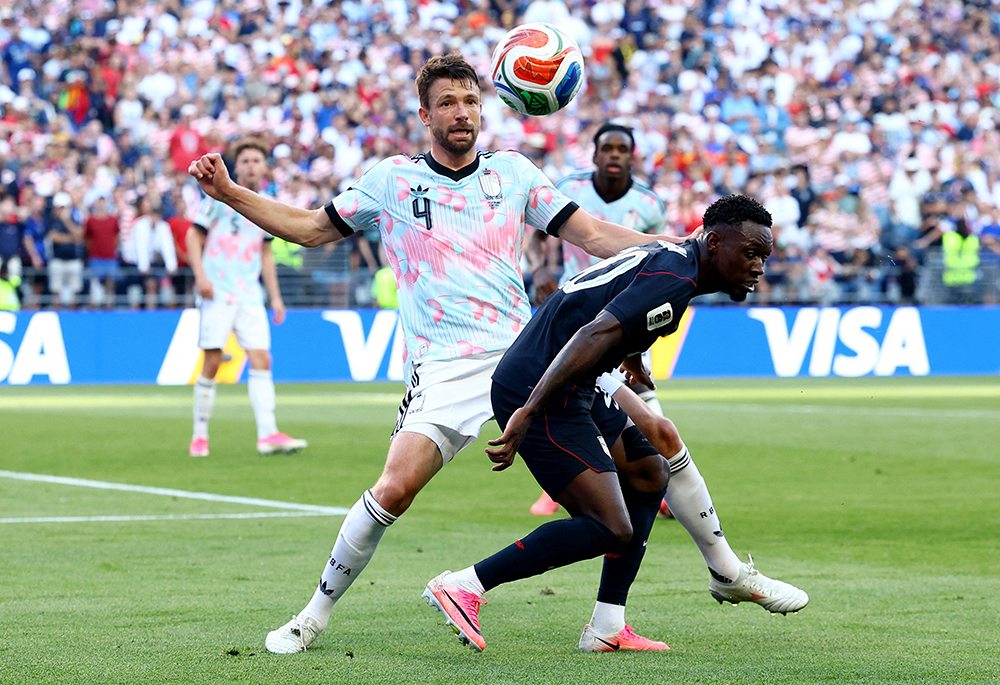
Folarin Balogun of the U.S. and Belgium's Brandon Mechele compete in the FIFA World Cup at Seattle Stadium July 6, 2026. (OSV News/Reuters/Albert Gea)

by Patrick Kelly
Join the Conversation
Send your thoughts to Letters to the Editor. Learn more
I have played and watched sports most of my life. But the first several weeks of the World Cup took me by surprise. I found myself inspired as Americans were uniting around an exciting U.S. national team and welcomed appreciative fans from around the world. As I was reminded there is more to life than politics and the conflict and division it brings these days, I even started to feel new hope for our country and the world.
Ignatius of Loyola points out that it is important in the spiritual life to be aware of and even savor such experiences we have of joy and inspiration, that increase our hope and love. Reflection on such experiences can help us to understand their deeper meaning and even point the way forward regarding how we want to live in the future.
In addition to the fun of watching an exciting U.S. team and some other great games, one of the first things I noticed was that the U.S. men's soccer team was very diverse. The most obvious difference one could see right away when watching African American and white players on the pitch together. But that is not all: Twelve of the 26 players had immigrant or diaspora roots. Their heritages can be traced to countries such as Mexico, Guatemala, Liberia, Nigeria, Ghana, England, Germany and the Netherlands. Folarin Balogun, who scored two goals in the first win and was responsible for another in the second, could play for the U.S. only because of birthright citizenship.
Malik Tillman, son of an American father and German mother who grew up in Germany, reflected on this diversity. "It's not only in our team, I think it's the U.S. in general, it's a lot of different cultures, different backgrounds. And that's also what we as a team stand for. The whole country is kind of that way, so why not the same on our team?" According to Tillman, having the experience of playing with teammates on a diverse roster also "makes it a lot easier to grow connections outside of the pitch."
Tillman makes an important point about how playing on a team can form young people with values that influence how they relate with others outside of sport. For many young people playing on a sports team is one of their first experiences of being part of something larger than themselves, outside of their family. They have the opportunity to make friends with other young people who may be from different socioeconomic, cultural or religious backgrounds from their own. This is a value which needs to be protected when considering how to organize youth sports.
In such contexts and with good coaching young people can learn how to develop their own skills, but in such a way that they work together with their teammates as they pursue a shared goal together. Such experiences can prepare young people to live and work with others later in life.
In a tweet to mark the beginning of the World Cup, Pope Leo put it this way:
Soccer reminds us of something we must not forget: life is not a race to show off on our own, but a path we learn to walk together. Anyone who does not know how to pass the ball, even if they have talent, has not yet understood the game. Anyone who does not know how to live with and for others has not yet understood life.
Speaking of living with and for others you might have noticed that ordinary U.S. citizens have been welcoming teams and fans from all over the world, who are encountering one another on American soil. I discovered on a recent trip that independent coffee shops in Kansas City were offering coffee specials that were native to the cultures they were hosting. Nearby the University of Kansas marching band was welcoming the Algerian team by playing their national anthem.
Elsewhere the Norwegians were showing the Scots how to do the "Viking row", and English fans were line dancing in Texas bars, while the Japanese respectfully remained after their team's loss to collect the trash near their seats. Bostonians put on joint parties for the beer-loving Scots and the Haitian diaspora community. On Tiktok, visitors from around the world were expressing surprise at how different America is from stereotypes they had heard, and their gratitude to ordinary Americans for being so welcoming. Iranian players, who were required by the U.S. government to stay in Mexico and leave immediately after their matches in Los Angeles, left a note in the locker room as they departed thanking LA for its hospitality. They also made a plea that "peace, respect, and friendship prevail among all nations."
Indeed, we were experiencing that soccer has a remarkable capacity to foster a culture of encounter. For one thing, it is fun. The research is clear that most young people start playing soccer — and other sports — for this reason. It is a form of play that is done without a purpose or a need to do it and yet we immerse ourselves completely in it. In this sense, it is a free activity. Most of us remember the fun of playing a team sport when younger and watching the sport today can reconnect us to the joy and love of the game. U.S. captain Tim Ream, the oldest player on the team at 38 who broke down in tears in the team huddle after the Paraguay win, said: "I've told these guys that this is the most fun, special, enjoyable group that I've been a part of."
Advertisement
We also live in a world where it is common for people to move often and even for family members to be separated by great distances. The dynamics of the digital age lift us out of our embodied lives, and we have less face-to-face time with others. Social media algorithms help to create ideological bubbles and promote conflict, further separating us from one another. In this context, for many fans a local or national sports team can function as a reminder of place and regional traditions. And this can foster a sense of belonging and connection. Maybe this is why John Denver's "Take Me Home, Country Roads" was such a hit for U.S. fans in this World Cup, with its refrain being sung with special passion: "Country roads, take me home, to the place I beloooong."
The other thing about sport that allows it to foster a culture of encounter is that, contrary to war, it is based on cooperation. This is needed for something as basic as agreement on what the rules of the sport will be. The rules help to create "another world" to live in temporarily that is different from ordinary life. This is why any attempt by an external actor to undermine such rules for their own interests is considered such a serious offense. As Johan Huizinga put it: "Indeed, as soon as the rules are transgressed the whole play-world collapses. The game is over." However, the cooperation needed in sport extends beyond the rules to scheduling, the logistics of hosting visiting teams and other matters.
In his letter on the value of sport "Life in Abundance", Pope Leo pointed out that "the word competition is derived from two Latin words: cum meaning 'together,' and petere meaning 'to ask.' In a competition, therefore, it can be said that two people or two teams strive together for excellence. They are not mortal enemies. And in the time before or after the competition, there is usually an opportunity to meet and get to know one another."
In his letter the pope points out that international competitions in particular "offer a privileged opportunity to experience our shared humanity in all its rich diversity." He writes that experiences such as the opening and closing ceremonies of the Olympic Games where each nation processes in with their flag and athletes dressed in traditional garments "can inspire us and remind us that we are called to form one human family. The values promoted by sport — such as loyalty, sharing, hospitality, dialogue, and trust in others — are common to every person, regardless of ethnic origin, culture, or religious belief."
The experiences we had of the World Cup in the first few weeks are important at this particular time in the U.S., when a narrative has taken hold in our country that diversity is our problem. And when persons from immigrant communities are sometimes demonized. A recent executive order tried to overturn our country's laws on birthright citizenship. The U.S. is also increasingly isolated on the world stage. Our tariffs are unpopular with other countries, as is the war with Iran. Our threats to "take" other countries or territories do not sit well with those committed to the rules-based international order that emerged in the wake of World War II.
What we were learning from the World Cup in its early phase was that sport can be experienced as a human phenomenon with internal goods or intrinsic rewards. These are worth protecting from the corruption that occurs when sport is reduced to being merely a means for market purposes or in service of a nationalist or ideological agenda. This is important in the U.S. at a time when market values in youth and higher levels of sport increasingly threaten to "crowd out non-market values worth caring about" as Harvard philosopher Michael J. Sandel puts it. It is also a time when the U.S. federal government is trying to exert influence on most domains of civil society including the arts and humanities, education, museums, news programming, public media or even late-night comedy, in service of a particular nationalist agenda. International soccer is only the latest domain to be added to the list.
Ignatius emphasizes the importance of acting against (agere contra) such dynamics, which undermine the human values of sport and other domains of culture. As Leo put it:
Yet another distortion of sport happens with the political exploitation of international sporting competitions. When sport succumbs to the mentality of power, propaganda or national supremacy, its universal vocation is betrayed. Major sporting events are meant to be places of encounter and mutual admiration, not stages for the affirmation of political or ideological interests.