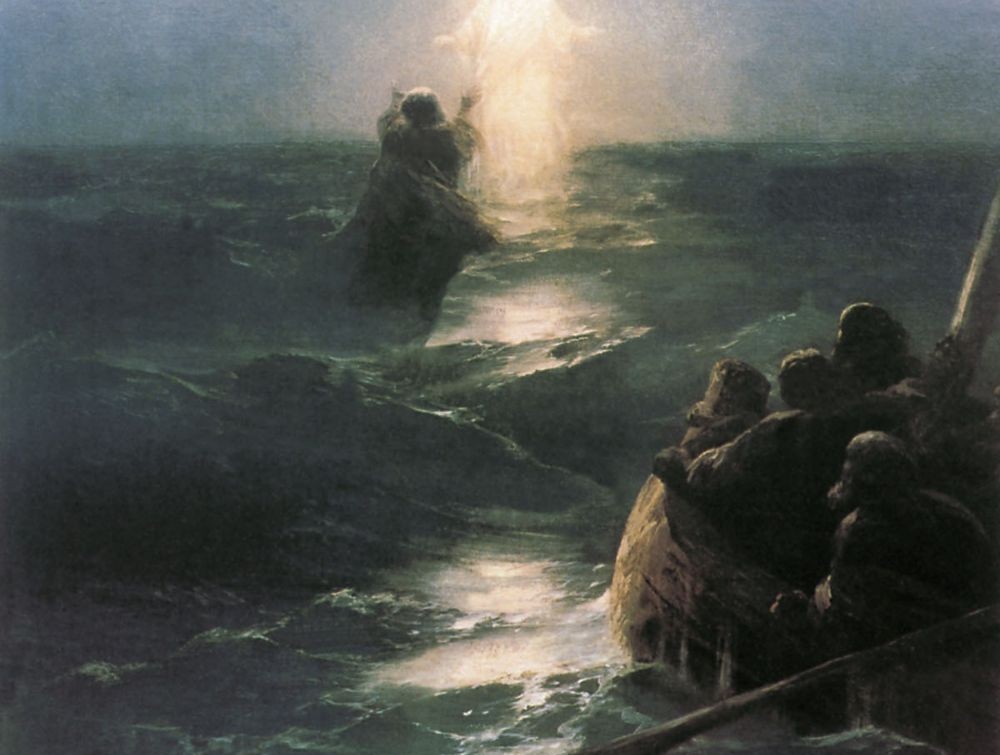
"Walking on water" by Ivan Aivazovsky (1890s) (Wikimedia Commons/Public domain)

by Sr. Mary M. McGlone
Join the Conversation
Send your thoughts to Letters to the Editor. Learn more
Did you ever ask for a sign? Did you get it? Have you seen the billboard that proclaims, "This is your sign"? This announcement alone might be the necessary sign for someone waffling about an important decision. Sometimes we are open to an idea but can't quite take the leap of commitment. Then comes the sign.
Scripture suggests that rather than planting obvious signs, the Spirit works inside us, spurring us forward through our hopes and desires. That's how it was with Elijah. Hiding from Queen Jezebel who was out to kill him, he ended up in a cave. Burrowing into the earth was not exactly his idea. Fleeing from Jezebel's minions, Elijah called it quits, ready to give up the ghost in the desert. But God wouldn't leave him alone. An angel messenger ordered him to eat and start out on a 40-day hike to a hiding place (1 Kings 19). That's where today's story begins.
Elijah heard God's voice ordering him leave his protected space to encounter God in person. Who knows what Elijah was expecting? The story leads us to think he imagined that God would appear in power and might, with enough earth-shaking noise to disorient anyone who experienced it. But no, God disoriented Elijah with gentleness.
Today's Gospel presents a much more stunning tale.
Following last week's Gospel about the great sharing of bread, we hear that Jesus finally enjoyed the time for private prayer that he wanted. We can assume that his prayer was affected by the fact that he had to wait until after being moved by a need, responding to it and setting in motion the miracle of shared bread.
While Jesus prayed, his disciples were caught in a storm that frightened them half out of their minds. That storm was probably an interior experience as well as a natural hazard. Jesus had just shown them how to do what he did. His command, "You feed them," was a variation on all his calls to them. He had instructed them in the Sermon on the Mount; he warned them about the cross to come to his followers; he blessed their paltry offering and instructed them to distribute everything they had to a hungry crowd. Each of these experiences demanded a decision to risk everything in response to his call. Just by remaining with him, they expressed their commitment but each still carried a dash of doubt.
When the disciples thought they were dying, Jesus gave them a preview of his resurrection. He appeared, walking on the tempestuous sea. Because that was the last thing they expected, they perceived him as a ghost and shrieked with fright. (See Luke 24:36-39.) Jesus simply responded, "Take courage, I AM (it is I), do not be afraid." Testing Jesus and himself, Peter said, "Command me to come to you on the water," in other words, "I want to do what you do."
Peter started out perfectly. He asked Jesus to work through him so he could do what Jesus did. Then, as often happens in the face of resistance, threat or contradictions, Peter focused on the danger and succumbed to fright. Then, Jesus reached out and pulled him up.
Peter's problem was that while he wanted to do what Jesus did, he began to think he had to do it alone. He misunderstood Jesus' power. Jesus had just come from time in prayer that grounded him in his mission and God's power. Peter had only half an understanding of how to do what Jesus was doing, and that sank him.
Jesus must have had great sympathy for Peter. Knowing that his mission would put him in mortal danger, Jesus looked to the Father for strength. He knew the cost of risking everything and of living in danger, uncertainty and confusion. Jesus understood how Peter felt as he ventured out into deep waters while the others looked on. He also knew that even he could not do it alone. So, recognizing Peter's courage, Jesus charged them all: "Do not be afraid. Have faith."
The faith Jesus calls for goes beyond the rational, eliciting belief in what seems impossible. God's signs come in a myriad of ways, none of them crystal clear. They challenge our waffling spirits and tug at our hearts, gently calling us beyond where we are comfortable — or even, like Jesus and Peter, to perceive danger without fear.
Disciples who want to do what Jesus did are asking to walk on water. Rather than fear failure — which is inevitable at some point — we can remember that Christ does not abandon us, even if we think we're drowning or about to die alone in a desert.
In the end, our desire to follow him is all the sign we really need.
Advertisement