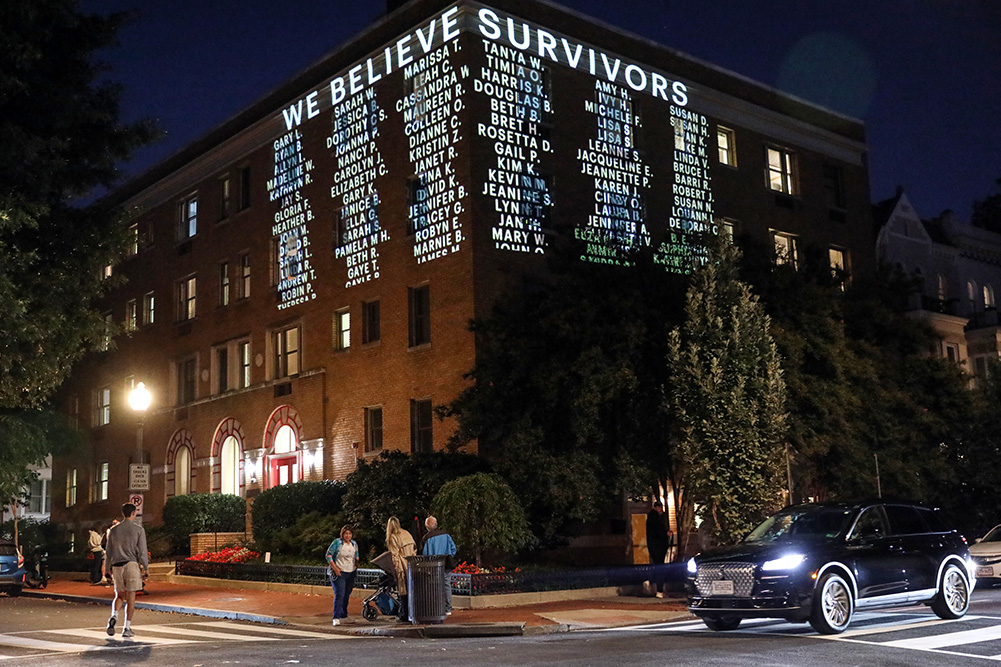
A message is projected on the side of a Cornell University building, Wednesday, Oct. 7, 2026, in Washington. (AP/Rahmat Gul)

by Meredith McKay
Join the Conversation
Send your thoughts to Letters to the Editor. Learn more
Following the news of the sexual assault-related lawsuit naming Cornell University and Chi Phi fraternity members, a familiar pattern occured: Victim-survivors began sharing their own stories en masse on social media, and Doubting Thomases began demanding proof.
Such cultural moments are important to victim-survivors' felt sense of peer support that can foster the courage to share their stories or, at the least, feel less alone by hearing the testimony of another, even if they themselves are not ready to voice their own. And yet there is something grievous about a wave of public sharing in response to a news cycle, because it often comes from an urgent need to prove to doubters that the Jane Does of these stories are telling the truth.
It troubles me that vocal skepticism about the accusation's validity — commentaries like "She showed up intoxicated" or "She wanted it at the time and just felt embarrassed later" — results in many more women having to put their own trauma on display, allowing the public to shove their hands into the wounds and probe around to prove they are real.
The trauma research I studied in my doctoral theology work indicates that it is necessary for a survivor to feel believed and supported by another if they are to undertake the work of healing and integration following sexual violence. I know this as a scholar, but I also know this to be true from my own experience.
During and after the years I was sexually abused by a similar-aged childhood friend, I thought it was my fault and that I had done something bad and shameful. But by my early 20s the memories would no longer accept being shoved down and I could not ignore the effects of trauma on my life.
I found a therapist and almost vomited as I said to her, "I think I was abused, but I don't know. Does this count?" With even just the few details I felt ready to share, her affirmation gave me the footing I needed to begin the work of healing. There is great power in being heard and believed.
Advertisement
The opposite is also true: It is very hard to pursue healing if one isn't first believed.
Rather than one Doubting Thomas, the internet supplies a noisy crowd of them. They demand to see the nail marks for themselves, doubtful the wounds really exist and oblivious to the pain their disbelief may cause.
"What was she wearing?"
"Did she lead him on?"
"Wasn't she intoxicated anyway?"
"What proof does she have?"
"Are we supposed to just believe her?"
For the general public, and especially for the Catholic faithful, the answer to that should be simple: yes.
The Title IX investigative process and the judicial system have their own burdens of proof, bent toward an assumption of the alleged perpetrator's innocence. Significantly, these burdens of proof demand evidence that does not always exist given the murky relational dynamics within which sexual assaults often take place. It is not uncommon for it to take a long time for a victim to emerge from the mental fog of trauma to recognize the violation experienced, or to gather the courage to make a report, or realize it's OK to cut off communication with their assailant.
We the public are not bound by these burdens of proof, nor are we responsible for enacting a punitive consequence. This frees us from the role of Doubting Thomas. We can believe that wounding happened, even when we cannot see or lay hands on the exact contours of the wounds. We can choose to have compassion for the pain experienced — and then turn our attention to the work that resurrection requires.