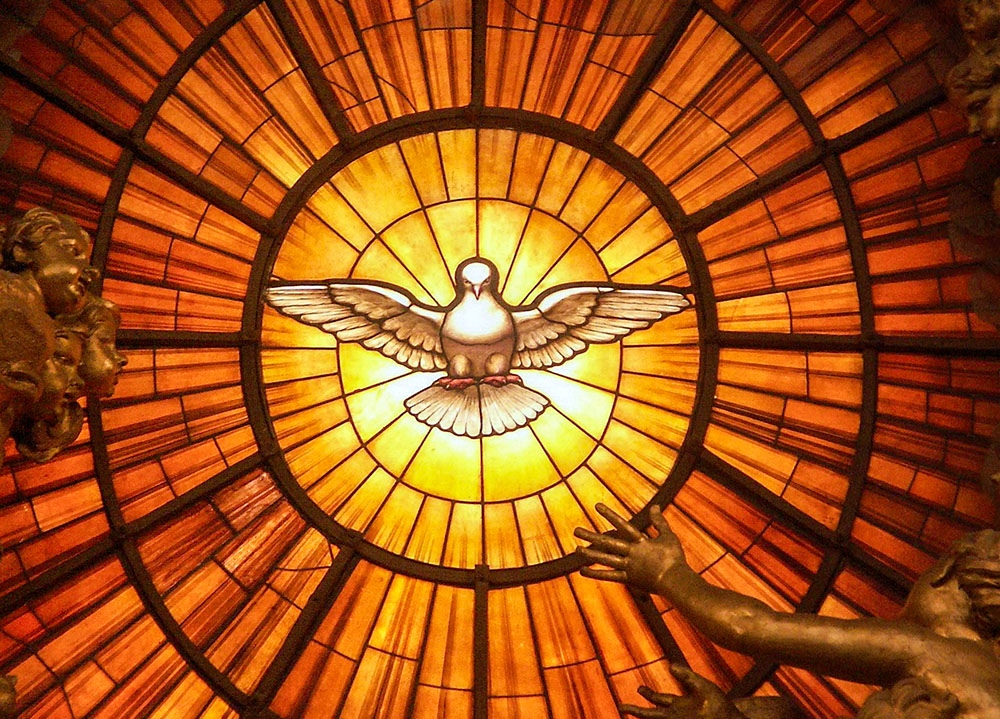
Sculptures are seen around stained glass depicting the Holy Spirit as a dove, by Gian Lorenzo Bernini circa 1660, in St. Peter's Basilica at the Vatican. (Wikimedia Commons/Dnalor 01)

Join the Conversation
Send your thoughts to Letters to the Editor. Learn more
Last month, Glastonbury Abbey in Hingham, Massachusetts, hosted a three-part seminar on Magnifica Humanitas. Jesuit Fr. Sam Sawyer, the editor of America magazine, gave the first talk, Jesuit Fr. Tom Reese gave the second and I delivered the third. You can find the videos of the presentations here. And, in the course of the talks, we stumbled upon a distinction that is at the heart of a divide between two ways of doing theology, but shouldn't be.
Sawyer raised the distinction right at the beginning of his talk. He rightly said, "Leo is inviting the church to think about the development of social doctrine not only as the church's application of timeless wisdom to changing circumstances, but also, and even more, as the church's cooperation with the Holy Spirit acting in history."
Sawyer added, and he admitted it is a bit of a caricature, "There can be a way of talking about development of doctrine that treats it in a way that I would say is overly deterministic, that kind of approaches development of doctrine by saying that everything interesting has effectively already happened and is just being worked through its final paces to give us a full explanation of all the details and specific applications."
In contrast, Leo has "a richer approach," attuned to the idea that "the church is a place where the Holy Spirit is at work." So we are not only or even primarily applying ancient truths to the historical moment in which we find ourselves. "The church is also engaging the Holy Spirit in its response to history," Sawyer said. He cited the encyclical's second paragraph:
Indeed, openness to dialogue is an integral part of the Church's vocation because, constituted in Christ as "a sacrament… of communion with God and of the unity of the entire human race," she recognizes history as the place where the Gospel challenges and directs human experience.
All this is true, but I want to register an important caveat. The Holy Spirit speaks to the church today and Magnifica Humanitas is a perfect example of how the church listens to the Spirit to respond to the challenges of our own time. But the Holy Spirit speaks to the Christians of every time and place and if we find ourselves responding in ways that are wildly different from the responses of those in earlier times, we need to make sure that our blinders are not filtering what the Holy Spirit is telling us.
Nowhere is this more evident in Magnifica Humanitas than in the fifth chapter and its discussion of just war theory. The pope wrote, "Today, more than ever, without prejudice to the right to self-defense in the strictest sense, it is important to reaffirm that the 'just war' theory, which has all too often been used to justify any kind of war, is now outdated." Indeed, it is outdated and needs to be updated. It can't be jettisoned.
Just war theory was conceived and refined by doctors of the church to address real moral quandaries: We are instructed not to kill, but we have a moral obligation to protect our loved ones and, indeed, anyone who is vulnerable. The church has never said, "Kill as you wish," nor has it said, "Hey, it's fine if the bad guys are the only ones with weapons." And, it never can say these things. Killing always involves a moral evil, the taking of a human life. Yet, we are responsible for one another and when someone is threatened unjustly, as was the case in Bosnia in the 1990s for example, we have a moral obligation to protect them and that oftentimes requires military force.
It is equally impossible to dismiss the value of nonviolent commitments in the Catholic tradition. From the perspective of Christian morality, Winston Churchill was wrong when he wrote in his war memoirs: "The Sermon on the Mount is the last word in Christian ethics. Everyone respects the Quakers. Still, it is not on these terms that Ministers assume their responsibilities of guiding states." From a constitutional perspective, he was mostly right. If the Church were to insist that all Catholics commit to nonviolence, no Catholic could run for office.
Advertisement
The Catholic nonviolent witness keeps us honest. It should function like an evangelical virtue in our Christian understanding of public morality. All Christians are called to chastity and charity, but only those who remove themselves from the world into religious life are expected to practice absolute abstemiousness in their exercise of chastity and absolute poverty in their witness of charity. The rest of us need that witness, even when we remain in the world and must wrestle with real world obligations.
This relationship between the tradition and the promptings of the Holy Spirit manifests itself on other issues. In Rome this week, bishops from around the world are gathered to reflect upon Pope Francis' apostolic exhortation Amoris Laetitia. That document did not propose any new doctrine, nor did it abandon any. On the issue of admitting some, not all, divorced and remarried Catholics to the sacraments, the two synods that led to the document instead asked if we had not forgotten a core understanding of the Eucharist. As Francis wrote, the Eucharist "is not a prize for the perfect, but a powerful medicine and nourishment for the weak." He did not say marriage was suddenly dissoluble.
In short, the Catholic tradition is the catalog of Catholics responding to the Holy Spirit in their own time. It is also a catalog of how previous generations of Christians were often blinded by their cultural circumstances, for example, in the church's long failure to recognize the evil inherent in slavery.
The tradition, like history more generally, curates, relegating poorly constructed ideas to the sidelines, refining other ideas that need adjustment to meet the needs of a different time and place, carrying forward ideas that worked before and work still. One cannot simply say, "I am taking a prophetic stance," and claim divine approbation. If any concept has been abused since the Second Vatican Council, it is the idea of a prophetic stance.
The prophets were reluctant to be chosen for their task. Isaiah needed to have an angel put a burning ember to his lips before he consented. The very ease with which some Catholics today proclaim they are taking a prophetic stance betrays the degree to which they are trying to baptize their own ideas rather than undertake the often painstaking task of trying to align our ideas with those incumbent upon baptism in the Catholic Church.
We should all be docile to the promptings of the Holy Spirit, but if we understand those promptings and they seem like a distortion of doctrine not a development, and out of whack with what our Catholic tradition has taught, we need to ask if we are listening to the Holy Spirit or only to ourselves.