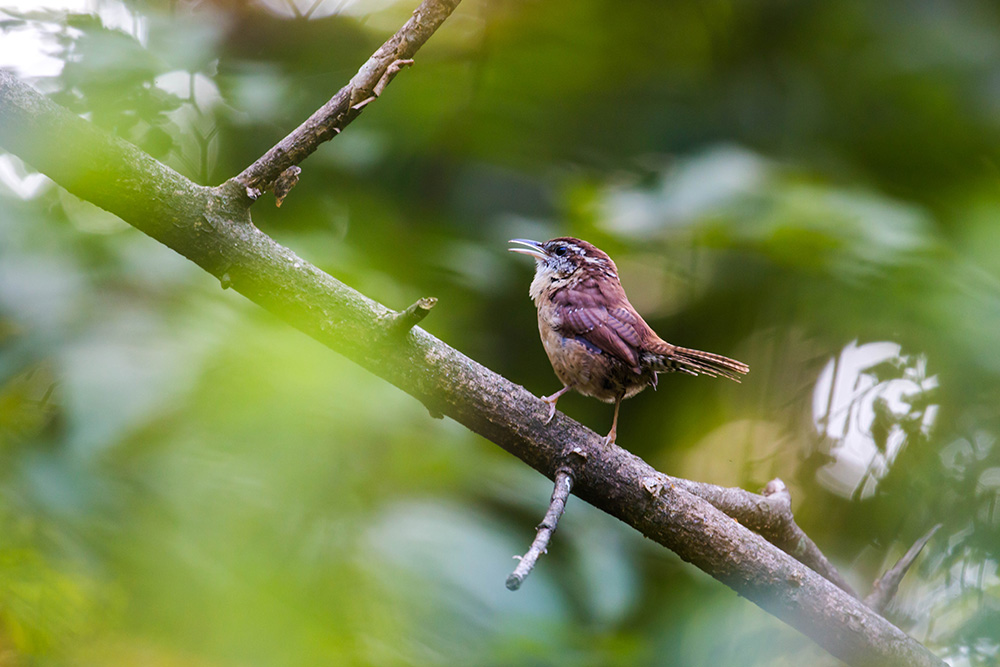
Carolina wren (Wikimedia Commons/Melissa McMasters)

by Alli Bobzien
Join the Conversation
Send your thoughts to Letters to the Editor. Learn more
My family recently gained new neighbors when a family of Carolina wrens moved into the mailbox affixed to our house. The mother bird and I had been negotiating this arrangement for a couple of weeks; she would begin to place twigs and grass inside the mailbox, and I would remove her efforts while retrieving our dusty, twig-laden mail. Then, my family went away for a weekend. In a mere 48 hours, the mama bird not only created an entire nest but also staked her claim definitively by laying five beautiful eggs — inside my mailbox.
I am not too proud to admit defeat. Her need was clearly greater than my own, so I wrote a note to all postal workers informing them of our new feathered neighbors and asking them to redirect our post to the bin beside the door.
My daughters, ages 7 and 4, were ecstatic about these winged developments. We checked the nest multiple times a day, and mama bird became so accustomed to our voices that she wouldn't dart out when we passed the mailbox on our countless trips back and forth from swim team practices. Instead, she would stay nestled on her eggs while we cooed and told her what an excellent job she was doing.
A few short weeks later, we heard the tiniest cheeps coming from the mailbox. Five of the ugliest, most wrinkled little hatchlings had emerged from their eggs, and we were all enchanted. Mama and papa bird did an excellent job caring for their young, but my daughters were concerned about the heat, the quality of bugs, and the accessibility to water. My girls are deeply caring young ladies — and they desperately wanted these baby birds as pets.
A common refrain in our house became, "Please, Mommy! It's so hot in that mailbox; it can't be safe for the birds. We could bring them inside and cuddle them and introduce them to all our stuffed animals!"
At my explanation that the mama and papa bird would be heartbroken if we took the babies, my eldest looked aghast. "We would invite the parents to live with us, too! We would never just take the babies!" Oh, good. They were plotting an entire aviary in our home.
After a few days of listening to their begging, I sat my daughters down and explained that it was important to let the birds stay wild. I gently told them, "They've chosen to trust us and nest very close; but they are wild things and deserve their space and freedom."
Advertisement
When my daughters' faces showed flashes of mutiny, I pulled out my ace in the hole. "Remember how in Narnia, Mrs. Beaver says that Aslan isn't safe, but he is good?" I asked. "It's because Aslan is wild, he is good, and he is the king, but he isn't someone to be contained or controlled. We need to let our birds be wild."
Drawing a comparison between Aslan of Narnia and our chirping Carolina wrens may have been a stretch, but it worked for my daughters. However, our conversation brought to mind my own childhood discomfort with this description of Aslan, a discomfort paired with the thrill of a God who isn't safe, but good — a God who is wild. I think a part of me ended up studying theology to probe such mysteries.
Walter Brueggemann spoke to this tension of God's wildness when he described "something wild, dangerous, unfettered, and free in the character of Yahweh."
There is beauty in the fact that we do not serve a God who grants us wishes like a genie, and that we cannot bottle up our faith to be released at our whims. Our God is wild and free, choosing to love and bless us not by our own merit but through his goodness.
Living a mere 30 minutes from a Houston megachurch known for preaching the gospel of prosperity and promising that faithful actions have direct correlations to earthly wealth, I feel the need to teach my daughters the beauty of a wild, unfettered God. A God whose hand stretches throughout history raising the humble things of this world to lead the strong, who casts tyrants from their thrones, who chooses the outsiders, who sits with sinners — a God who is not bound by the constraints of our world but who remains enduringly wild and uncaged.
Following such a God is not easy, nor does it promise a smooth path lined with riches, but we know and see time and time again that our God is good. We serve a wild God, but one who loves us well and promises to always be with us, through times of trial and joy.
Our baby birds transformed before our eyes, their wrinkled skin grew downy fluff, then longer feathers began filling in and in a matter of weeks they were moving around the mailbox. One morning, as we exited our car, we noticed that the baby birds were hopping around the front yard. Some were briefly airborne as they tested their wings for the first time. We watched in wonder at the miracle of these wild things, the bravery of the smallest hatchling, and the trust of the mama bird that her young were ready to take flight.
As we stood there, one young bird flitted over and landed on the pocket of my jeans. My daughters stifled shrieks of joy, and I stared in utter bewilderment as the small wren gazed up at me, resting for a full minute before taking flight once again. A wild thing unfettered and free, and whose care and attention was all the more dear for it.