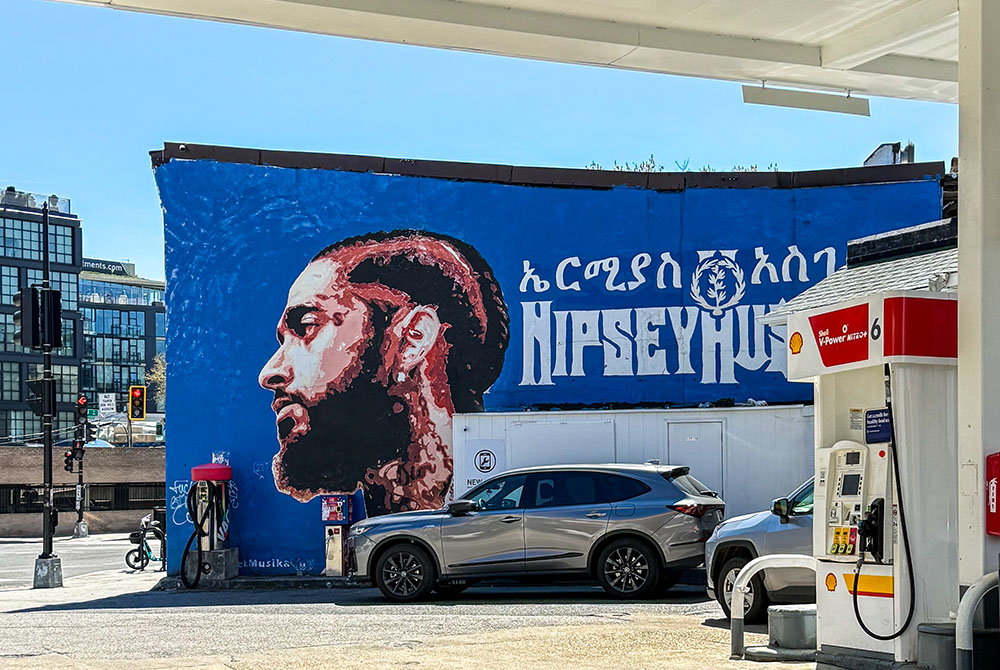
A mural of the late rapper and activist Nipsey Hussle in Washington, D.C.'s Shaw neighborhood (Tonya (Adéjọké) Butler-Truesdale)

by Tonya (Adéjọké) Butler-Truesdale
Join the Conversation
Send your thoughts to Letters to the Editor. Learn more
This year, Easter came into focus for me through a mural.
It is a mural of the late rapper and activist Nipsey Hussle in Washington, D.C.'s Shaw neighborhood, painted against a vivid blue wall. For many passersby, it may register first as public art or neighborhood tribute. For me, it became something more demanding: a site of theological reflection.
Part of that is because the mural stands less than five blocks east of St. Augustine Parish and School, where my grandfather graduated in the early 1900s and where I graduated in 1978. In that short stretch of the city, memory gathers densely: parish, school, family, neighborhood, grief, endurance and Black continuity.
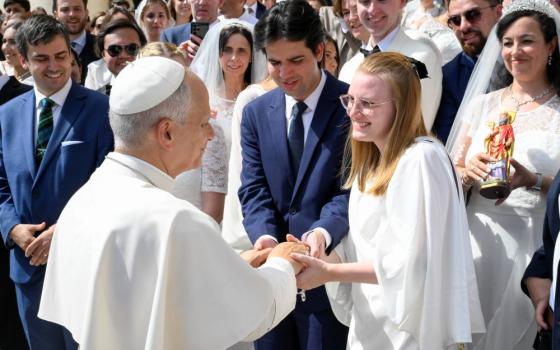
I carried that memory with me on a recent pilgrimage to Italy. There, during a journey that included a March 12, 2026, gathering with Pope Leo XIV, I found myself praying with an unexpected set of connections: St. Monica, St. Augustine, Nipsey Hussle and Angelique Smith, Nipsey's mother.
That grouping will strike some readers as unusual, perhaps even strained. I do not offer it as equivalence. Monica is not Angelique Smith. Augustine is not Nipsey Hussle. Ancient North Africa is not contemporary Black America. But Christian reflection does not always move by equivalence. Sometimes it moves by resonance. Sometimes prayer lets us hear echoes across time without collapsing differences.
What I heard this Easter was this: Black public memory often practices resurrection in ways the wider church should learn to recognize.
Advertisement
Too often, Easter is preached as if it begins in triumph. But the Gospel story does not begin there. It begins with grief, confusion, absence and a love trying to remain faithful after catastrophe. Black Christians know this terrain well. We know that hope is not optimism. Hope is what survives burial. Hope is what gathers after the funeral, what keeps singing, what keeps speaking the name of the beloved when the world has moved on.
That is what the mural in Shaw helped me see more clearly.
In Black communities, murals are rarely only decorative. They are acts of public memory. They refuse disappearance. They insist that certain lives continue to place a claim upon the living. They say that grief is not merely private emotion but communal responsibility. In a culture that too easily converts Black death into spectacle and then forgets, the mural becomes a counter-practice: memory held in public long enough to become moral witness.
Seen in that light, the mural is not a distraction from Easter theology. It is one place where Easter theology becomes legible.
That conviction deepened for me at Ostia, the place associated with the final season shared by Augustine and his mother, Monica. Monica is often remembered simply as the mother who prayed for her son, but that phrase can sound thinner than the reality it names. Monica represents a form of Christian witness that the church depends upon and too often understates: maternal vigilance, long-suffering, spiritual endurance and the refusal to give up on a life whose meaning has not yet fully appeared.
Black communities do not need Monica translated.
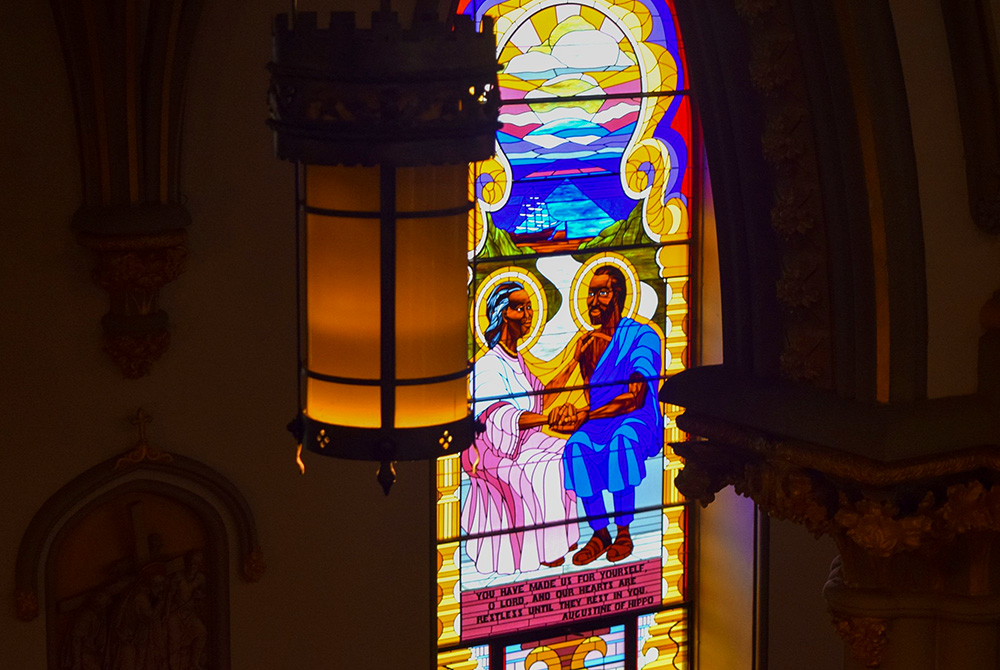
A stained-glass window depicts St. Augustine and his mother, St. Monica, at St. Augustine Church in Washington, D.C. (CNS/Elizabeth Bachmann)
We know women who pray children through wandering, danger, delay and becoming. We know women whose labor is hidden from institutional recognition even when it forms the unseen architecture of family and community survival. We know mothers and elders who keep vigil over futures others cannot yet imagine.
That is why, in Ostia, I found myself thinking about Angelique Smith.
Again, not because she and Monica are the same, but because both help illuminate a pattern of maternal witness under conditions of uncertainty and public pain. In Monica, I hear intercession. In Angelique Smith, I hear endurance, dignity and witness under public grief. In Augustine, I see a son drawn toward truth through a long and uneven journey. In Nipsey Hussle, I see a son whose life came to signify discipline, neighborhood responsibility, aspiration and unfinished communal work.
To hold those names together in prayer was, for me, not an act of careless comparison but an act of theological listening. It was a way of naming a truth many Black families already know: Mothers often midwife legacy before the world has language for what is being born.
This is why I think the church should take Black public memory more seriously as a source of theological insight.
What I heard this Easter was this: Black public memory often practices resurrection in ways the wider church should learn to recognize.
Catholic theology rightly treasures liturgy, sacrament, doctrine and tradition. But the church also needs to attend to the concrete practices by which communities remember, mourn and refuse erasure. In Black life, that often happens through testimony, funerary ritual, anniversaries, art, music, naming and neighborhood witness. These are not substitutes for Easter faith. They are among the places where Easter faith becomes visible in history.
The church proclaims that death does not have the final word. Black communities have had to practice that claim under pressure.
We practice it when grief becomes witness instead of silence.
We practice it when memory becomes public instead of hidden.
We practice it when mothers keep watch.
We practice it when the beloved are carried forward in the life of the community.
We practice it whenever erasure is refused.
That is what the mural in Shaw revealed to me this year. It helped me see that resurrection is not only an article of belief to be recited. It is also a discipline of remembrance. It is a refusal to surrender the beloved to disappearance. It is a way of living as though God's fidelity is stronger than the world's amnesia.
After Ostia, after prayer, after that March 12 gathering with Pope Leo XIV, that truth feels even sharper to me.
Easter does not bypass grief. It passes through it. And wherever communities keep memory alive in the face of loss, something of resurrection is already being made present.