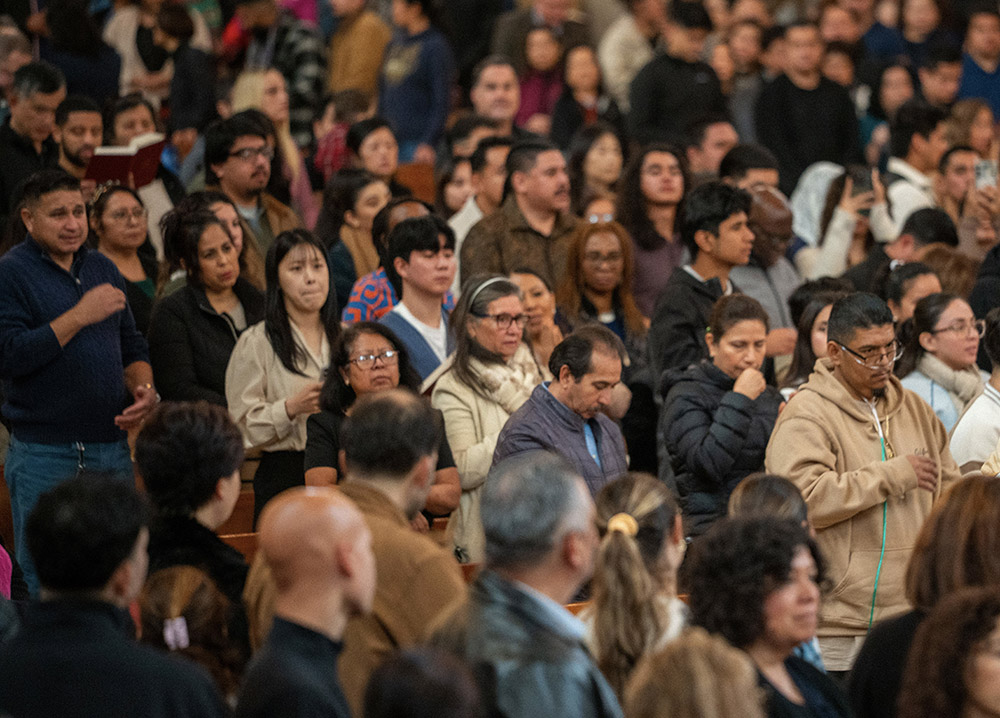
The faithful gather for Mass Dec. 28, 2025, on the feast of the Holy Family at the Cathedral of Our Lady of the Angels in Los Angeles. (OSV News/Los Angeles Archdiocese/Courtesy of John Rueda)

by Sr. Mary M. McGlone
Join the Conversation
Send your thoughts to Letters to the Editor. Learn more
Who are you? Your first response to that question would probably be to give your baptismal and last names. Something interesting happens as you try to answer the question 10 more times. You'll discover that a high percentage of your responses come from your relationships: family, work, neighborhood, nationality and perhaps even a sports team. Every one of those affiliations has a part in making you who you are.
In today's Gospel, Jesus turned his culture upside down in regard to families. In an era in which the family meant everything to people, he turned his back on his own family and his hometown. He was establishing a totally different type of family. That scandalized many who knew him. Jesus himself admitted that he was causing division (Matthew 10:34-36). Granted, his family and hometown didn't always appreciate him for who he was; thinking he was crazy, they tried to get him back home and under control (Mark 3:21). But that wasn't the reason for distancing himself from all that had been home.
Jesus' idea of family was very different from that of his contemporaries — and much larger. So, too, his sense of identity. He knew he was part of the whole God created. So, in this reading, Jesus was talking not only about family, but about how we manage our relationships and what that means for our identity. We are who we are because of who we love and who has loved us — and those who have not loved us, and our response to that.
Jesus expected his disciples to interact with their world like he did. Mirroring his relationship with the Father, nothing and no one should come between the disciple and the master who acted as family with everyone. When he said, "Whoever loses his life for my sake will find it," the loss he described included the disciple's former identity as son or daughter, parent, etc.
Jesus called God his Father. His family was God's family. As Pope Francis was fond of saying, "todos, todos, todos!" No more favorites. Everyone, without distinction. In this family, everyone is father, mother, sister, brother. Family identity for disciples includes all of creation.
Because of that, those who are suffering deserve our special concern and sacrifice. Jesus wanted disciples to be open to family-style relationships with any and everyone with whom they came in contact.
Pope Leo XIV reminds us that Jesus "presented himself to the world not only as a poor Messiah, but also as the Messiah of and for the poor" (Dilexi Te).
Jesus "emptied himself," and that was what he expected of his followers. Many prospective disciples were the "whoevers" he described for us in the Gospel today: whoever loves their own first, whoever does not take up the cross, whoever finds his life. These "whoevers" declined Jesus' lifestyle.
The second set of "whoevers" are not just any "whoever." They are ready to lose their life, they act in Jesus' name such that their identity grows bigger. The one who receives a prophet or righteous person, the one who gives cold water to the "little ones," all of these share an identity with those whom they serve and with Christ. That's Jesus' idea of family: Acting like family, we become family.
Advertisement
Jesus reveals the extraordinary depth of this process when he says, "Whoever receives you, receives me, and whoever receives me, receives the One who sent me." Jesus teaches that those who act in his name bring his real presence to others and become one with God.
Today, Paul offers us a mystic's commentary on this. He begins with an explanation/exhortation about how baptism affects and effects our very identity: "Are you not aware that we were baptized into Christ's death?" For Paul, baptism signifies an absolute break with ordinariness, with "the way we were."
According to Paul, we are dead to sin, invulnerable to its power; it need never influence us again. This isn't magic, it's God's grace and our decision. Our baptismal identity is a divine reality that keeps becoming deeper and more influential, drawing us always into "newness of life."
Speaking of newness of life, Paul uses an unusual phrase that literally translated says that Christ "lives unto God" or "to God." Christ is, as Jesus always was, totally open to the Father, so conformed to the Father's will that he truly lives in the Father and the Father in him.
Why is this important? Paul insists that through the process of growing in our baptismal identity, we are drawn into that very same relationship Christ had with others and with God. That means that our identity, including all other relationships, finds its center through our life in Christ.
We are baptized. Who do we want to be because of that?