(Unsplash/Dolina Modlitwy)

by Alli Bobzien
Join the Conversation
Send your thoughts to Letters to the Editor. Learn more
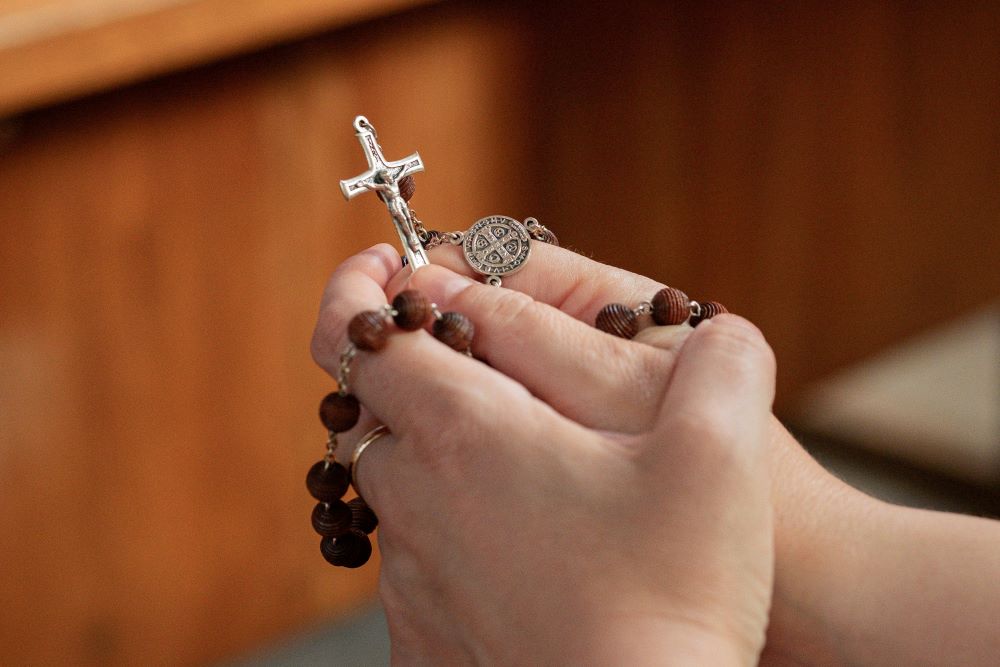
My small hands gently slide the beads across my forefinger and thumb. The rhythmic chanting of the rosary rises and falls around me as I slowly learn the words and speak them alongside my aunts. My dad raises an eyebrow at me, surprised to see me joining the decade. At 9 years old, I had never been to a rosary and if I had attended a Mass, I don't recall it. This first foray into Catholicism came alongside the grief of my grandmother's passing. And now, the night before her funeral, I sit wedged between my two aunts, clutching the worn glass beads produced from one of their purses, hailing Mary.
My eyes travel around the room, I note the casket looming large, the abundance of flowers with their cloying scent, and my grieving family members. But no matter how I try to avoid it, glancing anywhere but on the wall, the crucifix transfixes me. It is horrible. Christ's body hangs bloody, twisted and grotesque in his pain. I cannot look away.
Love and death intermingle in the chant surrounding me, repeating again and again "now and at the hour of our death." This openness around topics of pain and death confounds me, but something inside me loosens at the thought of a God who is honest about the suffering in this life, who sees the tears of my father and his siblings, grieving their mother, and cries alongside them.
God does not promise his followers an easy life, but offers them a full one.
Our nondenominational church back home always felt very clean, new and sanitized. There was no Jesus hanging on our crosses. This sterile decor did not pose a problem — spirituality and religion can grow regardless of the trappings of a building — but even as a child I sensed a hollowness in the theology, which skated dangerously close to the prosperity gospel.
At this tender age, I could not articulate the feelings of disconnect between my church's teaching and my own experience with suffering in the world. The questions that plagued me were both universal and, as is often the case for pre-teens and teens, deeply personal in a way I worried no one else could possibly understand. But the disquiet lingered with me, as did the conviction that a church which taught me to avoid suffering was selling something I did not want: a half-life, and an empty one.
As I grew into my teen years, my church's gilded promises of earthly comfort rang wildly empty to me, and I chose to stop attending the church in which I had grown up. I maintained a strong faith in God, but I declared a deep distrust of organized religion.
After my grandmother's passing, we had not often attended Mass while visiting relatives, but while studying abroad in Rome I was reintroduced to that haunting, most organized of religions, Catholicism. In every chapel, cathedral and grotto I entered I saw beautiful paintings of love and pain intermingled on the ancient walls. I had very little experience with stories of the saints, but from the intensely gruesome and detailed depictions surrounding me in Rome, I could gather that they had not lived easy lives.
In these spaces holding the stations of the cross, skulls of martyrs and images of saints, there was no promise of earthly prosperity, no obfuscation of suffering. The Catholic Church openly advertised the pain in life — and especially in the life of a Christian. But they also emphasized the deep love that inspired sacrifice.
Advertisement
While in Rome, I would kneel at daily Mass, and my eyes would once again be drawn magnetically to the crucifix. That same shivering shudder of horror would creep up my spine, a reminder of that first time I noticed Jesus on the cross. I had been raised to understand that Christ had died for me, but in this moment, the depth of his love and sacrifice settled in my bones. Having been raised in a church that offered a sanitized version of Christianity that failed to emphasize the suffering of both Christ and his followers, the love which shone from the images felt overwhelming. The passion of Christ was bold, sacrificial and central to the crucifix and Catholicism.
As I explored Catholicism more, I clung to the stories of the saints, the cloud of witnesses that surrounds us in our moments of pain or suffering, witnesses that, like Christ, understand the nature of suffering. In the Catholic Church I saw a community which actively taught that caring for the vulnerable — and in doing so, welcoming the grief and suffering of others into our lives — drew us closer to Christ and his powerful work of redemption.
Walking alongside someone in suffering or experiencing difficulty of my own no longer felt too messy for my faith; it made me feel whole. I understood that I was joining with Christ in an embodied experience of humanity, one that Christ himself had endured for our sake. God does not promise his followers an easy life, but offers them a full one.
Now when I see the crucifix hanging in the center of our parish, I appreciate the reminder of the suffering we acknowledge and the love to which it points.