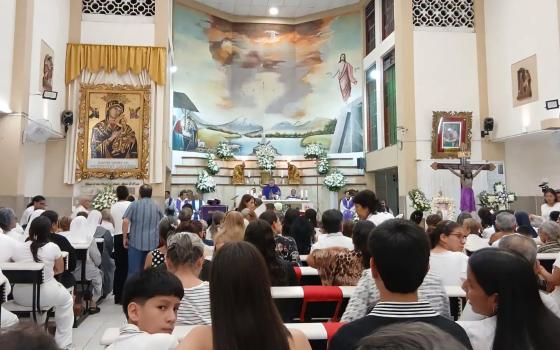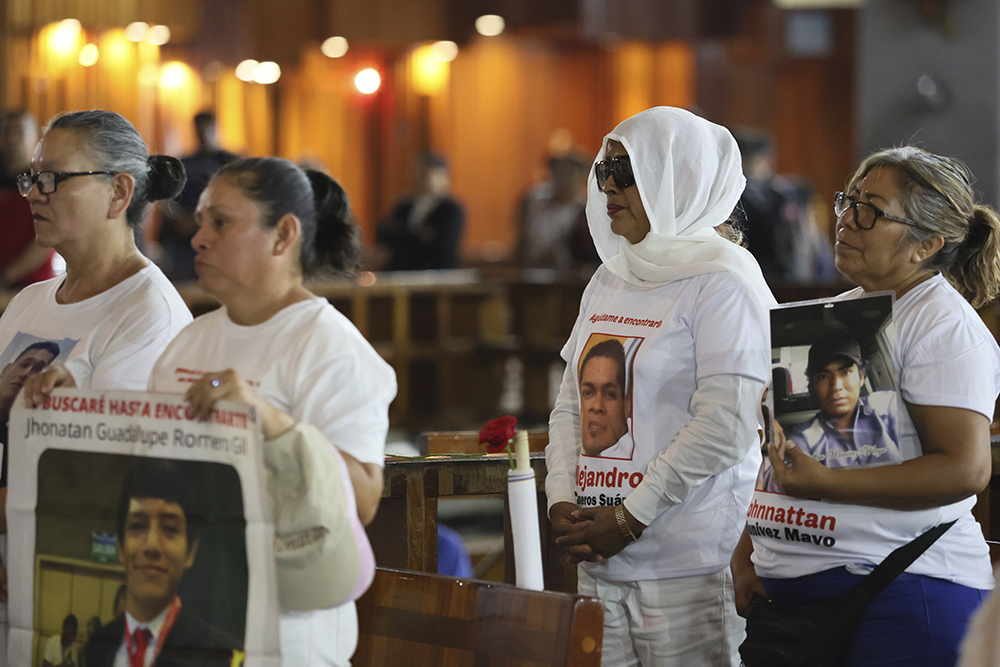
“Madres buscadoras” or searching mothers attend a Mass at the Basilica of Guadalupe in Mexico City, on Mother's Day, May 10, 2024. (AP Photo/Ginnette Riquelme)
by Yolanda Chávez
Join the Conversation
Send your thoughts to Letters to the Editor. Learn more
In my former ministry in Los Angeles, I offered spiritual accompaniment to migrant women who were enduring separation from their children. Their lives reflected many of the needs named by Jesus in Matthew 25: hunger, loneliness, exclusion, the need for shelter and so on. But as I learned to listen beyond those immediate needs, deeper stories emerged.
One of those women transformed the way I see. She was very young and confided to me that her mother belonged to the collective of madres buscadoras in Mexico searching for their missing children.
The person her mother was searching for was her.
In Matthew 25, Jesus shows us how another person's need becomes a call: "I was hungry, I was thirsty, I was naked, I was a stranger, I was sick, I was in prison."
Providing things like food, clothing, medical care and shelter is essential work. Corporal needs can't wait while we try to understand the whole story. And yet our response must not end there; we must take a second closer look to see the causes of the suffering, the very real relationships that have been broken, and the structures that need to change.
When Jesus tells us that he himself comes to meet us through those in need, it should profoundly change our perspective. The question is no longer simply, "What can I give this person?" It also becomes, "Who is this person? What story do they carry? What does their reality call us to change?"
That young woman in L.A. broadened the way I read Matthew 25. The needs listed by Jesus do not exist in isolation. A young woman living as a stranger in a foreign land may also be a desperate mother's missing daughter. Behind her need for food, shelter or protection may be a history of violence and displacement unseen at first glance.
Through my own experience of displacement, and from where I stand now in Mexico, I can say there is always more than what meets the eye.
Widening our perspective means recognizing Christ in those who stand before us, responding to their concrete needs with respectful attention, aware that their lives may hold losses, broken relationships, and painful realities that we cannot see.
Advertisement
Recently, I discussed this with attendees of Xabier Pikaza's lectures, titled "God is Word: The Human Being as Hearer of the Word" at the Spanish-language Catholic Bible Institute of the Archdiocese of Los Angeles. My role for the event was to accompany participants through a process of discernment to help them integrate the themes into their personal lives, communities and ministries. As we considered the needs listed by Jesus in Matthew 25, we paused on "I was naked, and you clothed me."
The other scenarios are easier to imagine, but what might it mean today for someone to be publicly exposed? We thought about situations in which a person is stripped of protection and belonging, left before the community as though without dignity. "To clothe the naked" means more than covering someone's body: It means protecting them without concealing the violence that left them exposed, safeguarding their privacy without silencing their voice, and accompanying them as they recover a sense of safety.
The works of mercy require us to not just meet the immediate needs of the vulnerable, but to ask what made them vulnerable in the first place. Furthermore, the call does not end with personal conversion but should also challenge the practices, priorities and structures of parishes, institutions and communities.
To widen our perspective is to see the whole person: their needs and their story, their wounds and their relationships, their capacity to endure and their right to belong. Only then can we move from seeing the works of mercy as isolated acts of assistance to, instead, an ongoing practice of care, justice and communion.