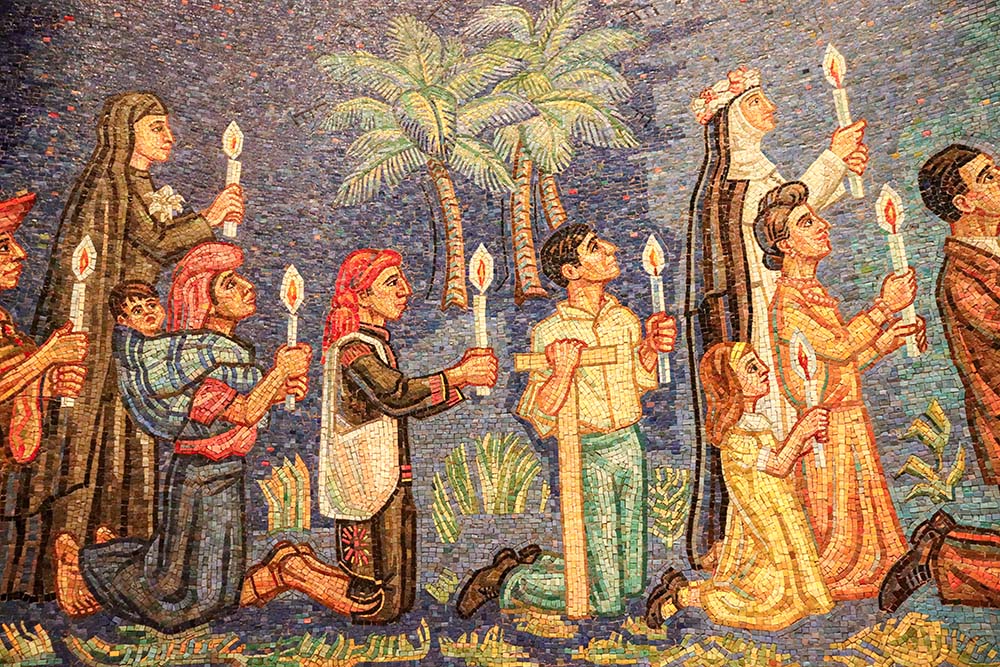
A procession of the faithful is depicted in mosaic in Our Lady of Guadalupe Chapel at the Basilica of the National Shrine of the Immaculate Conception, Washington, D.C. (Teresa Malcolm)
by Sr. Mary M. McGlone
Join the Conversation
Send your thoughts to Letters to the Editor. Learn more
When I was about 11 years old, my mother had to tell someone who worked for the family that we weren't the right fit. With all the tact an 11-year-old could muster, I asked, "Mom, how are you going to fire Charlotte?"
In a quiet voice of wisdom, she said, "I don't know yet, I am asking my mother to help me find the right words." My grandmother had died when Mom was 17, thus I knew this was no phone call, but an instance of something that goes far beyond what we might think of as "ordinary." Mom didn't talk about the communion of saints, she lived in it.
We have all kinds of testimony and descriptions of the communion that unites all people in God. The Book of Revelation describes our future as a share in Christ's victory. That's what Paul described as a reality, mystery and victory when he wrote, "All things work for good for those who love God, who are called according to his purpose" (Romans 8:28).
The saved people, a group so numerous that they are impossible to count, are gathered together as one. Some have passed through all the tribulations of life and are united in Christ, others are still in stages of becoming.
The First Letter of John is actually less a letter than a theological essay that shares ideas and vocabulary with the Gospel of John. The part chosen for this feast focuses on the idea of becoming God's own (John 1:12-13).
"Children of God, and so we are."
What does John mean by this? In this letter and in John's Gospel, becoming children of God is a process. It's not simply a matter of being conceived and brought to birth.
In Spanish, the phrase for giving birth translates to give to the light or deliver into the light. That's probably closer to John's meaning. Becoming children of God is a mutual process between God and humanity in which human participants have the opportunity to accept the gift of divine life and grow in it.
In today's Gospel, Matthew describes the life of those who share in Christ's victory as "blessed." His first description of the blessed as "the poor in spirit," can summarize them all with each that follows explaining what it means to be poor in spirit.
With God, they mourn the ways humanity distorts the purpose of creation by abusing others and misusing the Earth and her products.
The ones who will truly own everything are meek: They refuse to try to gain anyone or anything by force.
The blessed are the people whose desire for the fulfillment of God's plan is as strong as hunger, as urgent as thirst.
Because they know in their hearts that they are blessed, they are impelled to spread divine mercy and generate peace.
Because they know they belong to Christ, nothing can stop them from carrying forth the mission Jesus described in his beatitudes.
Advertisement
Each of our readings describe people who have been through the process of coming to live in Christ. They don't describe the real theme of today's feast, the communion of saints. This communion isn't just some new age idea or theological conundrum. Although we declare it as a reality each time we profess the Apostles' Creed, we may not have integrated it deeply into our life of faith.
In simplest terms, belief in the communion of saints declares that we belong to the biggest extended family in the universe. It professes a real connection between those who are becoming children of God in this history and those who are already living in a way that "has not yet been revealed," those who are now truly like Christ because they "see him as he is."
Belief in the communion of saints expresses an awareness of our oneness with all who live on Earth and in heaven. As Mom taught me, we can call on one another from here or there. We can ask the saints for inspiration, encouragement or a deeper sense of hope. If we are open to it, they can inspire us. Connection with them allows them to nudge us toward the creative love they knew and know.
How might we grow in this? First, let's get to better know our holy sisters and brothers who live on the "other side." (One good source of knowledge about them comes from Franciscan Media.) The story of the saints' lives can encourage us to move with greater boldness in faith, love and hope.
Our prayerful connection with them is not exactly what the world sees as "ordinary," but it joins us such that we can work wonders we've never imagined. All we need to do is ask.