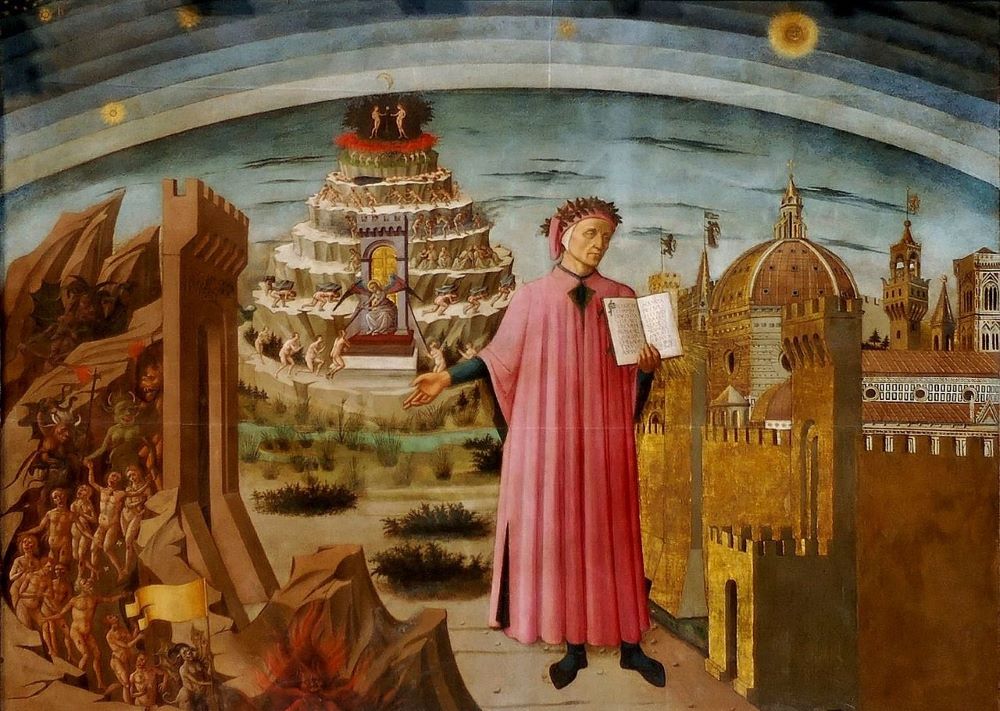
Domenico di Michelino's 1465 fresco at the Cathedral of Santa Maria del Fiore depicts the poet Dante Alighieri holding a copy of "The Divine Comedy," next to the entrance to Hell, the seven terraces of Mount Purgatory and the city of Florence, with the spheres of heaven above. (Wikimedia Commons/public domain/Jastrow)

by Christopher M. Bellitto
Join the Conversation
Send your thoughts to Letters to the Editor. Learn more
As we look back on Lent and prepare for Easter, it's a good time to take a walk with Dante Alighieri, the poet from Florence who wrote his masterpiece trilogy, The Divine Comedy, in the early 14th century. Why? Because his fundamental lesson is that we can change.
Dante's voyage through the inferno is a warning about what happens if we don't change; the promise of paradise is what will happen if we do. Virtue's power for overcoming vice is the essence of Purgatorio. The root word is right there in the name: purge.
In Dante's mind, the only way to get rid of a vice is to find the corresponding virtue and to work hard to move from the bad to the good. His own body bears the mark: an angel who is gatekeeper to purgatory draws seven Ps on Dante's forehead with a sword. Each P stands for a sin (in Latin and Italian: peccatum and peccato). These are the traditional seven deadly sins that Dante and his escort, the Roman poet Virgil, encounter on seven terraces in purgatory: pride, envy, anger, sloth (laziness), avarice (greed), gluttony and sexual promiscuity (lust). As Dante and Virgil work their way up the mountain of purgatory, Dante learns about each sin and how to get rid of them — that is, how virtue erases vice. As he progresses, angels wipe the Ps off his forehead one by one.
Although this is a promising tale, Dante is concerned for the reader's reaction:
But I do not wish, reader, to discourage you
from your good intention when you hear
how God wants the debt to be paid.Don't focus on the form of punishment:
consider the result: consider that at worst
what follows cannot last beyond the final judgement.
On the terrace in purgatory, Dante sees people who were gluttons in life now dragging themselves around. In life, these people filled their bellies with excessive food and drink, but now their eyes are empty and sunken. Their bones stick through their pale skin. Some gnaw on nothing and others keep drinking without quenching their thirst. Here, Dante meets Forese, a poet he'd once known. Forese reveals the point of the gluttons' toil:
Having chased their gullets beyond measure,
in hunger and thirst work to make themselves holy.
Reflecting on the passing Lenten season means recognizing the potential we have to transform a bad habit to good, even if the process is an imperfect one. The Christian tradition offers the Greek word metanoia and the Latin phrase conversatio morum; both describe a fundamental reorientation from selfishness to selflessness, to others instead of you alone, to sharing in place of hoarding.
Spiritual growth demands a conscious choice of good over bad actions. In purgatory Dante meets Marco, a man about whom we know little except that he comes from Lombardy, near today's Switzerland. Marco tells Dante:
Therefore, if the present world has lost its way,
in you is the cause, in you it should be sought.
As we leave Lent and enter into Easter, may we search within ourselves for the will to change vice into virtue.
Editor's note: This article is adapted from Christopher M. Bellitto's Walking Toward Virtue: A Journey with Dante (Liguori Publications).
Advertisement