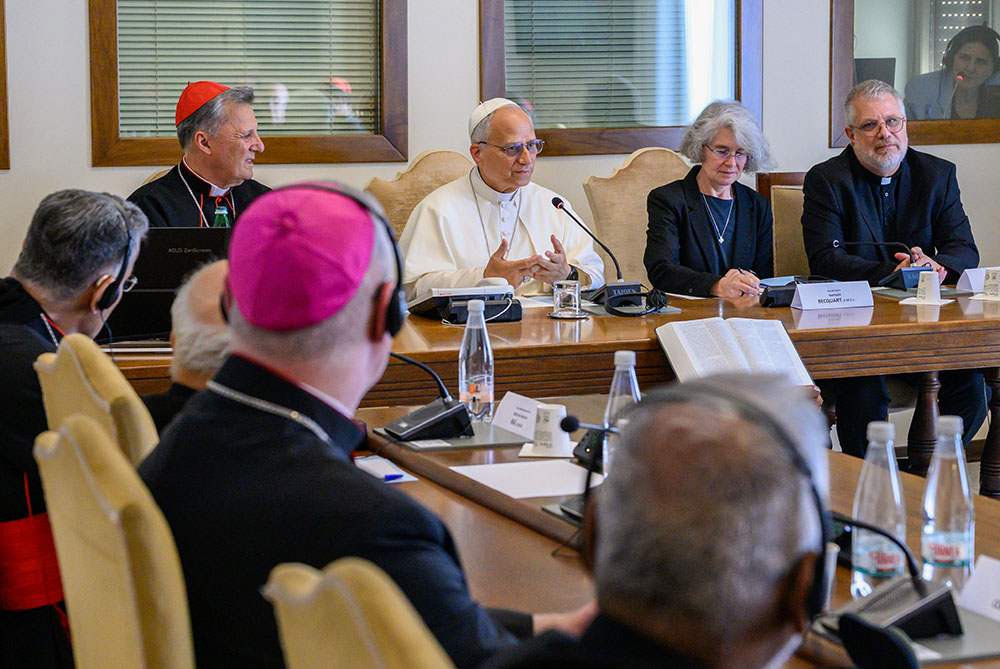
Pope Leo XIV speaks with leaders of the "continental bodies" representing Latin America, Africa, Asia, Europe, Oceania, the Middle East and North America, together with the coordinators of the continental synodal teams, during a private meeting at the Vatican June 25, 2026. (CNS/Vatican Media)

Join the Conversation
Send your thoughts to Letters to the Editor. Learn more
We learned more about how Pope Leo XIV intends to implement the reforms his predecessor introduced when the Vatican released a "thematic framework" for the meeting this autumn of the presidents of the world's episcopal conferences, as well as their Eastern rite counterparts. They will discuss the reception of Pope Francis' 2016 post-synodal exhortation, Amoris Laetitia.
Three things about the framework and this forthcoming meeting stand out: the priority afforded pastoral experience; the absence of any reference to the hostility with which Amoris Laetitia was greeted in certain sectors of the church; and the underlying assumption of a synodal church that is shaping this meeting and, indeed, the life of the universal church.
"The starting point of the meeting is a gaze upon reality enlightened by the Gospel and rooted in Christ," the document states. "Following the path traced by Amoris Laetitia, it becomes essential to appreciate 'those signs of love which in some way reflect God's own love', accompanying persons 'patiently and discreetly' (AL 294). This calls for attentive listening to the concrete lives of families and to the experience of those who accompany them, recognizing together both the beauty of love as it takes shape in daily life and the fragilities that often affect it, including precarious employment and housing, illness, the challenges of raising children, emotional loneliness, and the care of family members with disabilities, the elderly, or those who are not self-sufficient."
This framing highlights the ascent of pastoral theology in the life of the church that we discussed in a different context a few weeks ago. We need to move past the idea of two camps, one that insists the church begins its teaching with transcendent and unchangeable norms versus the other that begins with the lived reality of the people we serve. The church attends to the "signs of the times" not as sociologists but as evangelists looking for signs of God's grace in the lived circumstances of the Christian faithful. It is not an either/or but a both/and: We look at reality, but we do so through the lens of the Gospel and the teachings of the church.
The Dicastery for Laity, Family and Life, which worked on this framework, has been highlighting pastoral theology since Cardinal Kevin Farrell took its helm in 2016 and this approach is on display here. The document has a section on the special need to accompany married couples in their first few years of marriage. The document attends to the need to reach young people, asking: "What language, experiences, and educational and spiritual pathways help children, adolescents and young people today to recognize the value of marriage?" And the document, like Amoris Laetitia, does not give up on those whose marriages have failed. "Failure, fragility, the gap between the ideal and reality, and the complexity of life situations also become places in which the work of God's grace may be recognized and where persons can be accompanied with respect, patience and hope," it states.
Advertisement
The second thing that jumps out about the preparatory framework is the absence of any reference to the controversy that surrounded Amoris Laetitia and the two synods on the family in 2014 and 2015 that led to it. It was at those synods that the opposition to Francis took shape. Some bishops, Philadelphia Archbishop Charles Chaput most prominent among them, complained that the pope was sowing confusion by suggesting the divorced and remarried might be admitted to the sacraments under certain circumstances.
Chaput told the audience at a First Things' symposium what he thought of the 2014 synod: "I think confusion is of the devil, and I think the public image that came across was one of confusion." As I noted at the time, "When Chaput detects 'confusion' in the synod, I detect an agenda in Chaput." Chaput was the leader of Team Javert at the synods, and his agenda was to make sure that "those who falter and those who fall must pay the price."
Now, that opposition does not merit so much as a footnote in the preparatory framework document. In Amoris Laetitia, Francis included a single footnote about the subject of Communion for the divorced and remarried: "In certain cases, this can include the help of the sacraments. Hence, 'I want to remind priests that the confessional must not be a torture chamber, but rather an encounter with the Lord's mercy.' ... I would also point out that the Eucharist 'is not a prize for the perfect, but a powerful medicine and nourishment for the weak.' " The stars did not fall from the sky. The Catholic Church was not consumed by relativism nor were the people of God confused.
The last aspect of the new framework that jumps out is the degree to which synodality is now simply assumed in ecclesial proceedings. The text begins by quoting Pope Leo XIV's message announcing the meeting, which he said was intended "to proceed, in mutual listening, to a synodal discernment on the steps to be taken in order to proclaim the Gospel to families today, in light of Amoris Laetitia and taking into account what is currently being done in the local Churches."
The General Secretariat of the Synod helped draft this thematic framework, which itself indicates the role of synodality in the life of the Curia. But the days when synods were rubber stamps, and the pope presiding over them could read a book while others gave canned speeches, are over. Whether the meeting is a consistory of cardinals or, now, a gathering of the presidents of the world's bishops' conferences, mutual listening and discernment are how those meetings operate. And while we can expect the laity to be involved in the general synods in the upcoming years, Leo is not afraid to hold a meeting of clerics so long as the meeting is synodal in approach.
Pastoral theology, moving on from the feeble opposition to Francis, and comprehensive synodality. That is what the cardinals voted for last year in the conclave. It is what Leo is delivering now.
You are reading a selection from Michael Sean Winters' weekly newsletter. To get the full edition — including the "In the News" link roundup — delivered 24 hours before it appears online, sign up here!