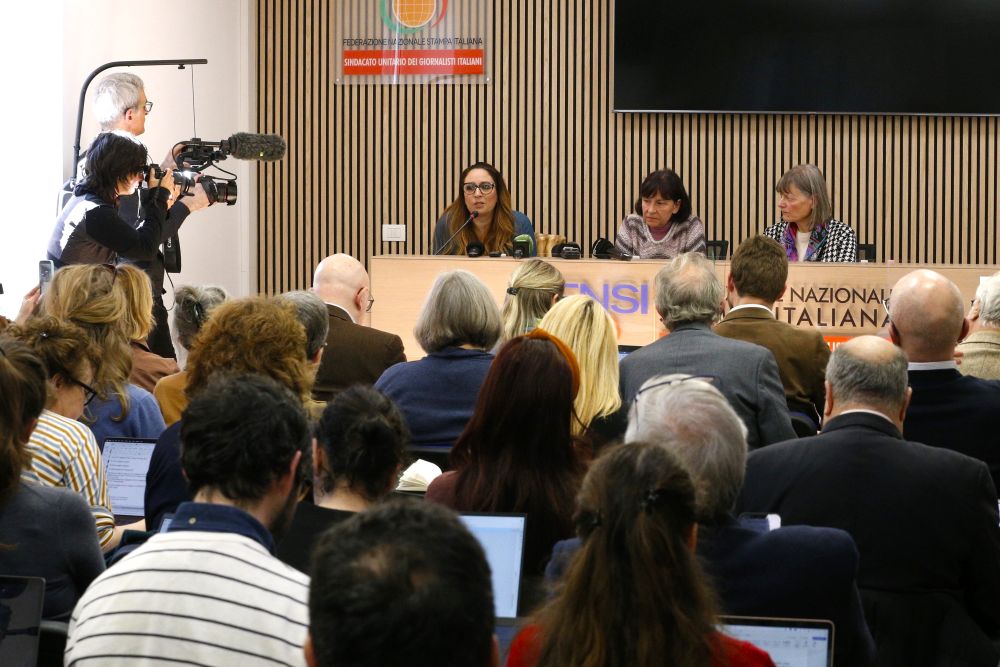
Laura Sgro, a lawyer representing a former religious sister that has reported sexual, spiritual and psychological abuse committed by Fr. Marko Rupnik, speaks at a news conference in Rome Feb. 21, 2024. (CNS/Justin McLellan)

Join the Conversation
Send your thoughts to Letters to the Editor. Learn more
The Vatican has denied rumors that Fr. Marko Rupnik, the prominent Catholic priest, artist and former Jesuit accused of sexually and spiritually abusing more than two dozen women, has been acquitted in an ongoing canonical case.
The proceedings against the Slovenian priest remain underway, the Holy See Press Office said in a July 22 statement, rejecting as "completely unfounded" rumors that the case had concluded and absolved Rupnik of any wrongdoing.
A former titan in Catholic circles, Rupnik's distinctive mosaics appear in prominent churches and shrines around the world, including in Lourdes, Washington and the Vatican. In 2020, Pope Francis tapped his fellow Jesuit to preach the Lenten reflection for members of the Roman Curia.
The handling of the allegations against Rupnik has become a major test of the Vatican's willingness to investigate abuse involving adult women and hold influential clergy accountable.
Two days before the Vatican statement, the traditionalist Italian blog "Messa in Latino" cited "persistent and highly credible reports" claiming that the proceedings had ended with Rupnik's acquittal.
The publication prompted Laura Sgrò, an attorney representing several women involved in the case, to publish a letter to Cardinal Víctor Manuel Fernández, prefect of the Dicastery for the Doctrine of the Faith, calling for greater transparency in the proceedings and lamenting that her clients had not been summoned to testify.
The Vatican said, however, that no decision had been reached.
"The review of the case is still ongoing, and the panel is examining documentation provided by the dioceses involved, the Jesuits, the parties concerned, and from the press," the statement said.
"No information regarding the ongoing investigation may be shared in any way out of respect for the process itself and to avoid causing harm to all those involved in the matter, as has occurred in recent days," it continued. "Should the panel deem it necessary to obtain further information, it will take the initiative to do so on its own."
Advertisement
The Rupnik case has cast a long shadow over the Vatican since allegations of abuse dating to the mid-1990s by several women who had belonged to a religious community Rupnik founded in his native Slovenia first became public in 2022.
After the allegations emerged, the then Jesuit superior general, Fr. Arturo Sosa, disclosed that Rupnik had previously incurred an automatic excommunication in 2020 for using the sacrament of confession to absolve a woman with whom he had engaged in sexual activity.
The Dicastery for the Doctrine of the Faith lifted the excommunication shortly afterward because Rupnik had repented, Sosa said, but Rupnik was expelled from the Jesuits in 2023 "due to stubborn refusal to observe the vow of obedience."
The Vatican's doctrine office, which handles canonical cases involving sexual abuse, initially declined to prosecute Rupnik over the abuse allegations because they involved adult women and fell outside the church's statute of limitations. More people subsequently came forward with allegations of abuse spanning approximately three decades.
Following pressure from the Pontifical Commission for the Protection of Minors, Pope Francis waived the statute of limitations, clearing the way for the current proceedings.
The Vatican's statement noted that Rupnik "remains subject to the laws of the countries where any offenses may have been committed; the statute of limitations for such offenses is determined by the laws of each country, independent of ecclesiastical authority." For the Vatican trial, a panel of five judges, who are external to the Dicastery for the Doctrine of the Faith and are not members of the Roman Curia, was appointed in October to examine the case.
Among Rupnik's accusers, Gloria Branciani, a former member of the religious community Rupnik founded in Slovenia, told reporters in 2024 that the priest raped her. She said Rupnik had also persuaded her and another sister to engage in sexual activity with him simultaneously "to reflect the Trinity" and that he took her to pornographic movie theaters.
Religious art in Rupnik's signature style, dynamic shapes depicting wide-eyed biblical characters, remain displayed around the world, often prompting mixed reactions. In Washington and Lourdes, efforts have been made to cover elements of mosaics created by Rupnik's Rome-based art studio, but the Marian shrine in Aparecida, Brazil, is pressing ahead with efforts to complete its facade with the mosaics.
The National Catholic Reporter's Rome Bureau is made possible in part by the generosity of Joan and Bob McGrath.