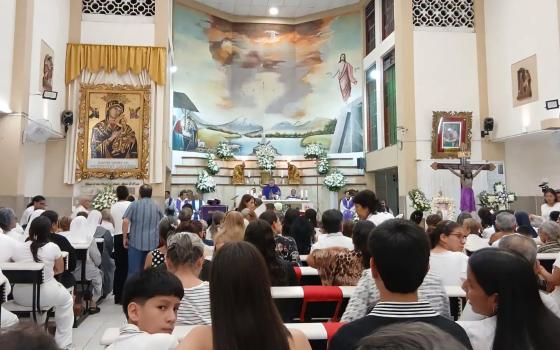
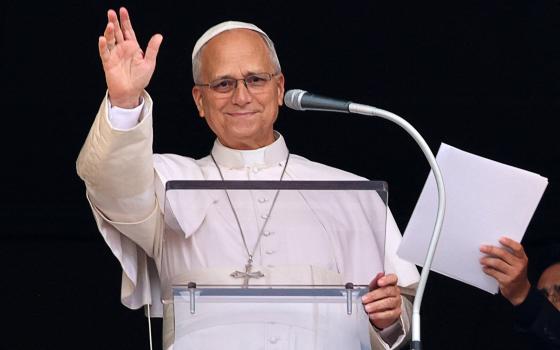
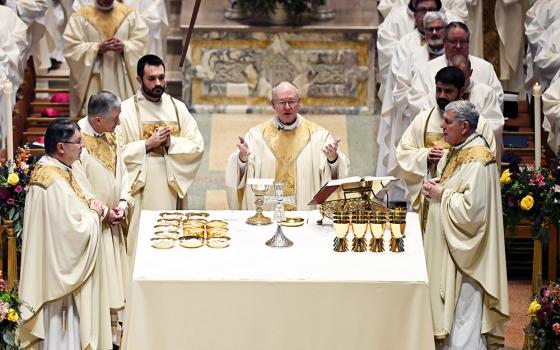
Cardinal Víctor Manuel Fernández, prefect of the Dicastery for the Doctrine of the Faith, celebrates Mass on the sixth day of the "novendiali," nine days of mourning for Pope Francis, at the Altar of the Confession in St. Peter's Basilica at the Vatican May 1, 2025. (CNS/Lola Gomez)
Join the Conversation
Send your thoughts to Letters to the Editor. Learn more
The Vatican warned that members of the traditionalist Society of St. Pius X will incur excommunication if the group follows through with its threat to ordain new bishops without the approval of Rome, marking the latest exchange in a theological tit-for-tat which has challenged Pope Leo XIV's push for greater unity in the Catholic Church.
"The episcopal ordinations announced by the Priestly Fraternity of St. Pius X do not have the corresponding papal mandate," wrote Cardinal Víctor Manuel Fernández, prefect of the Dicastery for the Doctrine of the Faith, in a statement published May 13. "This act will constitute 'a schismatic act' and 'formal adherence to the schism constitutes a grave offense against God and entails the excommunication established by the law of the Church.' "
"The Holy Father continues to pray that the Holy Spirit may enlighten the leaders of the Priestly Fraternity of St. Pius X so that they may reconsider the extremely serious decision they have made," wrote the cardinal, who met with the pope two days before the statement was published.
The SSPX, which celebrates the pre-Vatican II Latin Mass and rejects key teachings of the Second Vatican Council, announced in February its intention to ordain new bishops on July 1. It currently only has two bishops, both in their 60s, straining its capacity to create new priests to replenish its ranks.

Cardinal Víctor Manuel Fernández, prefect of the Dicastery for the Doctrine of the Faith, and Father Davide Pagliarani, superior general of the traditionalist Society of St. Pius X, are pictured at the Vatican Feb. 12, 2026. (OSV News photo/courtesy Dicastery for the Doctrine of the Faith)
The SSPX currently claims to have some 700 priests worldwide, with its most significant presences in the United States and France. As of December 2025, it said it had 254 active priests in the United States and 95 seminarians in formation at its seminary in Dillwyn, Virginia.
After the SSPX's announcement, Fernández met with its superior general, Fr. Davide Pagliarani, and offered to open a theological "path of dialogue" with the group in a last-ditch effort to avoid an outright schism.
The society swiftly shot down that prospect, stating that the society and the Vatican "cannot agree doctrinally" in light of the insistence that "the texts of the Council cannot be corrected, nor can the legitimacy of the liturgical reform be challenged."
The SSPX claims that its planned episcopal consecrations would not constitute a schismatic act, arguing that the new bishops would function only as auxiliaries and would not claim any jurisdiction or governing authority apart from Rome.
Yet Fernández's May 13 statement made clear that the Vatican does not share that interpretation of church law, and that it intends to uphold the automatic excommunication (latae sententiae) that would be incurred by the consecrations.
Additionally, two conservative cardinals who formerly headed the Vatican's doctrinal and liturgical offices have both stated that the SSPX consecrations would constitute a schismatic act.
The standoff echoes the 1988 excommunications incurred by the society's founder, Archbishop Marcel Lefebvre, and the four bishops he illicitly consecrated without papal approval.
Then, St. John Paul II declared the consecrations a "schismatic act," though, in an effort at reconciliation Pope Benedict XVI lifted the excommunications in 2009.
Pope Francis offered signs of reconciliation with the group, granting SSPX priests permission to celebrate marriages and hear valid confessions, but he famously clamped down on the celebration of the pre-Vatican II Latin Mass prized by the group.
While Leo has signaled greater openness to the Catholics who prefer celebrating Mass in the old form, he chose the teachings of Vatican II as the topic for his first weekly catechesis series as pope, indicating that the reception of the council is likely to remain a priority of his pontificate.
The National Catholic Reporter's Rome Bureau is made possible in part by the generosity of Joan and Bob McGrath.
Advertisement