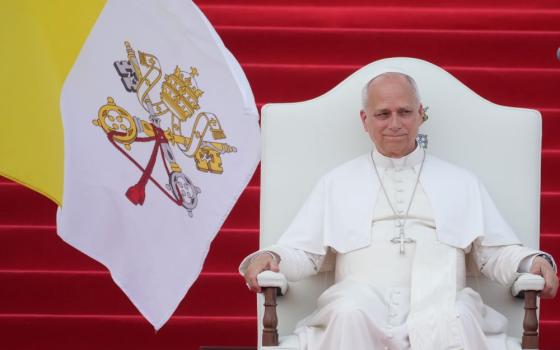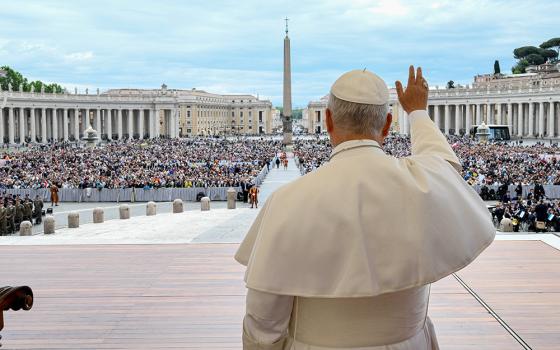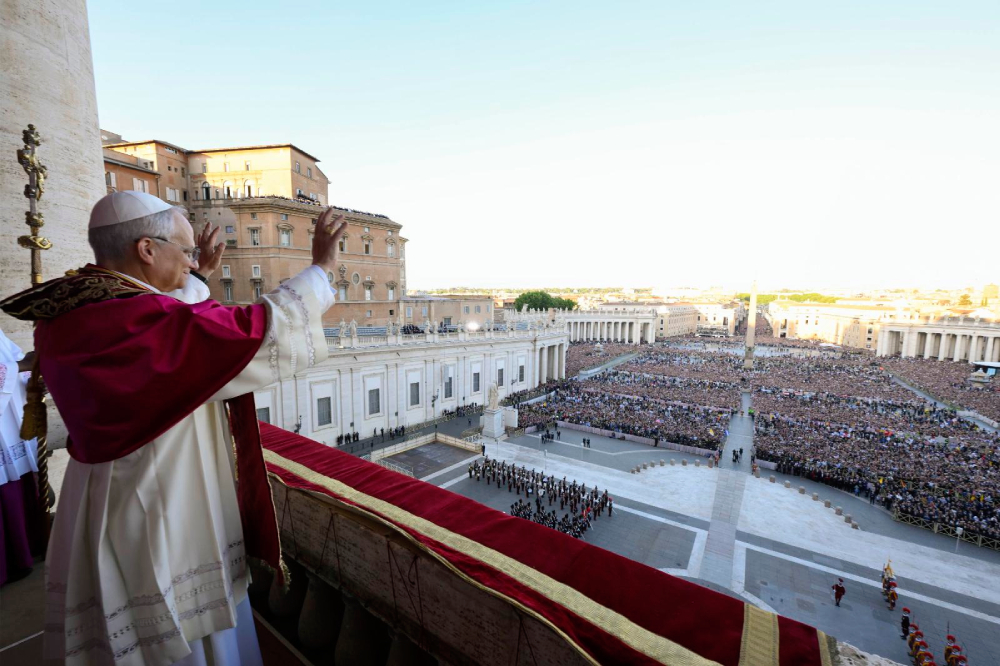
Pope Leo XIV, the former Cardinal Robert F. Prevost, waves to the crowds in St. Peter's Square at the Vatican after his election as pope May 8, 2025.(CNS/Vatican Media)

Join the Conversation
Send your thoughts to Letters to the Editor. Learn more
Pope Leo XIV may be the first pope to have been born in the United States, but he is the beneficiary of some outstanding and farsighted leaders of the Catholic faith in this country who have had dealings with the Holy See. On two issues in particular, the contribution of American Catholics to the development of the Holy See's ideas are noteworthy: religious liberty and organized labor. Interestingly, both issues are still clamant among us.
In 1776, the Holy See still understood politics in terms of the confessional state, with Catholicism as the established religion, and the church allied to the monarchical political structures of that era. The idea of ethnic or religious pluralism was largely unknown.
The Catholics in the young United States were a tiny minority, but as late colonial discontent turned to active revolution, toleration of Catholics increased. In a letter dated Feb. 28, 1779 and accessible in the marvelous online American Catholic History Classroom at the University Archives of the Catholic University of America, Fr. John Carroll, who would later become the first bishop in the U.S., wrote to his friend Dr. Charles Plowden:
I am glad however to inform you that the fullest & largest system of toleration is adopted in almost all the American states: publick protection & encouragement are extended alike to all denominations & R. C. are members of Congress, assemblies, & hold civil & military posts as well as others.
After the revolution was won, the Holy See's ambassador to Paris, Archbishop Giuseppe Doria Pamphili, inquired of Benjamin Franklin about what procedures to follow in appointing a bishop to the new country. Franklin assured the diplomat that the new Congress "cannot and should not, in any case, intervene in the ecclesiastical affairs of any sect or any religion established in America." This was new and Rome found it baffling: Civil governments had long been deeply involved in the selection of bishops. As a practical matter, Rome was happy to make its own selection, but at the level of theory, the church continued to favor the union of throne and altar.
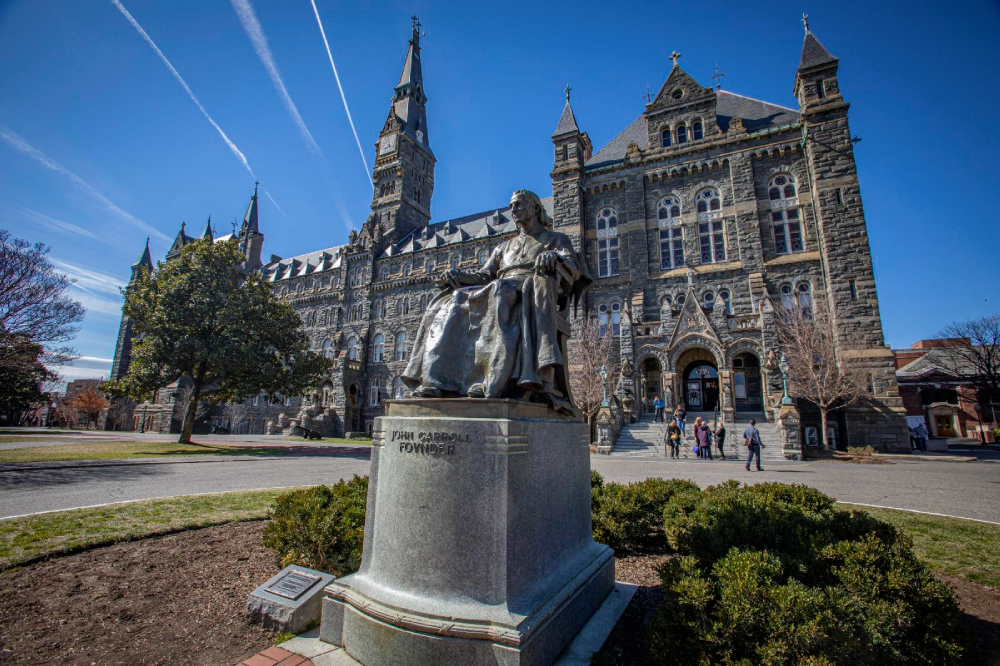
A statue of Baltimore Archbishop John Carroll, the first Catholic bishop in the United States and founder of Georgetown University, is seen on the Jesuit-run school's Washington campus March 3, 2022. (OSV News/Chaz Muth)
On March 25, 1887, Cardinal James Gibbons mounted the pulpit at his titular church, Santa Maria in Trastevere and delivered a sermon defending the American system of church-state separation. "I belong to a country where the civil government holds over us the aegis of its protection, without interfering with us in the legitimate exercise of our sublime mission as ministers of the Gospel of Christ," he said. "Our country has liberty without license, and authority without despotism." Rome remained suspicious of the arrangement.
Finally, at the Second Vatican Council, and with the scholarly assistance of Jesuit Fr. John Courtney Murray, the Catholic Church acknowledged the value of religious liberty in the conciliar decree Dignitatis humanae. The council did not endorse any particular juridical arrangement, nor did it endorse the U.S. Constitution's understanding of religious liberty as merely a negative freedom, a freedom from external interference. It argued, instead, that human conscience was obligated to seek the truth, and that the search for truth requires freedom of conscience. The difference is significant, but nonetheless, the Catholic Church at long last embraced religious liberty as a public good.
The second issue on which the Holy See benefitted from the example and intervention of the U.S. church is labor. We think of the 1891 encyclical Rerum Novarum, with its strong defense of the rights of workers, as the start of Catholic social teaching but it did not fall out of the sky. In the first place, the doctrinal and scriptural foundations of Catholic social teaching go back to the Hebrew Scriptures, the New Testament and the writings of the early church fathers, as Msgr. John Strynkowski, former director of the doctrine committee at the U.S. bishops' conference, has documented. The "new things" in Rerum Novarum were not the teachings, but the circumstances to which the teachings were applied.
Rerum Novarum was also preceded by a controversy surrounding the Knights of Labor in which Gibbons played a significant role. In the last quarter of the 19th century, the Knights of Labor was a proto-union of mostly Catholic workers who organized in secret for fear their employers would fire them. At that time, many Catholic officials were frightened of secret societies, such as the Masons, which were profoundly anti-clerical. In 1884, Archbishop Eleazar Taschereau of Quebec condemned the Knights as a secret society and news of the condemnation spread to the U.S.
Advertisement
Gibbons was sympathetic to the Knights and had met with their leader, Terence Powderly, who assured the archbishop that the group was not radical and that they would amend their constitutions as needed to avoid strife with the church. At a meeting of the U.S. archbishops in 1886, the archbishops could not come to an agreement on whether to condemn the Knights, and so the matter was referred to Rome. Gibbons was named a cardinal the same year (as was Quebec's Taschereau) and he wrote a memorial in 1887 to Pope Leo XIII arguing the workers' case. The following year, Rome decreed the Knights could be tolerated.
The discussion of the Knights, along with the advocacy of Cardinal Henry Edward Manning of Westminster during the London dock strikes of 1889, were the proximate instigators of Leo's decision to issue Rerum Novarum. And nowhere did Rerum Novarum receive a warmer or more long-lasting reception than in Chicago. Pope Leo XIV is heir to a long line of workers' rights advocates among the Chicago clergy, such as Auxiliary Bishop Bernard Sheil, Msgr. Jack Egan, Fr. Clete Kiley and Cardinals George Mundelein, Joseph Bernardin, Francis George and Blase Cupich. The pro-union stance of the Catholic Church in Chicago is without equal, and it is the local church in which Robert Prevost grew up.
There have been other historical instances of the U.S. church working tightly with the Holy See. For example, in advance of the Italian elections of 1948, 1953 and 1958, the American bishops urged Italian-Americans Catholics to write to their family in the old country, urging them to vote against the Communist party. In the 1980s, Washington and the Vatican had a shared interest in the collapse of the Soviet empire, although people tend to overstate the influence of both President Ronald Reagan and Pope John Paul II in the collapse of communism, which was on its last legs before either man came to power. A host of U.S. prelates have held important jobs in the Vatican curia.
Nonetheless, it was in the areas of religious liberty and the rights of workers that the U.S. church had the most profound and enduring influence on the Holy See. Until now, when a son of Chicago's South Side sits on the chair of St. Peter. Leo XIV has the potential to be the greatest gift from the church in the U.S. to the universal church.