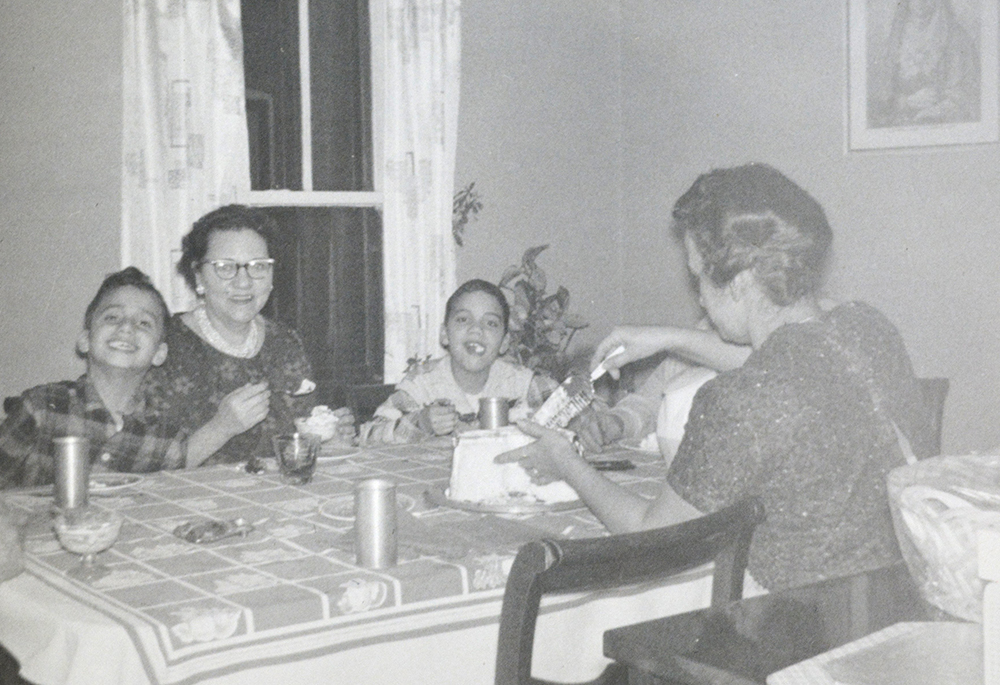
In this undated photo, Pope Leo XIV (then Robert Prevost, left) smiles while his mother (back to the camera) cuts a birthday cake in what his brother (right) guessed was the pope's ninth birthday, at the family home in the Chicago suburb of Dolton. (OSV News/Prevost family)
by Rone Tempest
Join the Conversation
Send your thoughts to Letters to the Editor. Learn more
He is this city's native son, a quintessential South Sider and a devoted White Sox fan with a penchant for pepperoni pizza. In Chicago's muscular vernacular, Pope Leo XIV is "Da Pope."
The Vatican announced in February that there will be no papal trips to the United States this year and, therefore, to his hometown. But when Leo eventually comes here, you can expect one of the grandest welcome parties and celebrations since Barack Obama won the 2008 presidential election.
An open-air Mass in downtown Grant Park would likely draw even more than the 250,000 communicants — who were served by 600 priests — in the park when Pope John Paul II celebrated Mass there on Oct. 5, 1979.
Since his surprise election last year, Chicagoans have had great fun proudly proclaiming Pope Leo XIV né Robert "Bob" Prevost as one of their own. The White Sox, his favorite team, (the Cubs are his mother's preferred club) have produced merchandise emblazoned with Leo references.
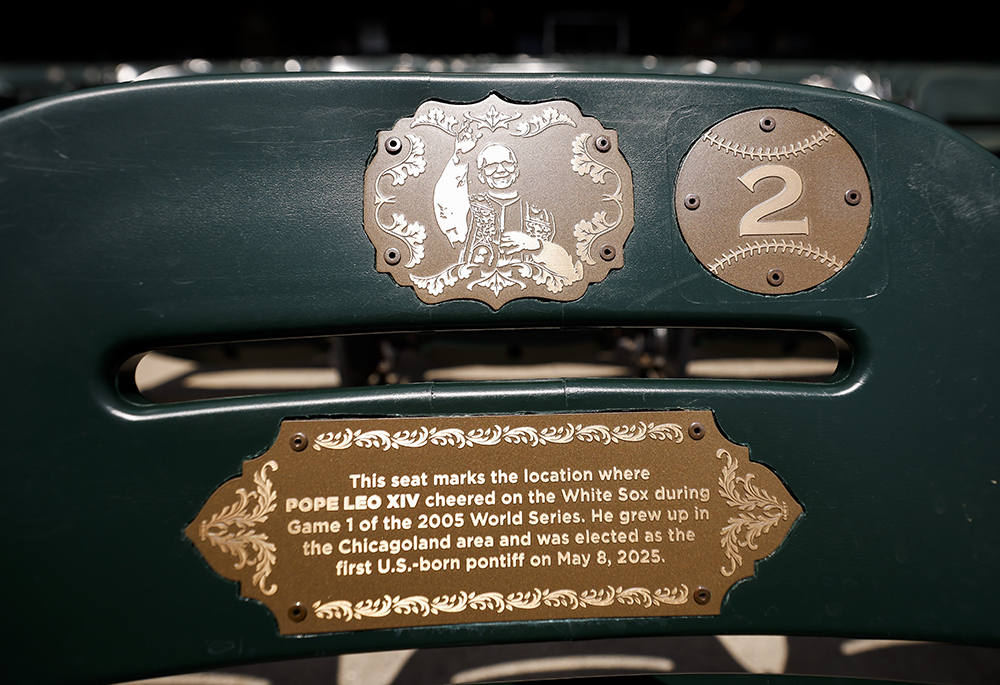
An Aug. 23, 2025, photo shows a plaque dedicated to Pope Leo XIV on a seat inside Rate Field, home of the Chicago White Sox baseball team. Since Aug. 22, 2025, baseball fans have been able to easily spot the stadium seat where Pope Leo, then-Augustinian Fr. Robert Francis Prevost, sat when he watched the first game of the 2005 World Series. (OSV News/Courtesy of the Chicago White Sox)
The White Sox placed stadium markers in the section where the future pope once sat at a game. But the team recently outdid all the idolaters when it announced that it would give out special black-and-green papal miters with the team emblem to fans sitting in a special "pews" section of the stadium at its Aug. 11 home game. Response was so intense that the team expanded the giveaway to the whole stadium and ticket demand has been high.
But all the joy and merchandising aside, the Chicago of Leo's youth and of the archdiocese that nurtured his faith, are vastly different than they were when he left for seminary in Michigan in 1969 when he was a young teenager. The future pope returned here at least three times for significant stays. He studied at the Catholic Theological Union in Hyde Park (1977-1982); in 1987 he worked as pastor for vocations and director of missions for the Augustinian order's Midwest Province of Our Mother of Good Counsel; and later he served as prior provincial for the Midwest province (1999-2001).
But he was mostly absent and overseas — at one point taking Peruvian citizenship — during the seismic demographic and cultural changes that have taken place. The city is no longer majority white, as it was in his time. In fact, with the burgeoning Hispanic and Asian populations, no single race has a majority. Dolton, the industrial suburb where the Prevost family lived, was once mostly white, but following a demographic shift, is now more than 90% Black.
Likewise, the Catholic Church is no longer the central player it once was when Euro-ethnic parishes — mainly Irish, Polish, Italian and German — were the cultural, social and political backbone of the city. As Chicago historian Eileen M. McMahon titled her 1996 book, the main identifying question of that era was, "What Parish are You From?" The answer revealed where you lived, your economic status, your ethnic background and perhaps even your politics.
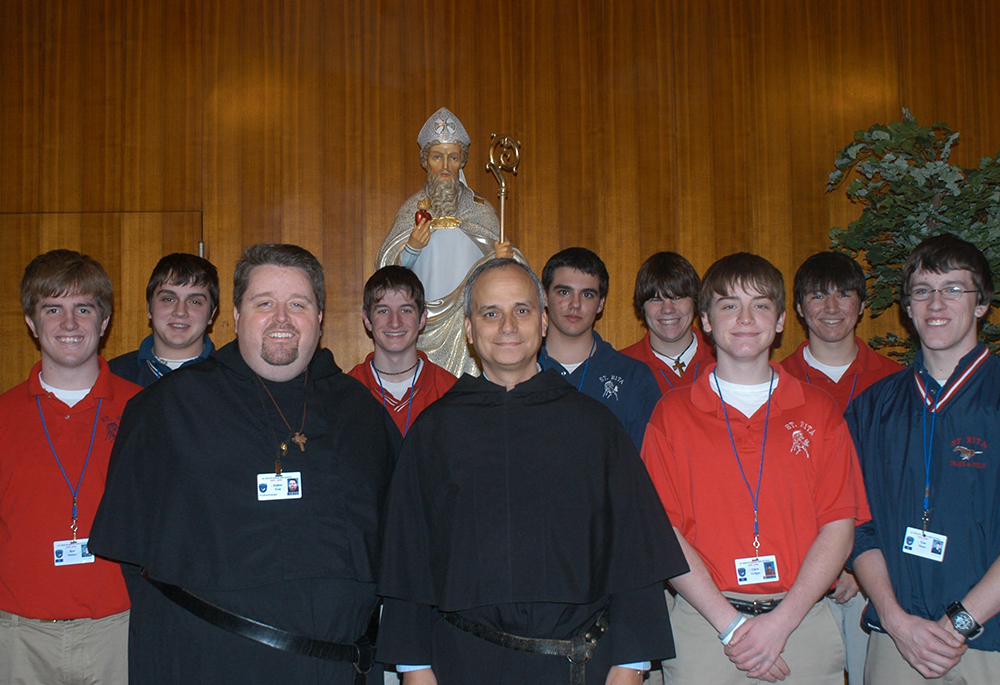
Then-Fr. Robert F. Prevost, now Pope Leo XIV, front center, prior general of the Augustinian order, poses with Augustinian Fr. Tom McCarty, president of St. Rita High School in Chicago, and upperclassmen in January 2006. (OSV News/Courtesy The Beverly Review)
The Irish political machine that once ran the city under father and son Richard J. Daley (mayor from 1955-1976) and Richard M. Daley (mayor from 1989-2011) has long disappeared from the scene after ruling the place for more than 40 years.
Since 1970, the overall number of Catholics in the Chicago Archdiocese, according to diocesan records, has decreased by about 22% from nearly 2.5 million to about 1.95 million in 2025. In the same general period, the number of parishes has fallen from 455 in 1975 to 216 in 2026. Perhaps the biggest indicator of change is in parochial education, where the number of Catholic elementary and secondary schools has dropped from 420 in 1970 to 151 in 2025. From 1985 to 2025, there was a loss of over 100,000 students.
Leo's childhood St. Mary of the Assumption Parish and affiliated school in the neighborhood village of Riverdale, adjacent to Dolton, was closed by the archdiocese in 2011 and merged with Queen of the Apostles Parish, also in Riverdale. In 2019, it was merged again along with two other parishes into Christ Our Savior Parish in South Holland where the pastor is Fr. Gosbert Rwezahura, a Tanzanian native whose first language is Swahili.
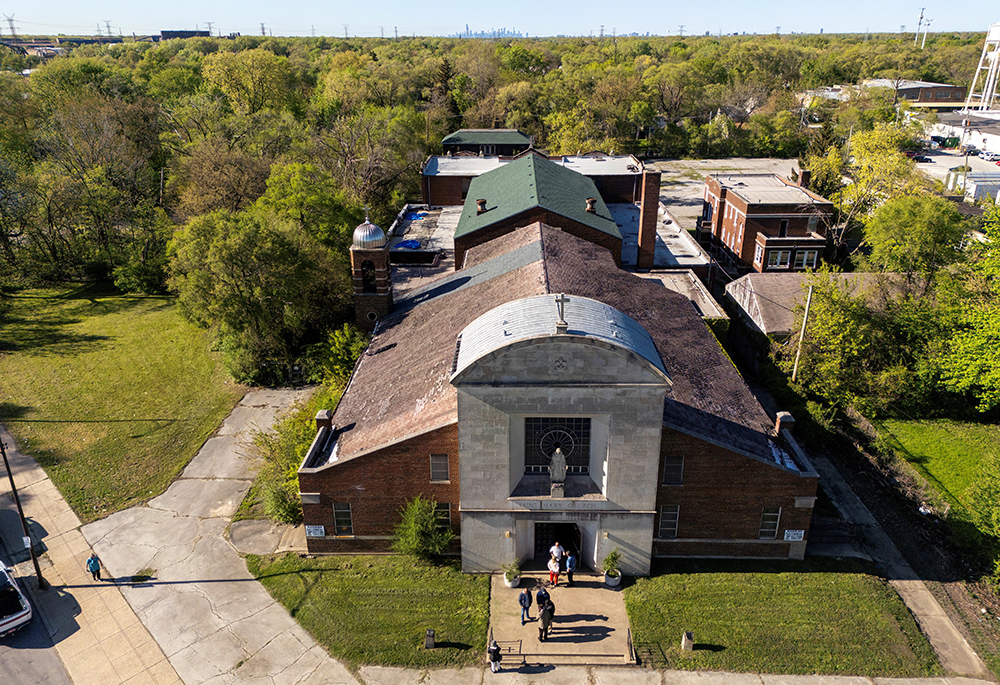
A drone view May 9, 2025, shows St. Mary of the Assumption Church at the very southern edge of Chicago, where Pope Leo XIV attended Mass with his family while he was growing up. (OSV News/Reuters/Carlos Osorio)
The abandoned St. Mary of the Assumption Church where the future pope once served as an altar boy now sits empty, with a gaping hole in the nave roof.
Despite the current struggling state of the church in these South Side suburbs of Dolton and South Holland, those same communities remarkably produced the first U.S.-born Pope Leo XIV (Dolton), the new Archbishop of New York Ronald A. Hicks (South Holland) and the prominent Chicago cleric Fr. John (Jack) J. Wall (Dolton).
Wall is a local hero and a beloved character in Chicago for his restoration and revival of the downtown St. Patrick's Church, one of the city's oldest public buildings. In his 24 years as pastor, he took St. Patrick's from the brink of closure with only 4 active members into one the city's most vibrant parishes with thousands of households in membership, a rare success story in recent church history.
Since 2007, Wall has served as president of the Chicago-based Catholic Extension Society that supports 87 dioceses around the country.
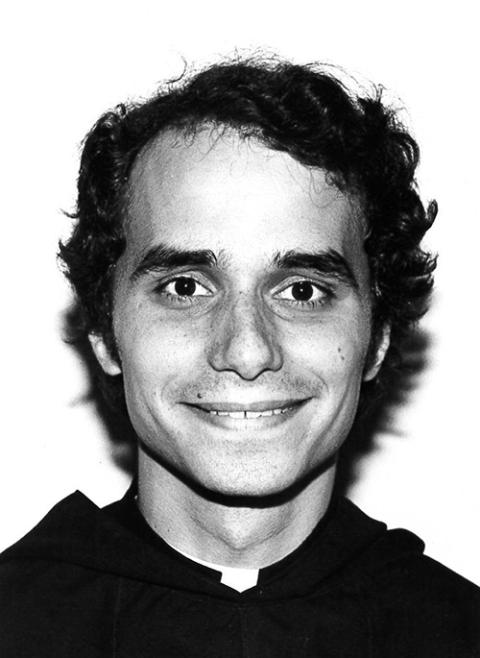
The future Pope Leo XIV, a young Robert Francis Prevost, is pictured in an undated photo. (OSV News/Augustinian Province of Our Mother of Good Counsel)
The amiable 84-year-old cleric delights in the fact that the new pope and Hicks each hail from essentially the same neighborhood as his. Hicks' childhood home, he points out, "is only two blocks south of our house in Dolton." After Leo's election, Wall conducted a video tour of Dolton, complete with his own lively commentary, and then posted it on the Catholic Extension website.
In a recent interview, Wall cited the New Testament story (John 1:46) in which the disciple Philip excitedly tells his friend Nathanael about Jesus of Nazareth and Nathanael responds, "Can anything good come out of Nazareth?"
Making the comparison, he joked: "You think, 'What good could ever come out of Dolton, Illinois?' Maybe it is something in the baptismal water."
Like many others, clergy and church historians alike, Wall thinks that despite his long absence from Chicago, Leo is a good fit for the place. The city changed. The church changed. But so did Robert Prevost, the future pope, who was just a young boy when Vatican II began to take hold. But he never lost his Chicago blue-collar values.
"The Mass was in Latin," Wall said. "He learned all his prayers in Latin as a server. When he graduated from grammar school the Vatican Council was just ending. So when he was in the middle grades there was this big transformation in the Catholic experience, but he really grew up in a pre-Vatican II experience as a young child at least. And then he moved beyond that into the Augustinian order in high school and beyond. He was really picking up all the shifts and changes that occurred at that time. But his early rootedness was here. And the first thing about Dolton is that it was a really blue-collar suburb."
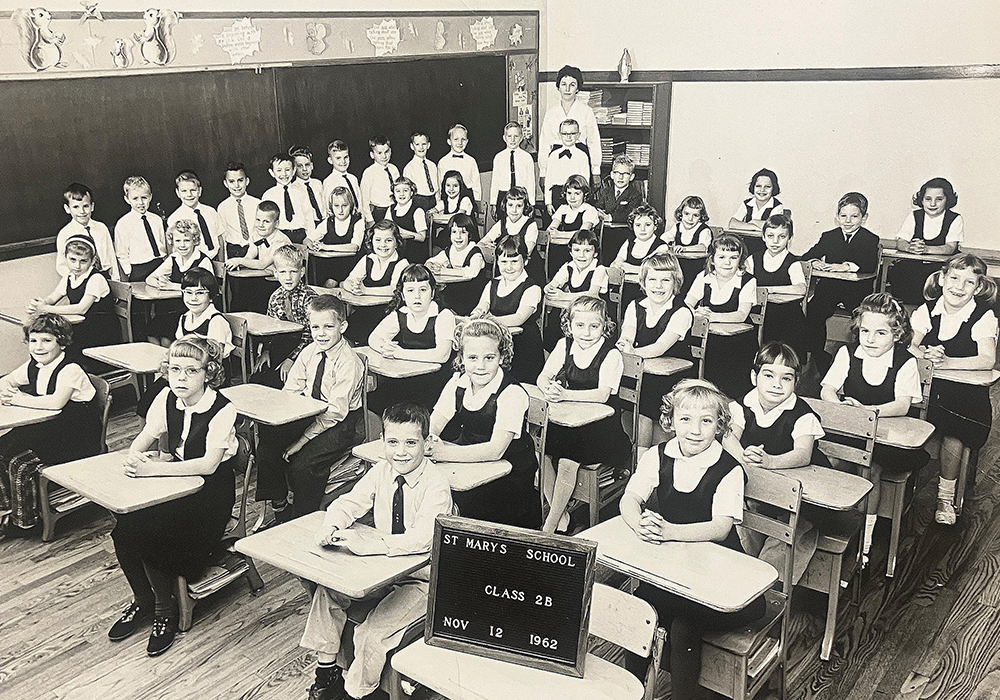
This photo shows the second-grade class of Robert Prevost, now Pope Leo XIV, at St. Mary of the Assumption School in Riverdale, Ill., in 1962. He is the fourth boy standing next to the blackboard. The Sisters of Christian Charity taught the future pope at the school. (OSV News/Courtesy of Province of the Sisters of Christian Charity in Mendham, New Jersey)
After Leo's election, Henry Louis Gates Jr., Harvard University professor and "Finding Your Roots" television host, presented the new pope with genealogical research. According to PBS News, a majority of the pope's ancestors came from France, with others from Italy, Spain, the U.S., Cuba, Canada, Haiti and Guadeloupe, and 17 of his ancestors were Black.
Calling it one of the most diverse backgrounds he and his team had ever researched, Gates wrote in The New York Times that Leo descended from "noblemen, enslaved people, freedom fighters and slaveholders." This polyhued background has allowed some to describe Leo as the world's first Black pope, an idea that plays well to a substantial portion of the Chicago population.
Historian McMahon, professor emerita at Lewis College, thinks the pope's recently revealed ethnic roots will help him in the increasingly diverse world of Chicago and beyond.
"The heterogeneity of Prevost's family history," McMahon wrote in a recent academic paper, "is quintessentially an American saga as well as reflective of the diversity of the Midwest."
Advertisement
Leo's impressive skill with languages can perhaps be traced to his paternal grandfather.
Sicilian-born Salvatore Giovanni Gaetano Riggitano Alito taught Romance languages in Quincy, Illinois, and had an extramarital relationship with Suzanne Louise Marie Fontaine, a Frenchwoman, that produced two children, including Leo's father, Louis, according to the report in The New York Times Magazine. The surname Prévost was taken from Fontaine's maternal grandmother.
Historian John T. McGreevy, provost at the University of Notre Dame and author of Catholicism: A Global History from the French Revolution to Pope Francis, thinks that the pope's skill with languages will help Leo navigate his way forward.
"He's certainly an American, but he is also a Peruvian citizen and as an Augustinian leader he's traveled the whole world," McGreevy said. "He was in South Korea and Rwanda and anywhere there's a group of Augustinians. He went there and visited them. That makes him a kind of global Catholic citizen. People I know who have met him say his Spanish and Italian are idiomatic."
The Spanish fluency will certainly help him spread the Gospel here in Chicago and other major American cities, as according to Pew Research Center Latinos are among the fastest growing racial or ethnic groups in the U.S.
According to a CARA/FutureChurch report studying the Chicago archdiocese between 1970 and 2020, the white/Anglo population decreased by 40%; the black population increased by 5%, while the Hispanic/Latino population increased by 422%.
The archdiocese reports that there are 261 Saturday/Sunday Masses conducted in Spanish each week compared to 768 in English, but the Spanish Masses are better attended.
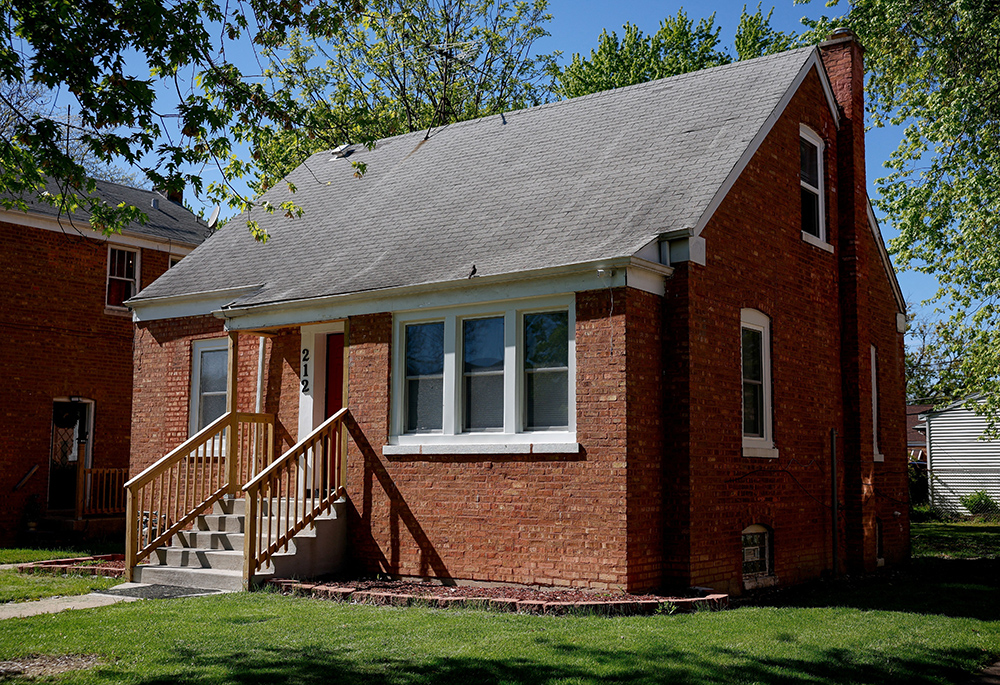
Pope Leo XIV's childhood home in Dolton, Illinois, a suburb of Chicago, is pictured May 9, 2025. Dolton's board of trustees on Dec. 1 approved a motion to officially declare the house a historic landmark. Shortly after the former Cardinal Robert Prevost was elected pope, the board purchased the residence in July for $375,000. (OSV News/Reuters/Carlos Osorio)
McGreevy feels that despite his long absences from Chicago, the young Robert Prevost would have been aware of the racial tensions and upheaval back home. The future pope was still living at home in Dolton when the Rev. Martin Luther King, Jr., came to Chicago in 1966 to push for open housing. On Aug. 5, 1966, King was stoned by a white crowd in Marquette Park, after which he said, "I've been in many demonstrations all across the South, but I can say that I have never seen, even in Mississippi and Alabama, mobs as hostile and as hate-filled as I've seen here in Chicago."
Later, while at the St. Augustine Seminary High School in Holland, Michigan, Prevost would almost certainly have been aware of the actions of Chicago priest Fr. Francis X. Lawlor — like Prevost an Augustinian. As the Chicago Tribune reported in Lawlor's obituary, the priest was "a high school teacher in the late 1960s when he came to citywide attention for efforts some decried as racist to slow the movement of African-Americans into white neighborhoods on Chicago’s Southwest Side." He led a coalition of block clubs "as large numbers of blacks began to move into the area between Ashland and Western avenues."
"I'm sure the kids at that high school knew about Lawlor," said McGreevy, whose scholarship includes the book Parish Boundaries: The Catholic Encounter with Race in the Twentieth-Century Urban North, which explores urban parishes and race in the United States.. "I'm sure of it. But what did they make of it? I suspect he was embarrassing to them."
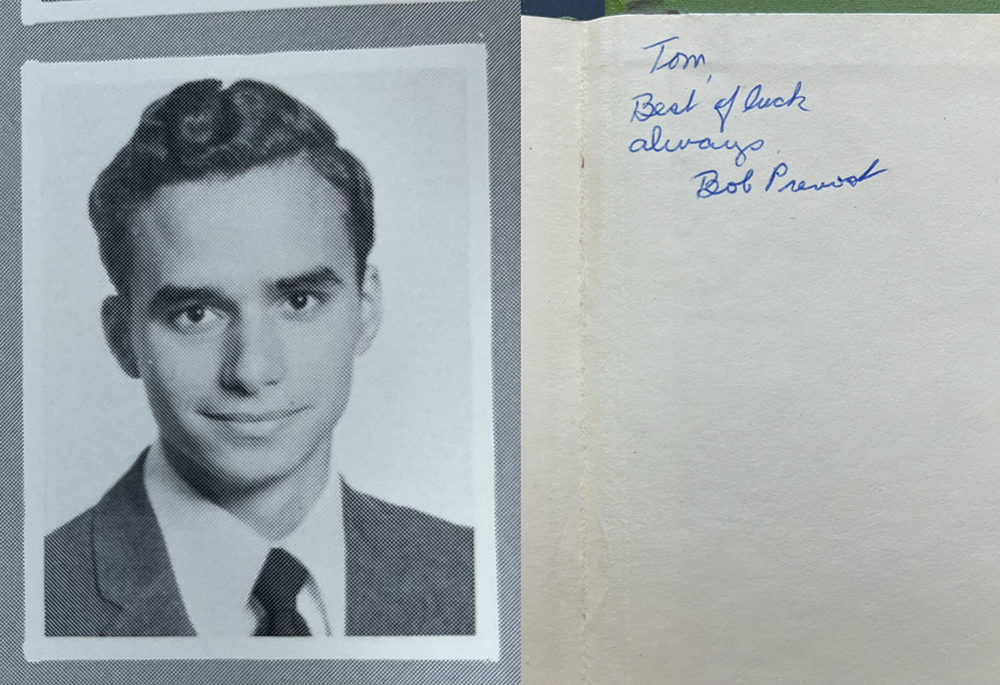
A photo of a young Robert Prevost, the future Pope Leo XIV, taken from his high school yearbook is seen next to his signature. He spent most of his childhood in the greater Chicago area, but he attended high school at the now-closed St. Augustine Seminary High School in Holland, Michigan. The former Cardinal Prevost, an Augustinian, was elected to the papacy May 8, 2025, becoming the first U.S. pope in history. (OSV News/Courtesy of Fr. Becket Franks)
Some Catholics in Chicago see in Leo a global figure promoting peace, as well as an American familiar with issues of racial injustice, and stand behind him.
Fr. Michael L. Pfleger is senior pastor at St. Sabina Church on Chicago's South Side, a thriving, now-predominantly Black parish that in the 1960s lost most of its then-white membership following a series of racially charged events, including the 1965 shooting death of white teenager Frank Kelly outside the church. Another teen, Cindy Celebrate, was wounded in the shooting.
According to Robert McClory, in his book Radical Disciple: Father Pfleger, St. Sabina Church, and the Fight for Social Justice, witnesses said two young Black people fired into a crowd of white teens leaving a community center. (McClory, journalist and NCR contributor, was a former priest who served as associate pastor at St. Sabina.)
In a city brimming with racial tensions, it was a pivotal event that accelerated white flight and emptied many of the old Euro-ethnic parishes of their white enrollments.
"The next day," recalled the former Cindy Celebrate, who now uses her original Italian surname, Calabretta, "my father moved us out of there because he was afraid. He took me out of [St. Sabina] school and put the house up for sale. It sold quickly."
According to St. Sabina annual reports, published in McMahon’s What Parish are You From?, enrollment at the parish dropped from 2,930 at the beginning of 1965 to 530 by 1967.
A charismatic and controversial figure in the Chicago church, Pfleger has restored the parish — renamed The Faith Community St. Sabina — which in addition to Masses hosts peace marches and block parties. Like many here, he is a strong supporter of Leo. And like others, he was outraged over President Donald Trump's and Vice President JD Vance's criticism of Leo because of his opposition to the war in Iran. After Sunday Mass on April 19, Pfleger, who is white, held a press conference in the church sanctuary under a huge portrait of a black Jesus.
"Shall we stand here today in support of Pope Leo? Yes!" Pfleger said in front of several hundred communicants who stayed after Mass. "And we stand here to condemn the unjust and manufactured war that Trump has got us into in Iran."
The administration's criticism of the pope also riled Cynthia "Cindy" Calabretta. Now 75 years old and retired with her husband in Ft. Myers, Florida, Calabretta says the 1965 shooting left her with a strong fear of guns, but that she opposes racism in all forms.
Although she considers herself more of a New Yorker after years of work there in the fashion industry, she reverts to her Chicago roots in her anger over the Trump administration's criticism of the pope.
"I try not to be political," she said in a recent telephone interview. "But this whole thing with the pope has offended me terribly. He's a holy man. Leave him alone. But I keep thinking. He's from the South Side of Chicago. I don't think you want to mess with this guy."