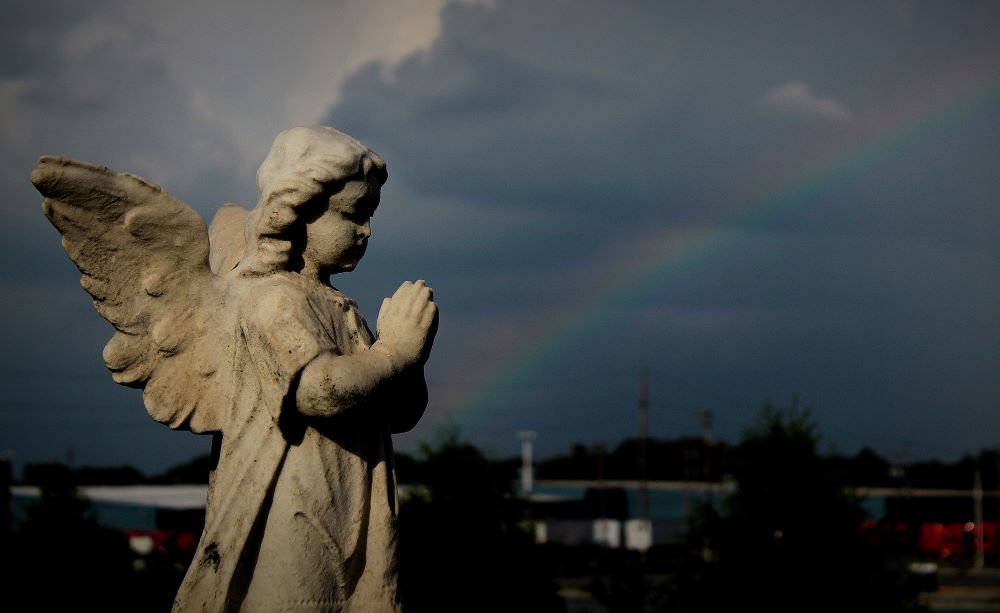
A rainbow appears in the distance near an angel grave marker following a thunderstorm at St. Patrick Catholic Cemetery in Neenah, Wisconsin. (CNS/The Compass/Brad Birkholz)

by Carol Zimmermann
Join the Conversation
Send your thoughts to Letters to the Editor. Learn more
A parish announcement about a support group for those grieving the loss of a loved one struck a chord with me but not for obvious reasons.
I wasn't grieving the dead.
But I did wonder if there could be a similar group for those experiencing an ongoing loss of a loved one (as they had once been or could be) due to mental health issues.
Ideally, it seemed like this would provide a unique setting for people to support each other, connected by their shared faith.
Was this too much to ask? I was pretty sure something like this existed since the Diocese of Phoenix, Arizona, set up a diocesan mental health ministry office in 2022 and a year later the U.S. bishops launched a campaign to address mental health issues. But maybe this hadn't fully found its way to U.S. parishes yet.
When I looked online, I found some related programs at a few area churches but none close to me. I mentioned this to someone on our parish staff and was urged to consider helping get a group like this going at our own parish.
I wasn't ready for that but I wasn't wrong to think it would be a good fit.
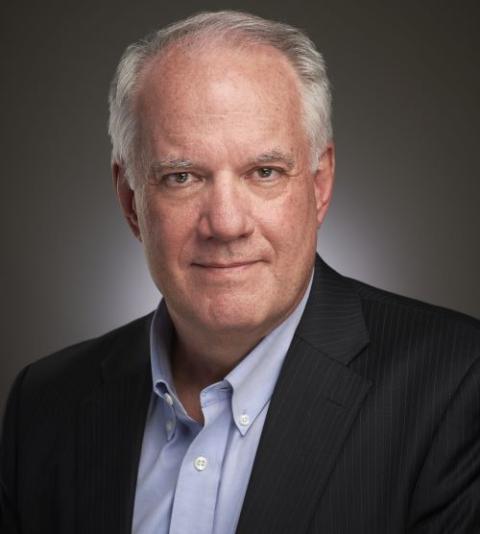
Deacon Ed Shoener is president of the Association of Catholic Health Ministers. (Courtesy of Ed Shoener)
In fact, as Deacon Ed Shoener, president of the Association of Catholic Mental Health Ministers, sees it, the parish is the perfect spot to bring people together to "share one another's burdens," to paraphrase St. Paul.
He said it "speaks volumes" if discussions or spiritual support groups on mental health take place in parish halls where people going through the same things can support each other akin to what grief ministry groups do. Those support groups "don't make the grief go away but they help people to live with grief and to find God in the midst of it," he said. Or put another way: "In any kind of suffering, mental health or grief, we are Christ to each other."
Shoener, from St. Patrick's Cathedral in Scranton, Pennsylvania, says he hopes that one day the Catholic Church will be known as the place people can go — not for therapy or counseling — but for faith-based support in dealing with mental health issues that complements professional treatment.
I reached out to him since May is Mental Health Awareness month and I was curious about just how aware, or active, the Catholic Church was on this issue.
'In any kind of suffering, mental health or grief, we are Christ to each other.'
—Deacon Ed Shoener
He acknowledged that the church, like society in general, had been relatively quiet about mental health until more recently because of the stigma often attached to it.
He told Catholic Health World that after his daughter Katie's first suicide attempt in 2005, his parish church "was the last place" he would have gone for help. "The church didn't know what to do," he said, about supporting people with mental illness and their families.
And then after she died by suicide in 2016, Shoener felt driven to do more to help connect people who might be going through similar struggles and feel alone. Three years later he formed the international ministry group that has since provided free resources and training to at least 50 dioceses across the country.
It wasn't just his daughter's death which prompted the deacon to this work; it was the viral response he received to the obituary he wrote about her, emphasizing how she had struggled with bipolar disorder but how she should not, even in death, be defined by that.
"In the case of mental illness there is so much fear, ignorance and hurtful attitudes that the people who suffer from mental illness needlessly suffer further," Shoener wrote. After the obituary was published in the Scranton Times, he said he was overwhelmed by the number of people who reached out to him thanking him for his candor. This led him to realize how so many people need support in acknowledging family members' suffering and that the church needs to do more to help.
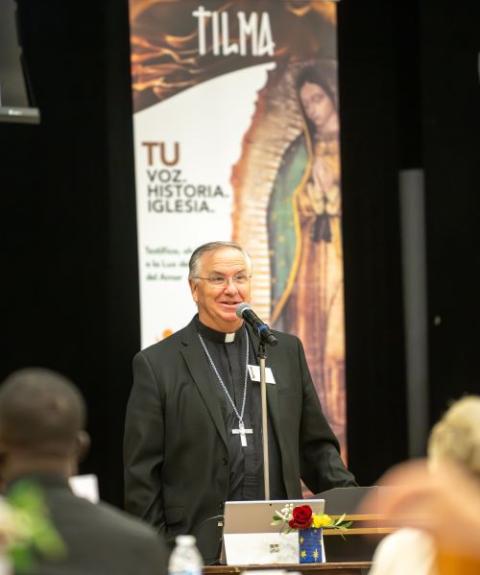
Phoenix Bishop John Dolan speaks at a synod assembly for the Synod of Young Adults at Ss. Simon and Jude Cathedral Parish in Phoenix Feb. 14, 2026. The Diocese of Phoenix, Arizona, set up a diocesan mental health ministry office in 2022. (OSV News/Diocese of Phoenix/Brett Meister)
And this is starting to happen, maybe in part because church leaders, like Phoenix Bishop John Dolan, are talking more frankly about mental health. Dolan, who lost three siblings and an in-law to suicide, has spoken out about the church's need to accompany those suffering from mental illness and their families and has recognized that the church has also not always been the best support.
In a 2023 column he wrote that he had "personally witnessed a pastor chastise a family at the funeral Mass of their child who had died by suicide." He said the priest told the family "if they had been going to Mass as they should have been, this never would have happened," which the bishop described as "missing the mark — egregiously so."
As Dolan sees it, what parishes should be doing, and have started in his diocese, is essentially what the church likes to define as accompaniment — walking with people.
This is happening in Masses celebrated in dioceses around the country praying for those with mental health conditions and their caregivers. It's also been seen anecdotally. One church leader mentioned that every year some candidates are taking Dymphna — the seventh-century Irish teen saint who is the patron saint of people experiencing mental health challenges — as their confirmation name, which wasn't happening decades ago.
At an address earlier this year at the Franciscan School of Theology at the University of San Diego, Dolan said those involved in mental health ministry are "not called to fix, but to remain. To listen. To walk with. To be present."
He also said this work was necessary to "respond pastorally to the realities people are living."
And that reality, according to figures by the National Alliance on Mental Illness is that 23.4% of U.S. adults experienced mental illness in 2024 — or more than 1 in 5 adults — and 16.5% of youth in the U.S experienced a mental health disorder in 2016 — more than 1 in 7 youths.
Advertisement
The St. Dymphna Ministry at St. Ann's Parish in Washington, D.C., points out this statistic on its website and notes that since so many have navigated mental health struggles "it is certain that nearly every person sitting in our pews has personally encountered these trials or walked alongside a friend or family member who has."
The parish was offering an eight-week course on mental health and the church this spring called the "Sanctuary Course for Catholics."
The title seems fitting, as the church, in its finer moments, offers sanctuary for many — not necessarily in the form of a hiding place but as a way to help people move forward and find healing, whether in search of employment, food or shelter, legal aid amid deportation threats or prayers while in prison.
And as Dolan said in his talk about mental health ministry (that also rings true for church outreach in general) — the work is not so much about bringing God to people but instead that we "encounter him among them."