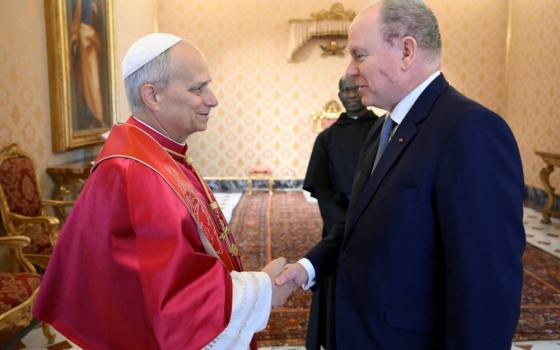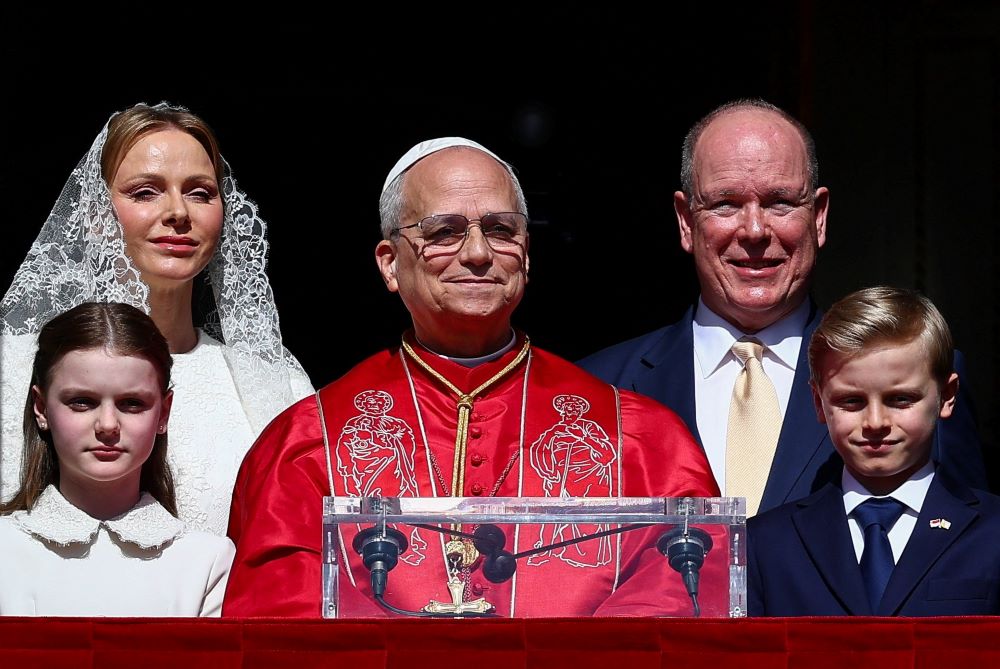
Pope Leo XIV greets the public with Prince Albert II of Monaco, Princess Charlene, Prince Jacques and Princess Gabriella at the Prince's Palace in Monaco-Ville, Monaco, March 28, during his second apostolic journey. The palace's state apartments were created in the 16th century and later remodeled on that of those at Versailles. (CNS/Lola Gomez)

Join the Conversation
Send your thoughts to Letters to the Editor. Learn more
From the glimmering coastline of Europe's playground for the rich, Pope Leo XIV decried "the unjust configurations of power" that entrench wealth for some while pushing others to the margins.
God disrupts "those structures of sin that create chasms between the poor and the rich, between the privileged and the discarded, between friends and enemies," Leo said March 28 in French from the balcony of the Prince's Palace, overlooking the microstate’s famed Formula One circuit, during his daylong visit to Monaco.
In a country where 1 in 3 of its 39,000 residents is a millionaire, Leo, standing alongside the Catholic sovereign Prince Albert II, insisted that "every good placed in our hands has a universal destination; it bears an intrinsic need not to be held back, but to be shared, so that everyone's life may be better."
During his nine-hour visit to Monaco, the second international trip of his pontificate and the first time a pope has set foot in the principality since the 16th century, Leo made the case for Catholic social teaching, linking the church's care for the poor to the defense of human life in one of the few European countries where Catholicism is enshrined as the state religion and where legal access to abortion is heavily restricted.
Monaco's size and rich religious heritage — the country's founding is traced back to a nobleman seizing an enemy castle while disguised as a Catholic monk — "invite you to put your prosperity at the service of law and justice, especially when the display of power and the logic of oppression are harming the world and jeopardizing peace," the pope said.
Long known as a tax haven, Monaco has attracted wealthy residents for decades with its absence of personal income, capital gains and property taxes, while also drawing scrutiny as a potential money-laundering risk.
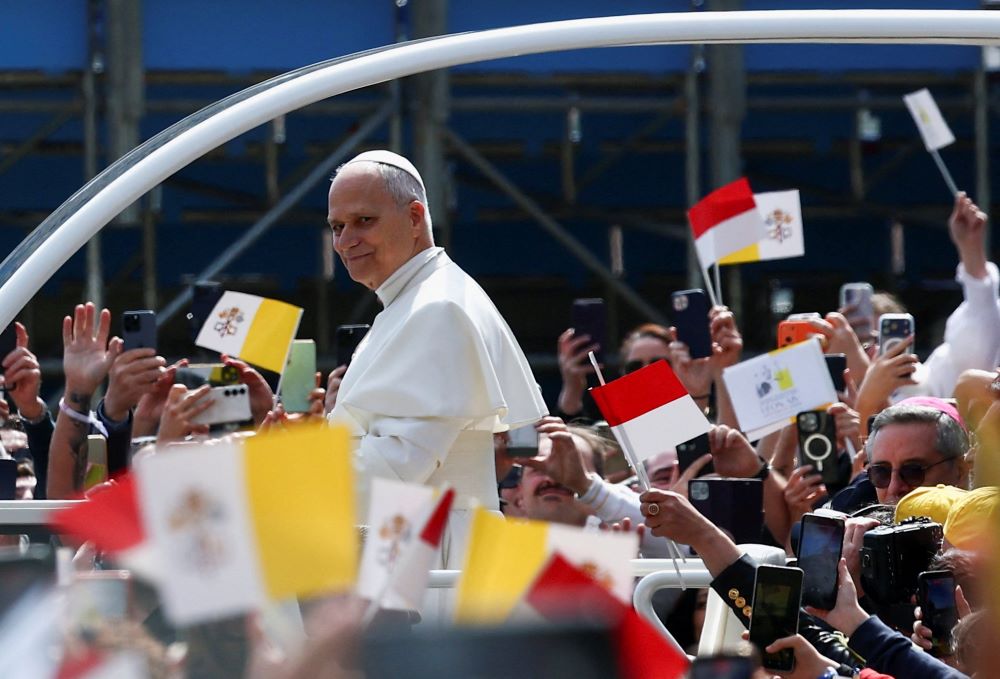
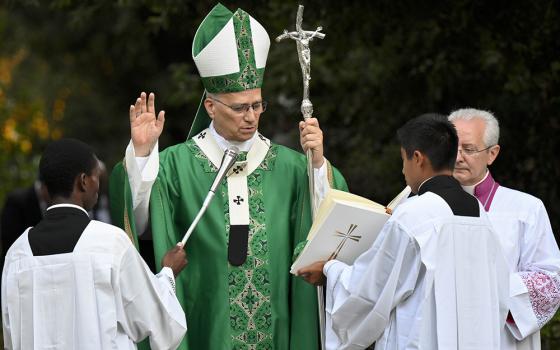
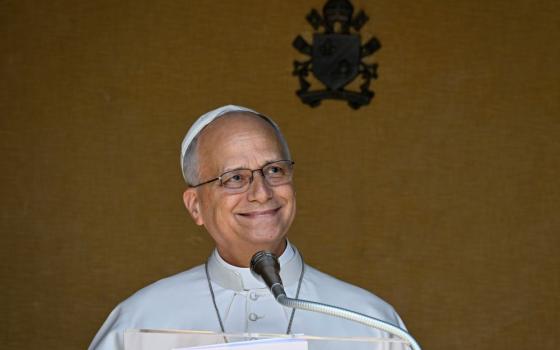
Pope Leo XIV smiles as he arrives at the church of St. Devota for a meeting with young people and catechumens, as part of a one-day trip in Monaco, March 28. It is Leo's first international journey of 2026 and only the second of his pontificate. (OSV News/Reuters/Guglielmo Mangiapane)
Atypical for a papal trip, Leo arrived in Monaco by helicopter directly from the Vatican while members of the papal entourage and press corps flew into nearby Nice, France. The world’s second-smallest nation after Vatican City, the principality has no airport; the route therefore allowed the pope to avoid triggering the diplomatic protocols that would accompany an official landing on French territory.
Leo was received in the decorous digs of the palace, which display 600 square meters of frescoes in its courtyard. In contrast, he gifted the prince a mosaic of St. Francis Assisi, associated with radical poverty. He gave a statue of the same saint to the local archbishop.
Monaco's resident population, an estimated 82% of whom are Catholic, more than doubles each day with the arrival of 30,000-45,000 foreign workers who commute daily into the microstate to sustain the local economy, often working low-wage jobs.
Yet despite the socioeconomic difference present in Monagese society, "in the church, such variety should never become the occasion of division," Leo said in a meeting with Monaco's Catholic community in the Cathedral of the Immaculate Conception. The cathedral houses the tomb of the actress-turned-princess Grace Kelly, the Philadelphia native who married into the Monegasque royal family.
Unlike Pope Francis' international trips, Leo's nine-hour visit to Monaco did not include a dedicated meeting with a marginalized group or an interreligious encounter.
'Peace is not merely a balance of power; it is the work of purified hearts, of those who see others as brothers and sisters to be protected, not enemies to be defeated.'
—Pope Leo XIV
But among Monaco's Catholics, Leo said Jesus' example to Christians cannot be reduced merely to the spiritual but includes "an important social and political dimension." He also called for the church to "offer new pathways capable of stemming the tide of secularism, which risks reducing humanity to individualism and basing social life on the production of wealth."
A principality for peace
Leo closed his time in Monaco by celebrating Mass in the Louis II Stadium, the first time he has celebrated Mass in a stadium as pope. In keeping with Monaco's scale, the venue held some 18,000 people.
In his homily, the pope shifted his focus toward peace, calling for Christians to purify their hearts in a world marked by violence, for "the wars that stain it with blood are the fruit of the idolatry of power and money."
"Every life cut short wounds the body of Christ," he said. "Let us not grow accustomed to the clamor of weapons and the images of war!"
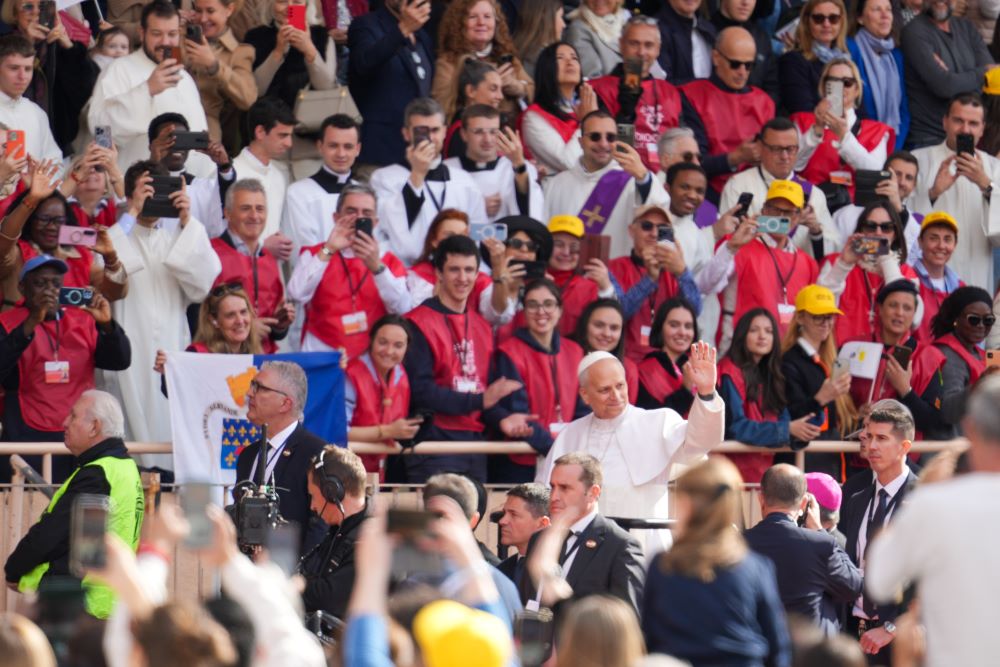
Pope Leo XIV arrives at Louis II Stadium in Monte Carlo, Monaco, March 28, 2026, during his second apostolic journey. The multisport stadium in the Fontvieille district was completed in 1985 and seats 18,523 people. (CNS/Lola Gomez)
Monaco, which hosts an international institute dedicated to peace founded in 1903, is a natural ally for the Vatican in its advocacy for peace on the global stage due to its small size and military interests.
Prior to the pope's trip, Cardinal Pietro Parolin, Vatican secretary of state, told Vatican News that "small nations prove to be natural guardians of multilateralism" and "represent an essential bulwark against authoritarian tendencies."
"Today, international influence is no longer measured solely by military strength, but by moral credibility and the ability to act as neutral bridges for reconciliation," he said.
In his homily, the pope linked that advocacy for peace with the spiritual, stating that "peace is not merely a balance of power; it is the work of purified hearts, of those who see others as brothers and sisters to be protected, not enemies to be defeated."
"Even today, how many plots are devised around the world to kill the innocent!" he said.
The question of human dignity also hovered over the visit, particularly following Prince Albert’s 2025 decision not to sign into law a bill that would have legalized elective abortion, citing the country's religious identity.
Throughout the day, Leo returned repeatedly to the theme, saying at Mass that God’s mercy "nurtures every human life in all its frailty, from the moment it grows in the womb until it withers away."
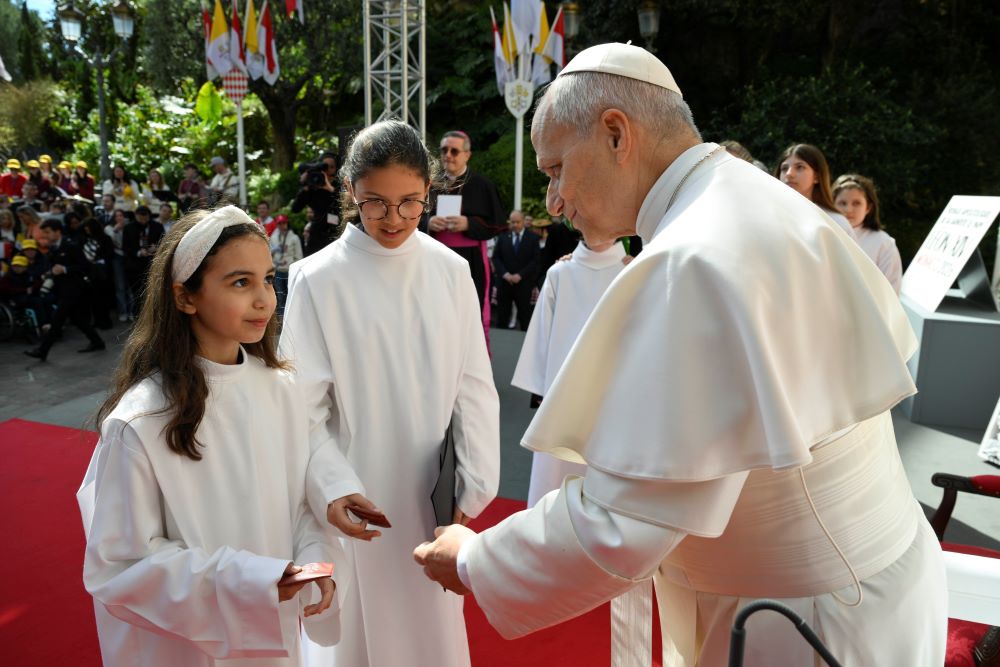
Pope Leo XIV presents young women with gifts as he leads a meeting with young people and catechumens outside the church of St. Devota, as part of a one-day apostolic trip in Monaco, March 28. (OSV News/Vatican Media/Simone Risoluti)
Meeting with youth in a frenzied world
Amid reports of renewed religious interest in neighboring France as well as the United States, Leo met with Monegasque young people and catechumens preparing to enter the church at the Chapel of Ste.-Dévote, the principality's patron saint.
The chapel is home to one of six parishes in the entire country. Many in the crowd waved flags of their Catholic schools, and families watched the meeting from the balconies of their homes above the small valley where the church is situated.
In the midst of a constant stream of "messages, reels and chats," the pope said, young people must seek moments of silence and reflection to strengthen their relationship with God.
As Leo spoke, blaring horns of yachts docked in the nearby harbor rang out for several minutes to celebrate the pope's arrival, and they drowned out much of the pope's speech. The horns grew even louder as he spoke on finding peace in God's love.
"Us too, we also want peace!" he said with a smile, in a joke about hoping the honking would come to an end.
Monaco's archbishop, Dominique-Marie David, told Italian daily Avvenire ahead of the pope's trip that the record number of adult baptisms in Monaco in recent years reflected a "growing phenomenon" of people rediscovering the faith later in life throughout the archdiocese.
Advertisement
The pope told those preparing to enter the church to "incorporate the Gospel into the choices you make at work and in your social and political commitments in order to give a voice to the voiceless, thereby spreading a culture of care."
And to the young people present, Leo held before them the example of St. Carlo Acutis, the Italian teen the pope canonized in September and who he referenced four times in his speech to young people in Monaco.
Sandra Castellacci, a Monaco native who attended the pope's speech at the Prince's Palace with her husband and two young daughters – who she proudly said attend a local Catholic school — told the National Catholic Reporter that "it was important for the new generation, who are more involved in religion, to hear the pope's message."
"It's important to give them a base in life, it's fundamental, and with everything happening today it has become more important for people to draw near to the church and to their roots," she said.
The National Catholic Reporter's Rome Bureau is made possible in part by the generosity of Joan and Bob McGrath.