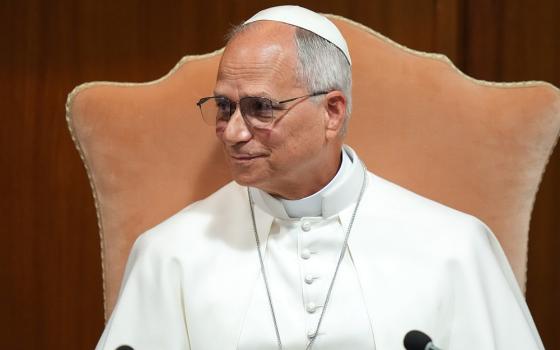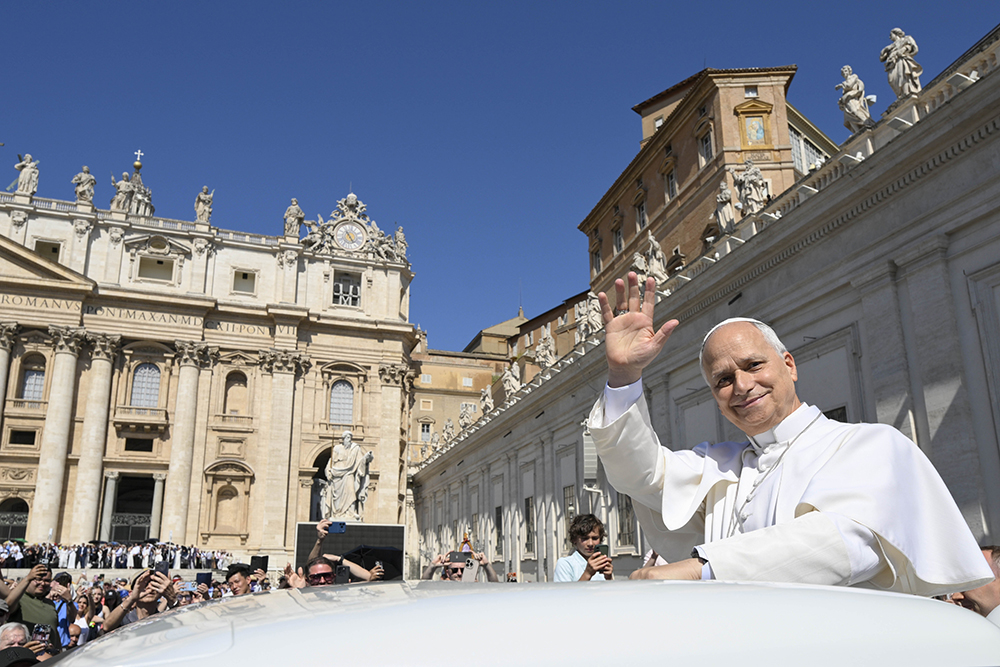
Pope Leo XIV greets visitors and pilgrims from the popemobile while riding around St. Peter’s Square at the Vatican before his weekly general audience May 27, 2026. (CNS/Vatican Media)

Join the Conversation
Send your thoughts to Letters to the Editor. Learn more
We are all still digesting Pope Leo XIV's first encyclical Magnifica Humanitas and wondering what difference it will make. What are the next steps in implementing the vision of Catholic social doctrine?
The pope gave us one idea when he included a significant section on the importance of education. Leo noted: "Without careful attention, an educational system lacking in a love for truth may emerge, in which an incessant flow of information replaces the essential exercise of research, reflection and discernment." Unlike Yale University, Leo's understanding of the goals of education consider the whole person, as he calls for "teaching students a sense of moderation and limits; recognition of the rights of others and of future generations to enjoy the goods that are either provided for us or made available by human ingenuity; freedom and responsibility; and a sense of transcendence and the common good."
On other issues addressed in the document, Leo can start in his own backyard, by asking the church to live by the vision of its own doctrine. As St. Paul VI said in his 1975 apostolic exhortation Evangelii nuntiandi, "Modern man listens more willingly to witnesses than to teachers, and if he does listen to teachers, it is because they are witnesses." How can the church witness to the truths contained in Magnifica Humanitas?
The pope, and indeed the entire tradition of Catholic social doctrine, warns against gross income inequality. In one of the more interesting passages of the text, Leo states:
Just laws and methods of redistribution are certainly necessary for correcting imbalances, including tax systems that lighten the burden on the weakest and ask for more from those with greater resources. However, the pursuit of social justice should not be considered a separate issue that follows only after the production of wealth, as if the economy existed solely to create wealth, with politicians only intervening afterwards in order to distribute it. Indeed, justice concerns every phase of economic activity, from resource acquisition to financing, and from production to consumption; every choice has moral consequences.
Advertisement
Could not the Catholic Church take the lead in addressing income inequality? Could not Rome ask each episcopal conference to establish a ratio between the highest and lowest paid employees of the church's ministries? I have written before about the scandal of executive salaries in our Catholic healthcare systems. These hospitals were built and sustained by religious women who had taken vows of poverty. Yet, in the 21st century, they have been entrusted to lay executives who demand multi-million dollar contracts and claim that they alone have the expertise needed to manage the increasingly complicated systems. We are Catholics. This isn't Harry Potter. We don't believe in wizards.
The same could be said for certain salaries in the educational sphere. I cheer for the University of Notre Dame all football season and I admire their head coach Marcus Freeman. But is he that much better at his job than someone who would demand less than the $7 million plus bonuses Freeman gets each year?
I can't think of a more powerful countercultural witness to the evil of income inequality than for the church's ministries to all commit to establishing a just ratio between what is paid to the CEO and what is paid to the housekeeper or the janitor.
Similarly, it would be good to see the Holy See remind its institutions that our church recognizes the rights of workers to organize. Earlier this year, St. John's University abrogated its union contract with school faculty. Last year, Loyola Marymount University in Los Angeles did the same. The next time a Jesuit lectures anyone about social justice, they first might want to ask their fellow Jesuits on the Loyola Marymount board why they voted to become union busters.
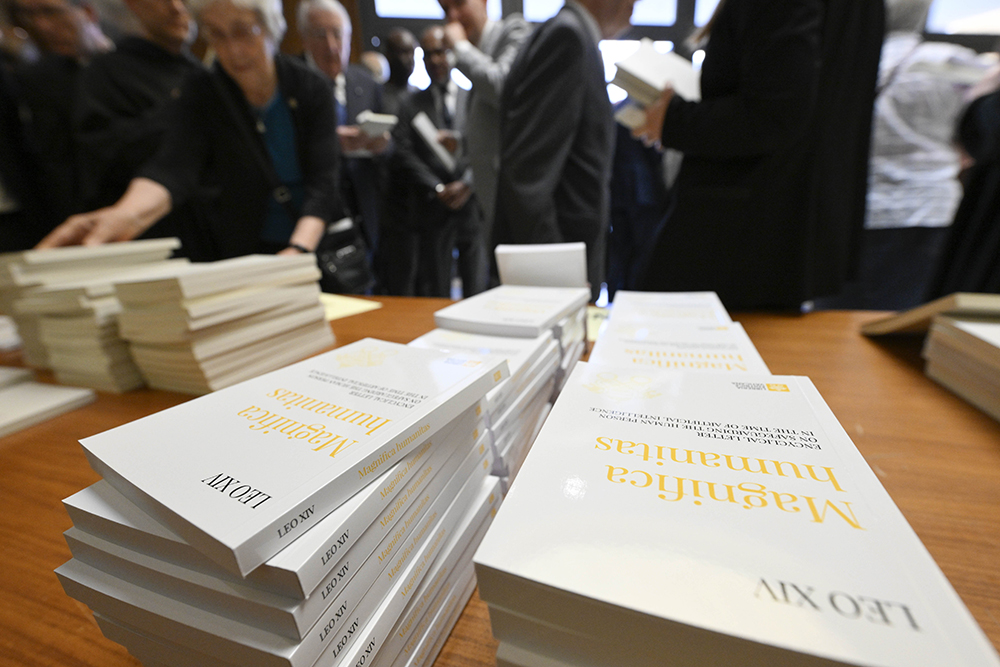
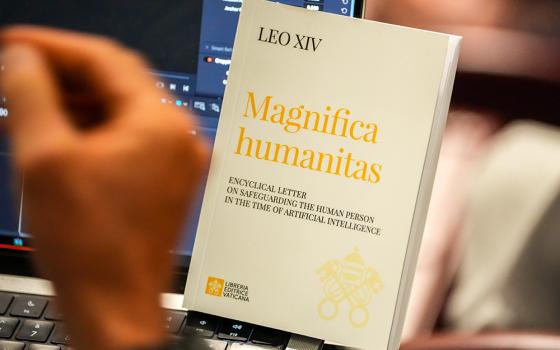
Copies of "Magnifica Humanitas" are seen at the Vatican's Synod Hall May 25, 2026, the first encyclical of Pope Leo XIV's papacy, which focuses on the rise of artificial intelligence. (OSV News/Vatican Media/Simone Risoluti)
Leo also raised the need to find other metrics for the economic health of a society than those most commonly employed by economists. "It is important to move beyond the current metrics of development — which for more than eighty years have been tied to the concept of Gross Domestic Product (GDP) — since these metrics almost systematically neglect aspects essential to the overall wellbeing of people and the environment." The Vatican has an academy for social sciences. They should be tasked with devising a "gross solidarity index" that measures things like access to healthcare, carbon emissions, income inequality, things that tell us something about the degree to which a society is living out the vision of Catholic social doctrine.
It is difficult to know how to proceed on the encyclical's central issue, artificial intelligence. One friend noted that when Laudato Si' was issued in 2015, there were already United Nations' agencies, governmental departments, and academic centers focusing on environmental issues. For AI it is not clear at all where to begin. I think the Holy See will act as a convener, and episcopal conferences and individual bishops should be reaching out to the AI industry in their areas to begin a dialogue. Given the current state of the U.S. bishops' conference, it is far from clear anyone should expect them to ramp up an effective program for dialogue and implementation.
The Catholic Church teaches, and we all have much to learn from what Pope Leo has taught in Magnifica Humanitas. The church is also a large organization with millions of employees in various ministries. If the church can show the world it is possible to conform to the goals of our own teaching, other people might be more attracted to that teaching. If not, we are a counter-witness, a noisy gong and clanging cymbal in a world crying out for justice.