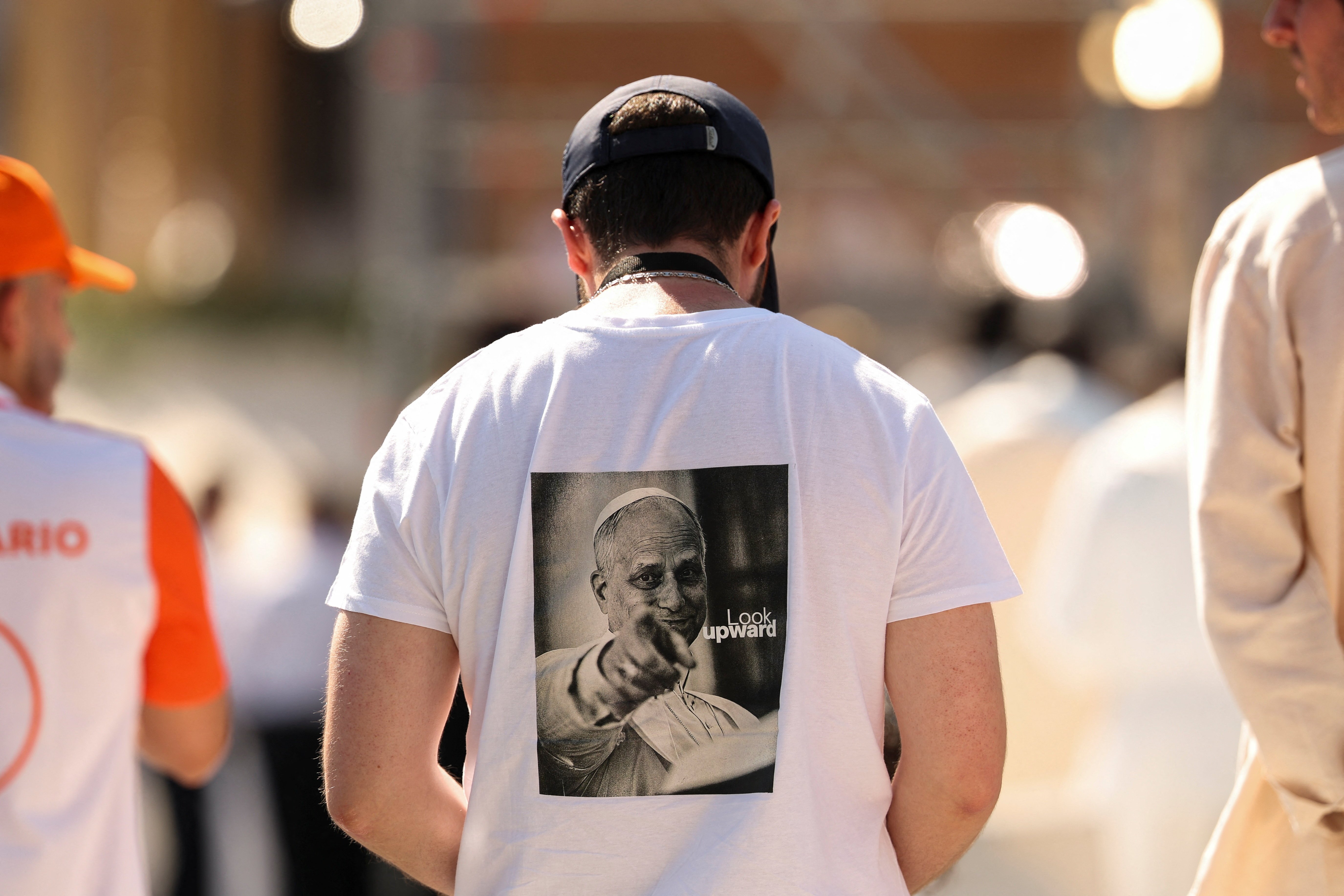
A man wears a T-shirt with an image of Pope Leo XIV as the pontiff celebrates Mass at Plaza de Cibeles in Madrid June 7, 2026, during his apostolic journey to Spain. (OSV News/Reuters/Violeta Santos Moura)
Join the Conversation
Send your thoughts to Letters to the Editor. Learn more
Pope Leo XIV brought bustling Madrid to a halt Sunday, drawing 1.2 million people — the largest crowd he has encountered yet in his 13-month pontificate — for his first public Mass in Spain and a Eucharistic procession through the Spanish capital.
Before the most public act of devotion of his seven-day visit to Spain — a Corpus Christi procession in which the pope carried the Eucharist through Madrid's streets — Leo said that religious practice cannot remain a "comfortable, private faith," prodding Spain's Catholics toward conversion marked by care for the poor and marginalized.
"The Christ who processes through the streets in the monstrance is the same one who identifies with the poor, the downtrodden, those who are alone and forsaken," he said in Madrid's Plaza de Cibales, where the city's four main roads meet at a fountain depicting the Greek goddess of fertility Cibele.
Leo celebrated Sunday Mass in Madrid on the second day of his seven-day trip through Spain on the feast of Corpus Christi, which celebrates what Catholics believe to be the real presence of Jesus Christ in the Eucharist.
"God is a real presence and that we too are called to be present in the realities and challenges of society, not shying away, but personally committing ourselves to the building of the common good."
Spanish authorities estimated that approximately 1.2 million people were in the square and surrounding streets for the Mass. The previous record for Leo's largest event as pope was the Jubilee for Youth where he celebrated Mass with a million young people outside Rome.
In Spain, which has a rich tradition of popular religious processions, Leo said that Eucharistic processions are "not merely a matter of bringing out the monstrance, but of allowing ourselves to be brought out of our selfishness and indifference, of a comfortable, private faith, so as to respond to his invitation to conversion, to change our perspective, and to welcome his presence which transforms us and makes us builders of a new world."
The pope's message comes as Eucharistic processions are becoming increasingly common in the United States; the U.S. bishops' conference organized an approximately $14 million congress in 2024 to draw people closer to the Eucharist which was preceded by a nationwide Eucharistic procession.
Leo said that such processions, which originated in medieval Europe in the 12th and 13th centuries, should not be "confined to wistful nostalgia" but an invitation to build a better future.
The pope tasked Spain's Catholics to ensure "to ensure that the religiosity which has shaped and defined this country for centuries is not a museum of the past to be visited, but a school of faith from which to draw even today."
"God is a real presence and that we too are called to be present in the realities and challenges of society, not shying away, but personally committing ourselves to the building of the common good," he said.
Hand fans fluttered throughout the sprawling crowds standing under the relentless Spanish sun as the pope spoke. Many stood on balconies or leaned out of windows looking out onto the square.
In a massive public spectacle of faith, 2,300 Eucharistic ministers descended upon the throngs to distribute communion during Mass. Leo then descended the stage, took up the monstrance and began to slowly walk through the barricaded streets as the faithful threw flower petals before him. Walking ahead of him were young children who had taken their first communion in the last year, dressed in their first communion attire.
Leo has been decidedly optimistic about the future of the church in Spain, a historically Catholic stronghold which has seen declining numbers of faithful amid increased secularization and the church's ongoing reckoning with the clergy sex abuse crisis.
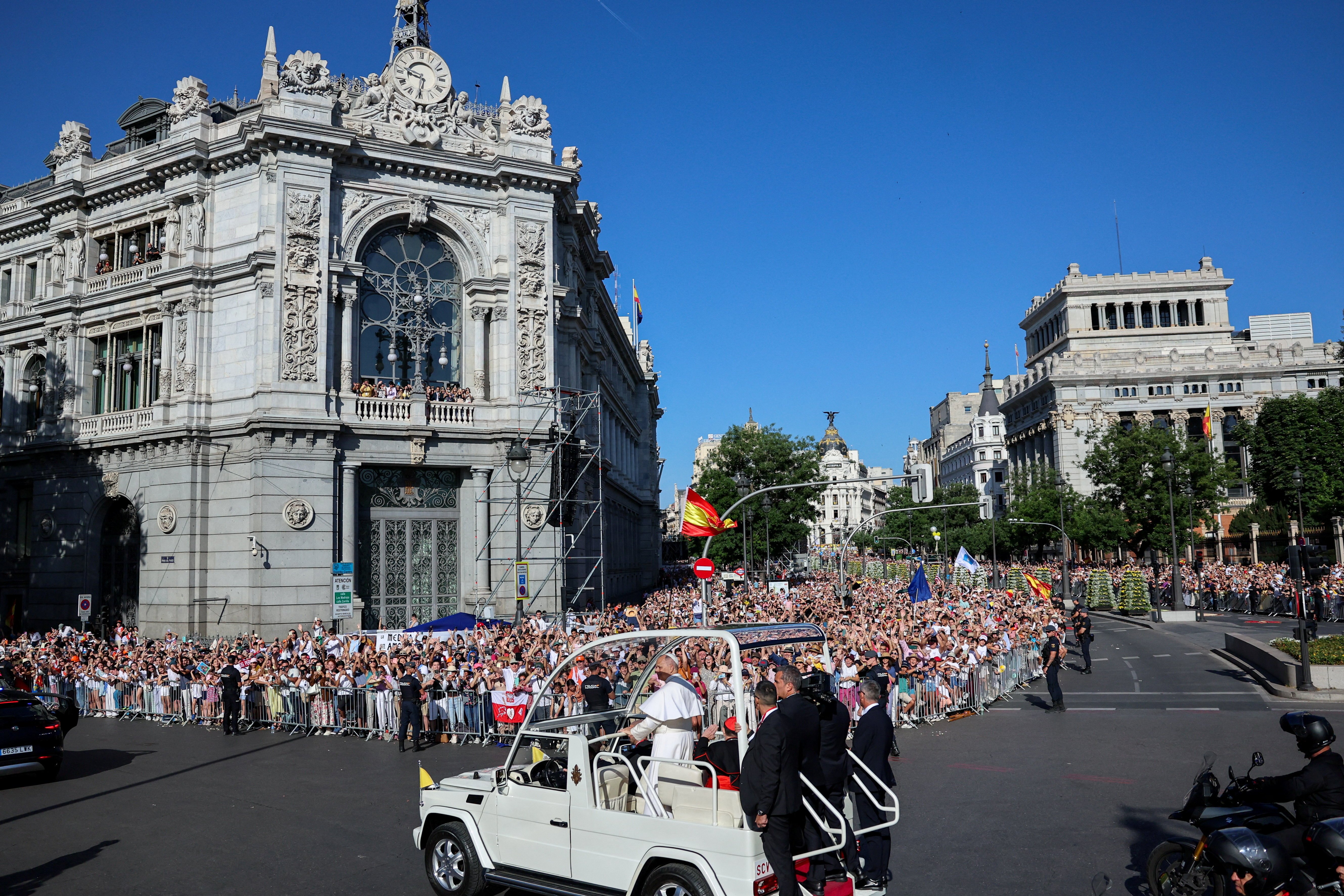
Pope Leo XIV rides on the popemobile ahead of Mass at Plaza de Cibeles in Madrid June 7, 2026, during his seven-day apostolic journey to Spain. (OSV News/Yara Nardi)
On his way to Spain he told reporters that young people are turning to religion in response to a lack of meaning in their lives and joked that, despite the concert of Puerto Rican musical sensation Bad Bunny overlapping with his Saturday evening prayer vigil, "there will also be a few there to see the pope."
Those "few" turned out to be half a million. Leo looked loose and lively before the massive crowd, going off script in his fluent Spanish and joking with the crowd. He emphatically told young people not to be afraid of pursuing religious vocations or marriage: "Do not be afraid of marriage and starting a family!" he said.
While the percentage of Spaniards who identify as Catholic has hovered around 50% in recent years — not entirely aligned with the narrative of a Catholic resurgence among young people — several young people at the vigil told National Catholic Reporter that the stigma against being religious has faded in recent years.
Advertisement
"There was a period with a lot of prejudice, in which people didn't want to risk saying what they thought, to show their faith, and I think that is changing," said Maria Lu Conejero, 29, from Madrid who attended the prayer vigil with the pope. "The young generations talk a lot about tolerance, about accepting each person's reality, religions, other ways of thinking about life."
Standing alongside the procession route at the pope's Sunday Mass, Felipe Sánchez Pedreño, 49, said that the turnout for the pope's Eucharistic procession "shows that Spanish Catholics are not insecure about showing, about having pride, in being [Catholic]."
"After several generations that might have had some kind of crisis of identity, young people today are strengthening their religion and want to make that clear," he told NCR. "I see it as something very positive, that goes beyond each person's politics, and it says a lot about the young people that are coming up the ranks – it's a source of pride without a doubt."
The National Catholic Reporter's Rome Bureau is made possible in part by the generosity of Joan and Bob McGrath.