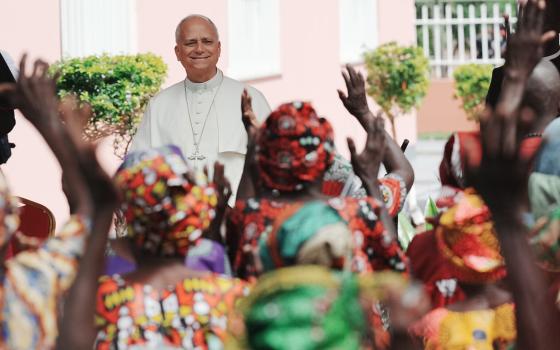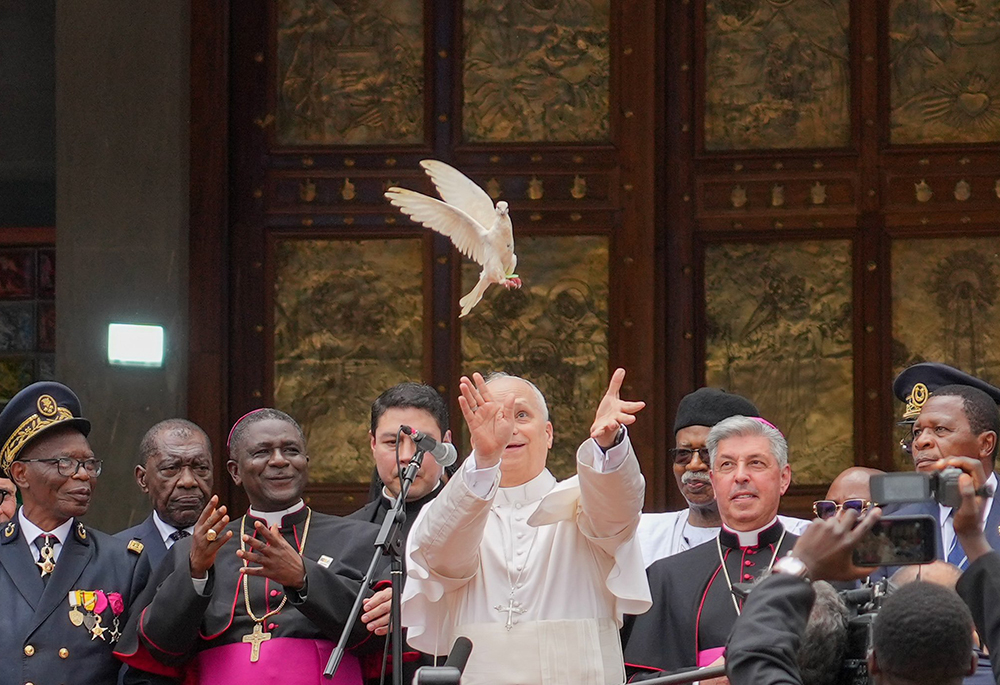
Pope Leo XIV releases a dove with community representatives at the conclusion of a peace meeting at St. Joseph Cathedral in Bamenda, Cameroon, April 16, 2026. (CNS/Lola Gomez)

Join the Conversation
Send your thoughts to Letters to the Editor. Learn more
"Welcome to the messenger of peace," proclaimed banners stretched across the streets of Yaoundé, where crowds waving palm leaves welcomed Pope Leo XIV on April 15 in a scene that recalled Jesus' triumphant entry into Jerusalem before his passion.
In Cameroon, where a brutal internal conflict driven by a cultural and linguistic division has divided the country since 2017, Leo's peace mission quickly became concrete: English-speaking separatists announced a three-day pause in fighting to coincide with the pope's visit.
On his second day in the Central African country, the morning after issuing a stark call in the country's capital for political leaders to break "the chains of corruption" that shackle them to the pursuit of profit, Leo traveled to the northwestern city of Bamenda in Cameroon's Anglophone northwest, where he delivered a plea for peace amid the violence that has plagued the region as well as to the world writ large.
Following claims of legal marginalization of English-speaking Cameroonians propagated by the Francophone-majority population, clashes broke out between separatist groups and the military in 2017 that have since killed more than 6,000 people and displaced more than 600,000 others, as AP reported.
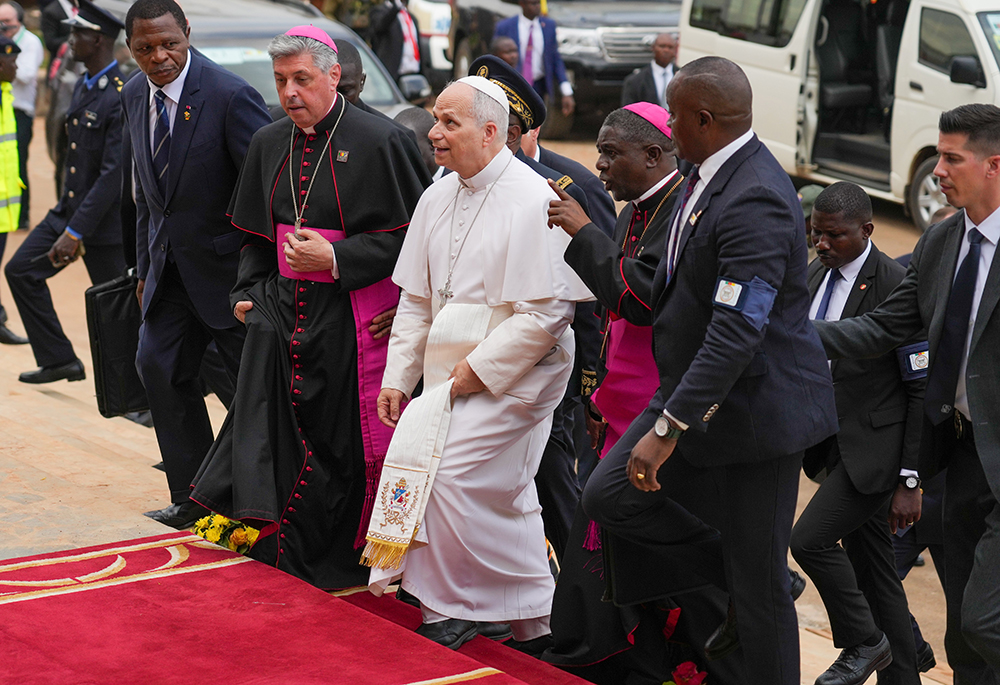
Pope Leo XIV arrives for a peace gathering at St. Joseph Cathedral in Bamenda, Cameroon, April 16, 2026. Bamenda is the largest city in Cameroon's two Anglophone regions, which have been engaged in a nine-year insurgency seeking separation from the country's Francophone regions. (CNS/Lola Gomez)
After arriving in Bamenda, the pope traveled in the popemobile on an unmarked concrete road winding through the forest to the Cathedral of St. Joseph, passing mudbrick houses with corrugated metal roofs and tens of thousands of shouting, singing and swaying Cameroonians lining the street. Many waved sugar cane plants, referred to as "peace plants" in the area and said to express a person's desire for peace.
From Cameroon, sometimes referred to as "Africa in miniature" because of its cultural diversity, the pope's message appeared oriented more toward the whole of Africa rather than his immediate surroundings, in addition to offering an admonition for the external powers that exploit the continent's resources.
"The world is being ravaged by a handful of tyrants," the U.S.-born pope proclaimed in English from the cathedral's altar. "The masters of war pretend not to know that it takes only a moment to destroy, yet often a lifetime is not enough to rebuild."
"Those who rob your land of its resources generally invest much of the profit in weapons, thus perpetuating an endless cycle of destabilization and death," he said. "They turn a blind eye to the fact that billions of dollars are spent on killing and devastation, yet the resources needed for healing, education and restoration are nowhere to be found."
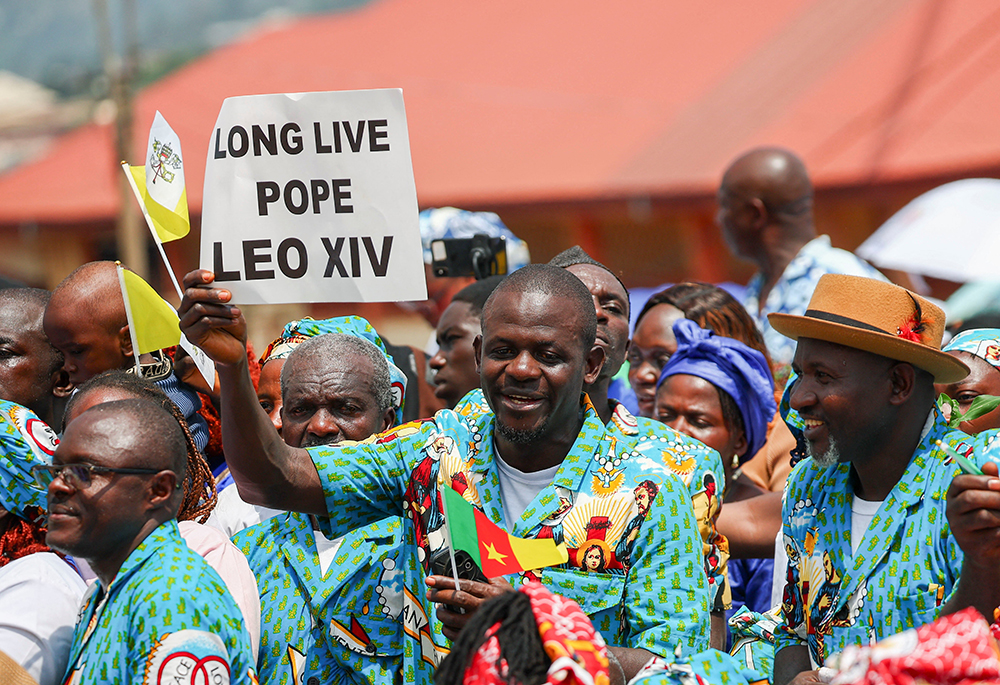
A man holds a sign as people gather outside St. Joseph's Cathedral in Bamenda, Cameroon, April 16, 2026, as they wait for the arrival of Pope Leo XIV for a Meeting for Peace. (OSV News/Reuters/Guglielmo Mangiapane)
Notably the pope made reference to dollars, the currency in which arms are typically bought and sold internationally, rather than the local Central African franc, indicating his speech's outward-looking approach.
Continuing his condemnations of the instrumentalization of religion, which he began in earnest on Palm Sunday, Leo called "woe to those who manipulate religion and the very name of God for their own military, economic and political gain, dragging that which is sacred into darkness and filth."
The pope's message was preceded by speeches from Presbyterian and Muslim religious leaders who underscored the role of religious communities in pursuing a peaceful resolution to the Anglophone crisis.
Bishop Aloysius Fondong Abangalo of Mamfe, one of five dioceses in Cameroon's Anglophone regions and where the conflict first emerged, told reporters before the pope's trip to Bamenda that the Catholic Church is playing a "very significant role in resolving this conflict."
"But of course you have to go gradually, because dialogue is a gradual process," he said. "Now, we continue to pray, we try to dialogue with the separatists, dialogue with the government, [to say] that war is never the solution."
Following his remarks, the pope addressed the crowd outside the cathedral and with other representatives released seven doves into the air in a sign of peace.
Under the brilliant sun in the first row of the crowd gathered outside, Achu Cecilia Neh sang in a chorus of women from her Catholic community while waving a "peace plant" in the air before the pope's arrival.
Despite her joyous disposition, Neh said that the violence from the Anglophone crisis caused deep suffering in her family: Her daughter's home near Bamenda was burned down during a clash between separatists and the military, and she and her six children had to flee to Nigeria.
"We need peace and justice because people have died, people's houses have been burned, and we need dialogue," she said.
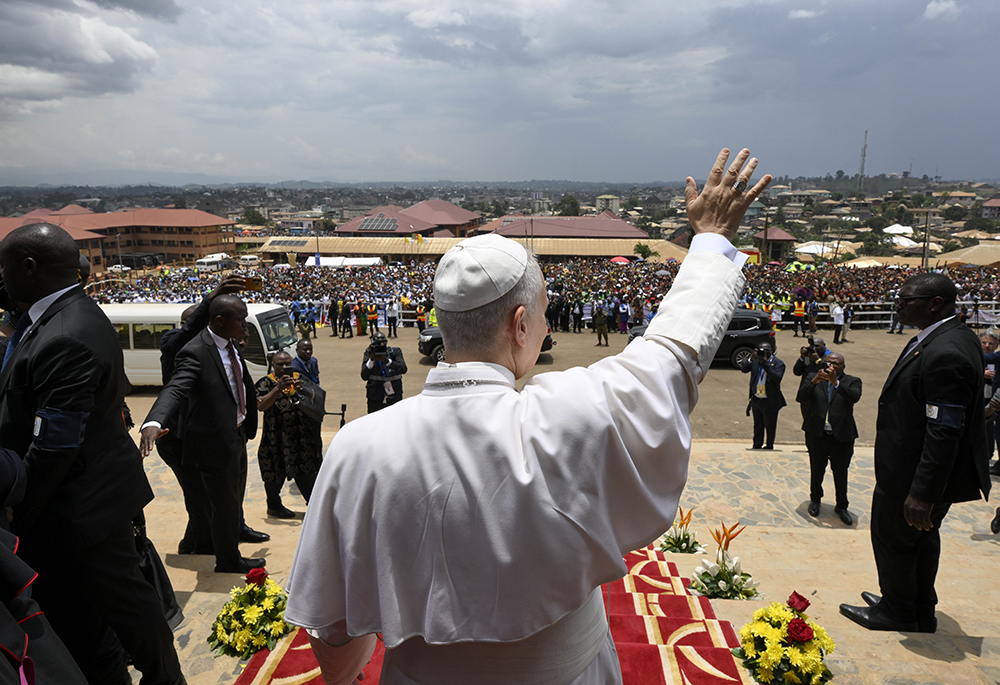
Pope Leo XIV waves after attending a Meeting for Peace at St. Joseph's Cathedral in Bamenda, Cameroon, April 16, 2026. (OSV News/Vatican Media/Simone Risoluti)
Leo's first large Mass in Africa
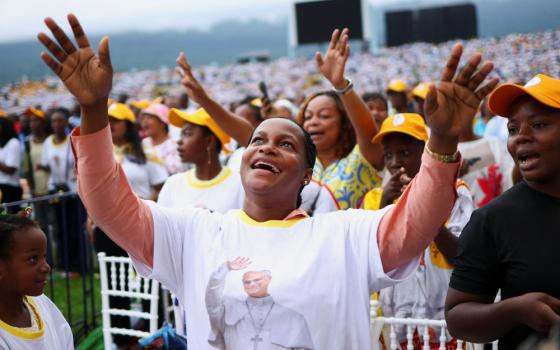
After celebrating an intimate Mass with some 1,500 at the Basilica of St. Augustine in Annaba, Algeria, Leo's second Mass on the African continent was attended by a whopping 20,000 at the airport of Bamenda, which had been closed since 2019 and was reopened specifically to receive the pope and host the Mass.
Many had come from across Cameroon's western regions to attend the Mass, and several from Bamenda had walked more than 8 miles from their homes to reach the airport. And they showed up to welcome the pope with great energy, each hymn animated by xylophone music and throngs of swaying faithful.
The vibrant atmosphere was palpable in Cameroon, where some 28% of the population is Catholic and some 40% of the population is under 15 years old, with attendees cheering at the pope's calls for transformation and renewal within the country during his homily.
On a tarmac surrounded by forest and rolling hills, Leo decried the "moral, social and political corruption, seen above all in the management of wealth, which hinders the development of institutions and Infrastructure" in Cameroon.
Advertisement
After the readings, each delivered in English, the pope preached a homily which mirrored the pointed critique of Cameroon's authoritarian tendencies he had delivered the previous day, sharing the stage with the country's 93-year-old president, Paul Biya, who began his eighth term in office following a contested election. Biya welcomed St. John Paul II to Cameroon twice in 1985 and 1995 and Pope Benedict XVI in 2009.
Drawing from the first reading from the Acts of the Apostles, in which Jesus' followers say they "must obey God rather than men," Leo said that "those who obey God rather than human beings and earthly ways of thinking rediscover their inner freedom, succeed in discovering the value of goodness and do not resign themselves to evil."
Beyond the struggles within Cameroon, the pope said Africa at large also suffers from "those who, in the name of profit, continue to lay their hands on the African continent to exploit and plunder it."
"The time has come, today and not tomorrow, now and not in the future, to restore the mosaic of unity by bringing together the diversity and riches of the country and the continent," he said to applause and shouts of approval from the crowd.
Leo left Bamenda with just a taste of what is to come for the next celebrations over the next seven days of his tour of Africa. The next day he was due to celebrate a stadium Mass in Douala, Cameroon's economic hub, where an estimated 600,000 are expected to attend.
The National Catholic Reporter's Rome Bureau is made possible in part by the generosity of Joan and Bob McGrath.