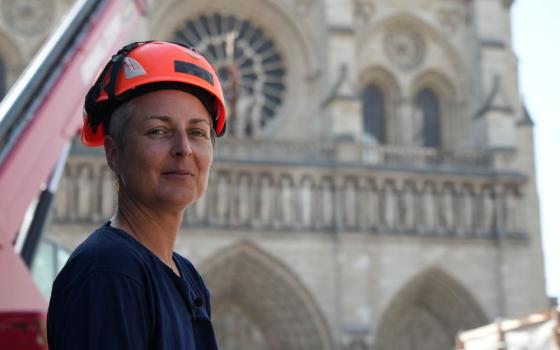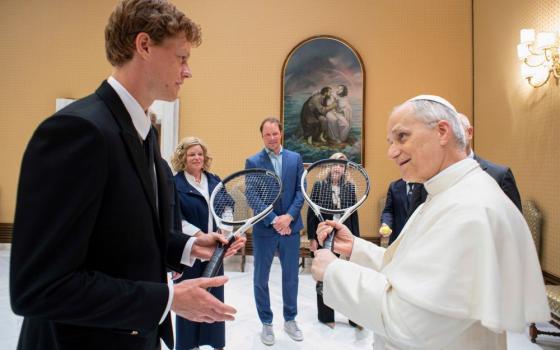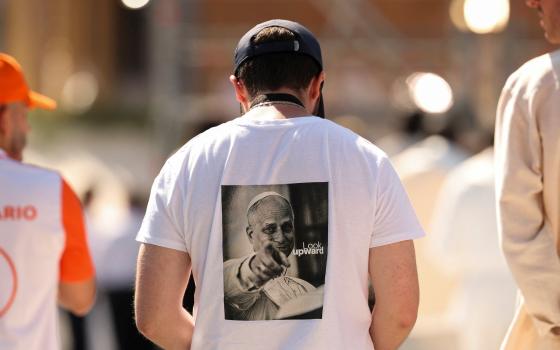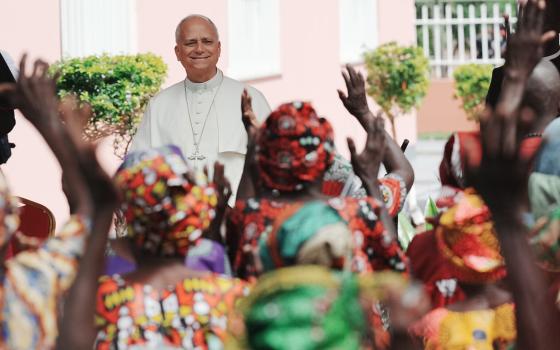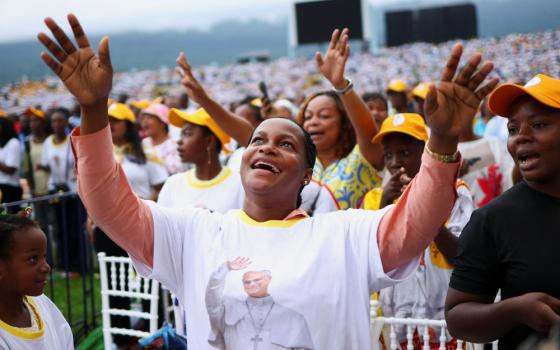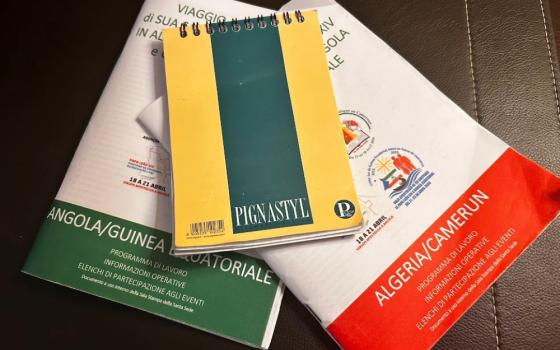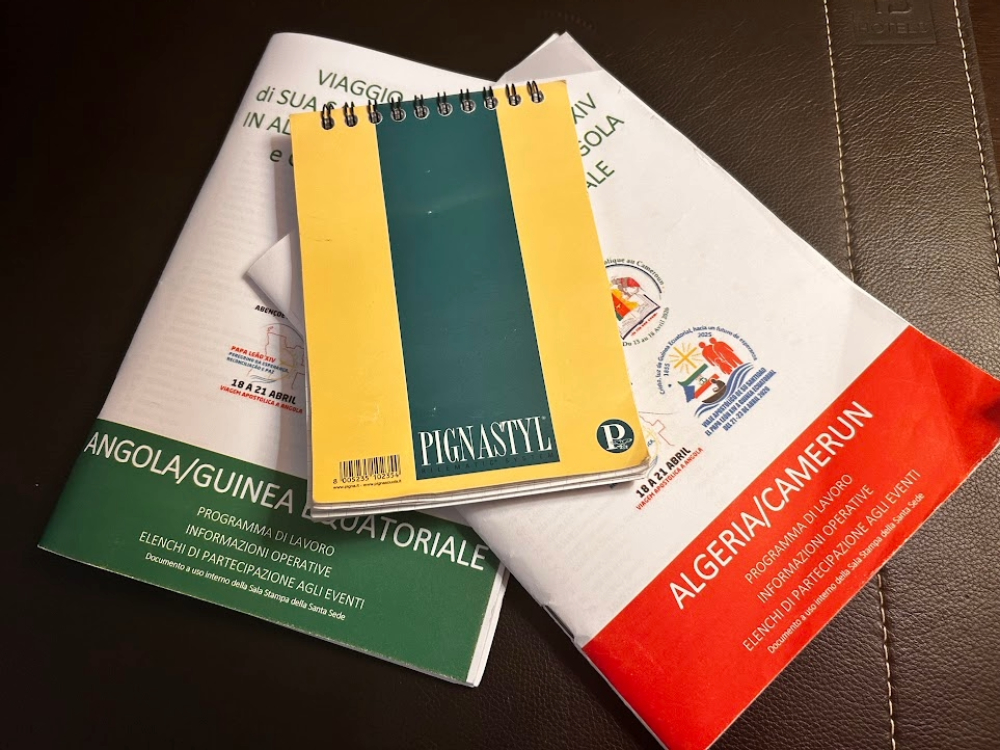
The notebook used by NCR Vatican correspondent Justin McLellan during his trip through Africa with the pope. (NCR photo/Justin McLellan)

Join the Conversation
Send your thoughts to Letters to the Editor. Learn more
All of my reporting gadgets — pens, a voice recorder, cables, adapters, microphones, a mini-tripod and a mobile Wi-Fi router — have a dedicated place in the backpack I carry over Rome’s cobblestone streets to the Vatican press hall, and which has now traveled with me to seven countries to report on the pope.
All of them, that is, except my notebook.
It is a shoddy, two-euro thing, creased and chewed at the edges, that I keep, with a pen, tucked into the outer pocket of my blazer. It's always on hand if I want to quickly jot down an impression which, I hope, could make for an interesting detail to include in an article.
On papal trips, and especially on Leo’s 11-day, four-nation tour through Africa, there is no time to rummage through a backpack while racing between events in a police-escorted press van or walking briskly across airport tarmacs (we saw plenty over the 16 flights which the journalists accompanying the pope took throughout the continent), so my notebook stays holstered at my side.
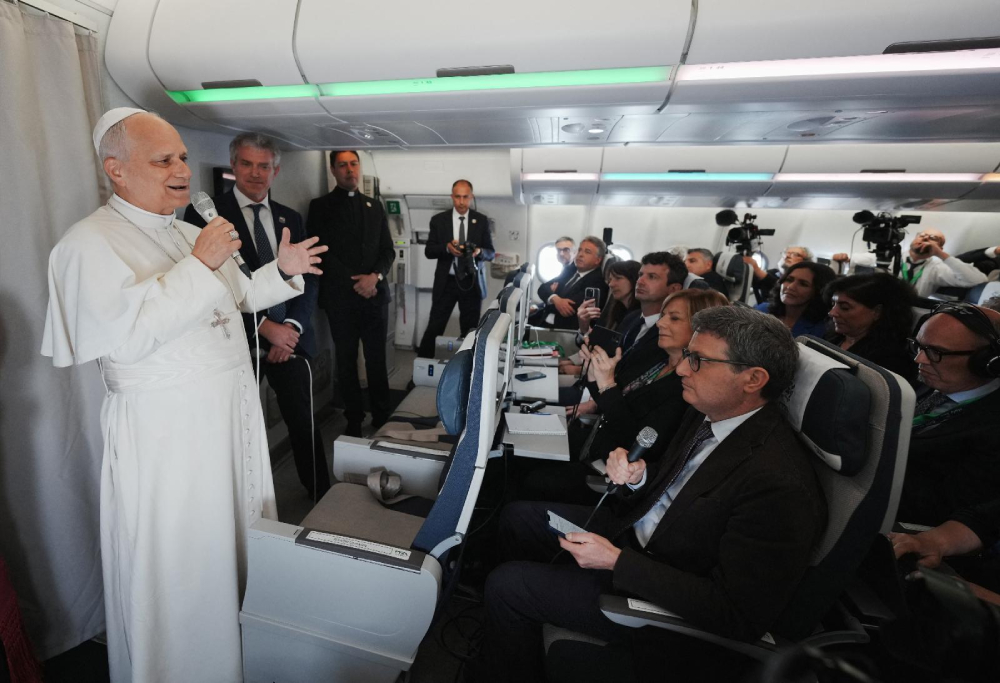
Pope Leo XIV speaks to journalists aboard a flight returning to Rome April 23, 2026, at the conclusion of his 11-day apostolic journey to Africa. (OSV News/Reuters/Andrew Medichini)
The logistics of shepherding 67 journalists across all that distance made the journey, in many ways, feel like a school field trip: frequent roll call ("Present!"), cliques (journalists clustering by language group) and plenty of assignments ("Did you file your story yet?" became a kind of refrain).
In that blur of movement I prize my notebook for retaining the small, often inconsequential details of the trip that my brain would otherwise discard. Some of those notes made it into the National Catholic Reporter's coverage of the pope's historic trip, but many didn't. Sparing the truly trivial entries, here is a selection:
"Wanted Africa as first trip — deferential to papacy"
The first note in the notebook, written when its pages were still crisp.
During Leo's greeting to journalists en route to Algeria, he said he wanted this Africa trip to be the first of his pontificate. The fact that it wasn't (he previously traveled to Turkey, Lebanon and Monaco) revealed how he views his obligation toward the papacy, I thought, which could make for an interesting analysis piece.
That story would never manifest, however, after the pope later responded to President Donald Trump's digital diatribe lodged against him while speaking to American journalists. That quickly became my article for the day.
"Heavy rain"
In Algeria we are met by a downpour in a country that is 80% desert, and where the government issues public calls to prayer for rain.
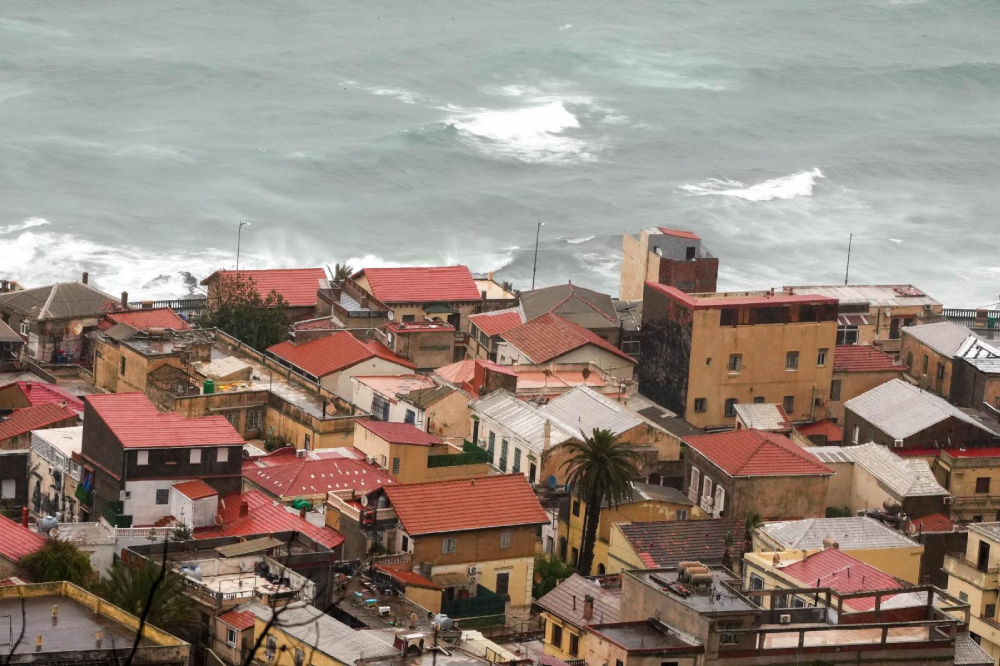
A view of Algiers, Algeria, is seen April 13, 2026, during Pope Leo XIV’s visit. (CNS/Lola Gomez)
"30 seconds"
The length of time Leo stood in a moment of silent reflection in the Great Mosque of Algiers. The pope caused a stir by not stopping to pray during his visit to a mosque in Turkey, though this visit seemed much more choreographed.
"Followed in Annaba"
In the city where the site of ancient Hippo rests, a colleague and I walked to the hotel next to the press center to speak with a cardinal. On our way there we were followed by two plain-clothed Algerian men who waited for us outside the hotel, and walked behind us as we returned to the press center. That was noteworthy.
"Banners: 'Welcome to the messenger of peace'"
This is what the banners strewn across the Cameroonian capital Yaoundé read. The country is experiencing an internal conflict between the Francophone government and Anglophone separatists, a struggle which was put on pause for the pope's visit. The message seemed prescient.
"Biya everywhere"
Plastered around the city were images of the pope alongside Cameroonian President Paul Biya, the world's oldest head of state at 93 years old. He's fresh off his eighth reelection in what is widely considered to be a rigged election.
Leo would later speak on the potential of his trip to lend moral credibility to, or "popewash," the authoritarian regimes he visited.
"Metal corrugated roofs, unmarked asphalt road, mudbrick houses, large forest, people sitting in chairs outside their homes"
The scenes we passed along the roads in Northeastern Cameroon. Some journalists in the press van waved to the throngs of people lining the streets to their delight.
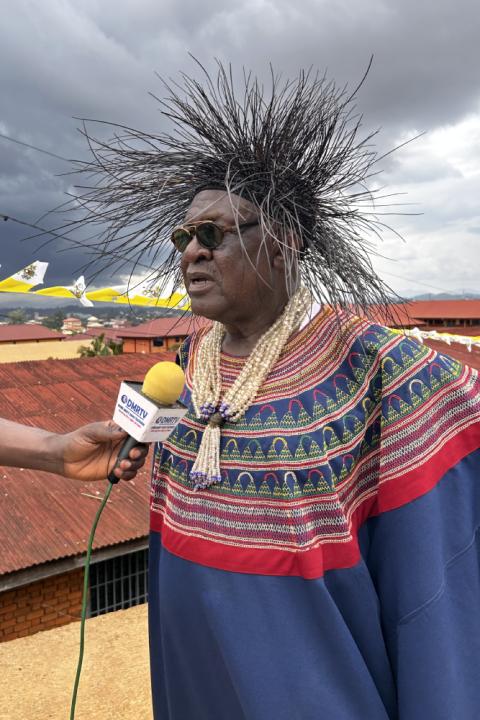
A tribal leader speaks with reporters after attending a meeting for peace with Pope Leo XIV in Bamenda, Cameroon, April 16, 2026. (NCR photo/Justin McLellan)
"Elephant whisker crown"
A local tribal leader explained his headwear.
"Small crowds. Hot. Umbrellas up mid-homily. Switch to English – do not be discouraged."
At the papal Mass in Douala, some 600,000 were expected to attend, though only 120,000 showed, leaving huge empty spaces jarring for an event with the pope. The Vatican didn't provide any information as to why, and various theories surfaced. I later found local news articles alleging that scammers were selling tickets to the Mass, which was free.
Despite the intense heat, I always try to stand among the crowd during the pope's homily to get a sense of how it is received. Halfway through the pope's homily this time, people put up umbrellas to shield themselves from the emerging sun.
I noted how the pope switched from French to English for a segment of his speech, telling Africa's youth to "not give in to distrust and discouragement" in a message clearly intended for an audience broader than the French-speakers gathered before him.
"Cheers – international scholarships. Leo buoyed by applause: 'your country.'"
At the Catholic University of Central Africa, the students cheered loudly when a professor introducing the pope mentioned the university's international scholarship programs. A student I talked to in the crowd said many students come on scholarships from neighboring countries: Chad, Equatorial Guinea, Democratic Republic of the Congo (many Congolese flags were waving among the crowd).
During the pope's address, Leo was noticeably energized when he elicited applause from the crowd. In this instance, cheers came when he told the young people to respond to Cameroon's brain drain crisis "with an ardent desire to serve your country."
"More muted. No cheers. Billboards in Chinese."
Leo's first Mass in Angola was much more sober than the exuberant crowds he was met with in Cameroon. Whereas the Cameroonians broke into applause and yelled during the pope's homilies, here people listened with their heads down nodding along as the pope spoke on the need to overcome the divisions left by Angola's civil war and economic inequality. After his speech, people clapped, but not one of the 100,000+ people gathered there opened their mouths to cheer.
All around Kilamba, the city where Mass was celebrated and which was built in an oil-for-infrastructure deal with China, advertising billboards are in Chinese, showing the extent of foreign influence in a country where the pope condemned the "logic of extractivism."
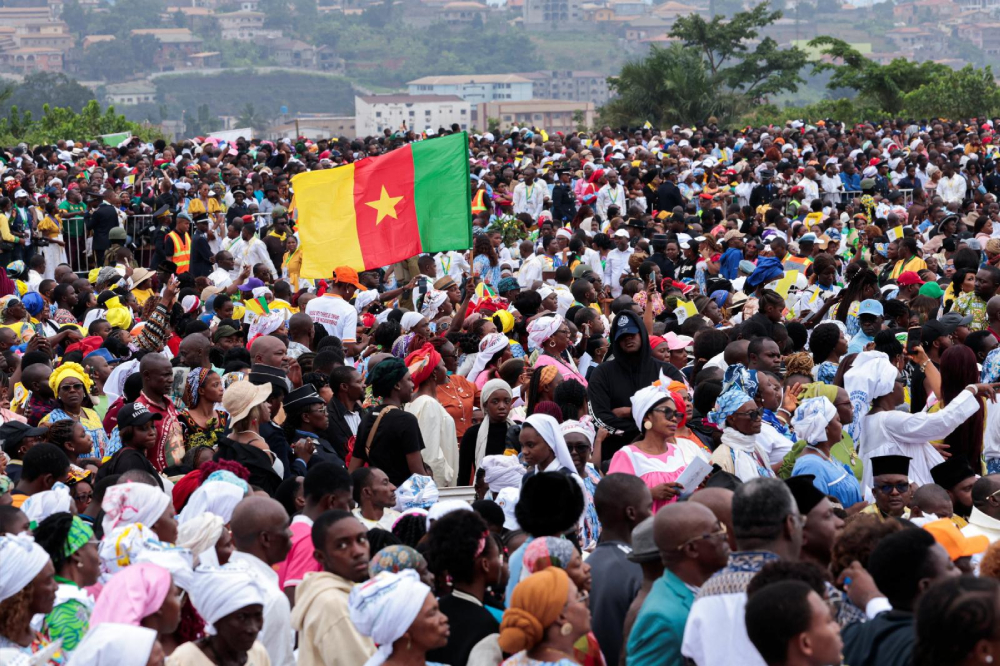
A Cameroonian flag flies as the faithful gather for a holy Mass led by Pope Leo XIV at Yaoundé-Ville air base in Yaoundé, Cameroon, April 18, 2026. (OSV News/Reuters/Luc Gnago)
"Good Counsel at pope's seat on airplane"
Someone showed me a picture of the pope's seat on the airplane taking him throughout Africa, where an icon of "Our Lady of Good Counsel" is placed right before him. The Marian image was the patron of the U.S. Augustinian Midwest Province to which the pope belonged as a missionary.
"This is somewhere only a pope would come to."
I recorded a comment made by a colleague, Jordi Barcia of Spanish public radio, while in a van riding through the dirt roads in Saurimo, Northeastern Angola. My Catalan colleague also noted to another journalist from Madrid with us in the van that all the kids running around were wearing F.C. Barcelona, and not Real Madrid, soccer jerseys.
The amount of young people lining the streets was staggering. Roughly half of the population in Angola is under 18. But more striking than the young people themselves was seeing how young the mothers are, who, at no more than 20 years old, walked with their children in hand.
Here again the pope's homily is met with quiet contemplation. Under the hot sun there is only silence as the pope speaks and the hum of a generator powering the (insufficient) air conditioning units in the press tent.
"Bird flying around chandeliers. Pope's Portuguese?"
At a parish in Angola's capital a bird flew around the church's chandeliers as Leo spoke. His accent in Portuguese is thick, and the echo of the church walls was unforgiving. It was difficult for me to understand what he said despite speaking Portuguese. I asked two people gathered in the parish on my way out how intelligible the pope's speech was. "He speaks Portuguese very well!" I was told, but it was not an answer to my question.
Advertisement
"Obiang walks well with a cane, but not for photos, hand shakes. First lady in colorful Leo dress."
Equatorial Guinea's president, Teodoro Obiang Nguema Mbasogo, received the pope at the airport. At 83, he walked with a cane, but for the photo op he gave it to an aide. As he posed his hand slightly trembled.
His wife was in a colorful dress with the pope's image printed all around it. It is difficult to imagine a first lady fawning over any other foreign head of state in such a way.
"Empty roads to basilica."
Equatorial Guinea has had an influx of foreign investment due to discovery of offshore oil and gas reserves, but half of its population remains below the national poverty line.
The highway we took from the airport in Mongomo to the Basilica of the Immaculate Conception, where Leo would celebrate Mass, was completely empty. Not a single other car was on the road aside from our press bus. The infrastructure is new but totally unused.
Upon arrival, the pope elicited huge cheers and ululating celebratory chants when entering the basilica. The president was met with silence.
"¡Se ve, se siente, el papa está presente!"
At the pope's meeting with families and young people in Bata, the crowd stayed singing and dancing and under a downpour of rain. The emcee repeated again and again: "You see it. You feel it. The pope is here!" (In Spanish it rhymes.) The atmosphere was exhilarating. When the pope arrived, Vatican security guards were each holding umbrellas in one hand and trying to hold back crowds with the other. Ultimately, they couldn't, and people spilled over from across the stadium and crushed along the barricades lining the track where Leo rode around in the popemobile.
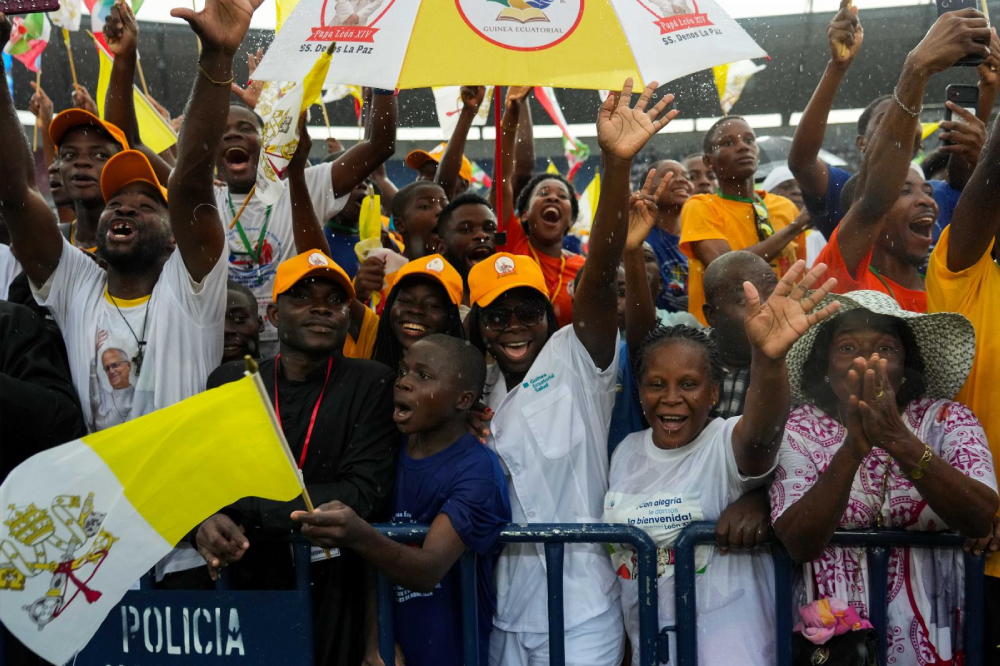
Young people celebrate in the rain as they wait to have a meeting with Pope Leo XIV at Bata Stadium in Bata, Equatorial Guinea, April 22, 2026. (CNS/Lola Gomez)
"Improvised. BXVI 2011?"
"Who is afraid of the rain?" the pope, who almost always sticks to his speech, said off the cuff and to a roar of applause to the rain-soaked crowd. "The church needs your enthusiasm!"
The scene was reminiscent of Pope Benedict XIV's 2011 meeting with young people in Madrid under a torrential downpour, where he opted to stay with the youth rather than take cover.
"Presi! Presi!"
Leo's last Mass in Africa. The president walked into the stadium to huge chants of "Presi! Presi!" The VIP section for attendees was totally separated from the rest of the crowd, with a red carpet leading there from the entrance.
"Flags as towels"
The morning's heavy rain had let up in time for Mass, but the seats remained soaked. Many people used the Vatican and Equatoguinean flags that they were given at the entrance to wipe down their seats before sitting down.
I again stood outside to listen to the homily. The stadium was packed and people filled the corridors that lead to the stadium seating.
Some people sat and listened as the pope spoke. I saw others sending pictures they had just taken of Leo on the popemobile to their friends.
One boy was eating popcorn out of a bag.
The National Catholic Reporter's Rome Bureau is made possible in part by the generosity of Joan and Bob McGrath.