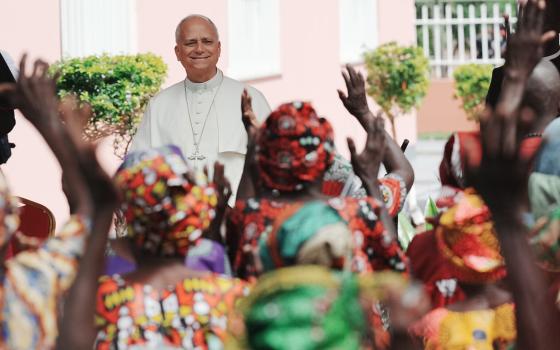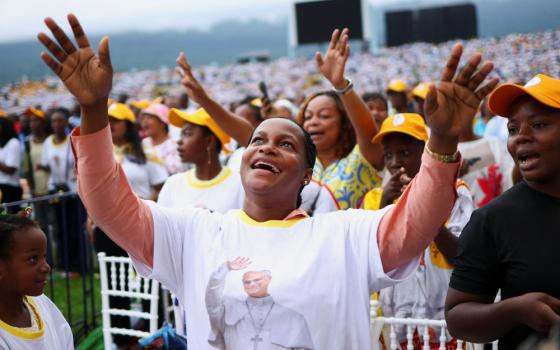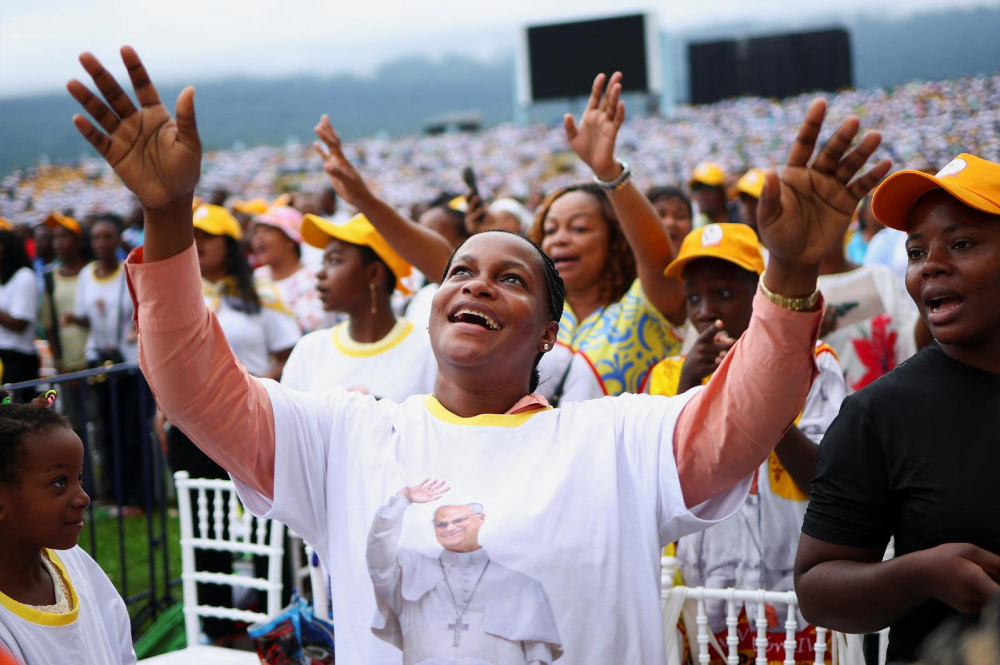
The crowd reacts as Pope Leo XIV celebrates the final Mass of his apostolic journey to Africa at Malabo Stadium in Equatorial Guinea April 23, 2026. (OSV News/Reuters/Guglielmo Mangiapane)

Join the Conversation
Send your thoughts to Letters to the Editor. Learn more
For the first 11 months of this pontificate, observers attempting to decipher Pope Leo XIV were left mostly to interpret the pope's subtle decision-making rather than frame bold proclamations on the Catholic Church's teaching and governance.
The "quiet American" label Leo acquired in his first months as pope largely held as he listened broadly, managed methodically and allowed the character of his papacy to emerge in due time.
Yet the missionary pope's first trip to the Global South changed that. During his 11 days in the African continent, Leo provided the clearest portrait yet of his pontificate, displaying how he understands and embodies the distinct dimensions of the papal office.
In Algeria, he appeared as a spiritual leader, returning to the source of his Augustinian identity. In Cameroon, he exhibited his prophetic voice before political crises. In Angola, he spoke as a pastor to the concrete fears and practices of a local church. And in Equatorial Guinea, before rain-soaked and ecstatic crowds, he showed that even a mild-mannered pope possesses the power of spectacle.
Algeria: Pope as a spiritual role model
The pope arrived on the African continent after a politically charged prelude to his trip. On the eve of Leo's historic journey, President Donald Trump launched an attack against him on Truth Social, and the pope, speaking to journalists aboard the papal plane, responded with surprising directness.
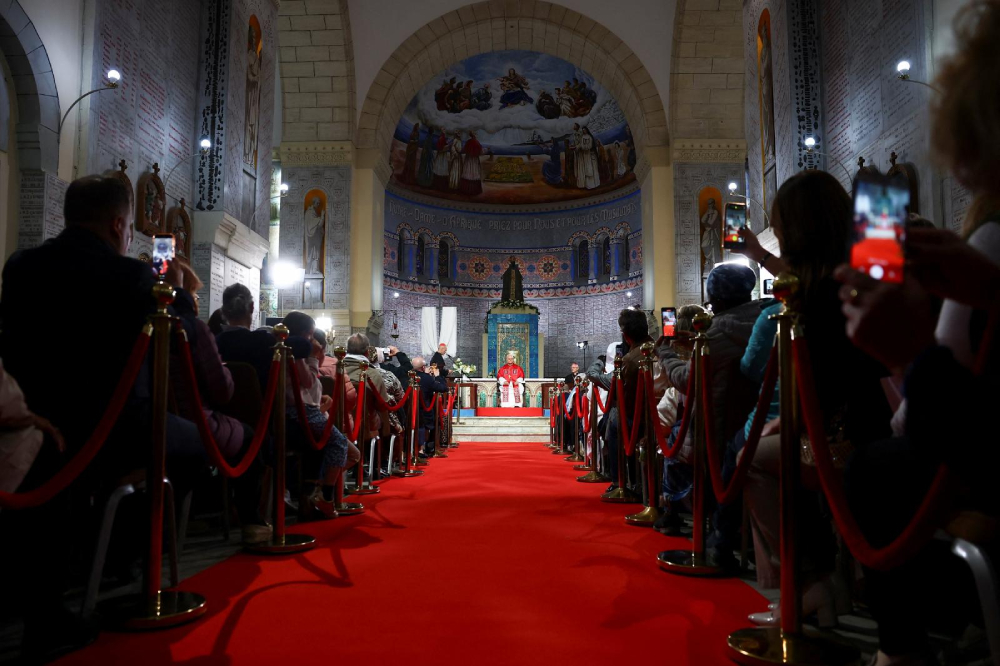
Pope Leo XIV attends a meeting with the Algerian community at the Basilica of Our Lady of Africa in Algiers, Algeria, April 13, 2026. (OSV News/Reuters/Guglielmo Mangiapane)
As the pope-versus-president spat threatened to frame the entirety of the trip in political terms, Leo's first stop shifted the tone almost immediately. His Algeria visit placed him before his spiritual father, St. Augustine, the North African saint whose restless search for God shaped Leo's own spiritual life and how he rooted his vision for the universal church.
In his homily at the Basilica of St. Augustine, the pope held out the saint's discernment as the "authentic criterion for ecclesial reform: a reform that must begin in the heart, if it is to be genuine, and must encompass everyone if it is to be effective."
Though the term "ecclesial reform" would open intrigue for any observer of the church, Leo made the case for church reform as the fruit of discernment and conversion rather than institutional disruption.
Instead of fixing the church's gaze solely on the problems that plague it, in Algeria Leo lifted it upward, insisting that reform be guided by charity and rooted in the proclamation of the Gospel.
His later messages on the trip would land more squarely on political realities, but in his first stop the pope offered the contemplative key through which to read them as one of conversion rooted in the Gospel.
Cameroon: A prophetic voice emerges
If Algeria supplied the spiritual lens through which to view Leo's journey, Cameroon gave his message its prophetic edge.
Leo has been cautious on issues that dominate Catholic debates in the West — outreach to LGBTQ+ Catholics, women's ordination to the diaconate and priesthood and disputes over the liturgy — to name a few. But in Cameroon, the missionary pope showed that on the issues he considers urgent for the church at large, particularly those afflicting the Global South, he did not pull his punches.
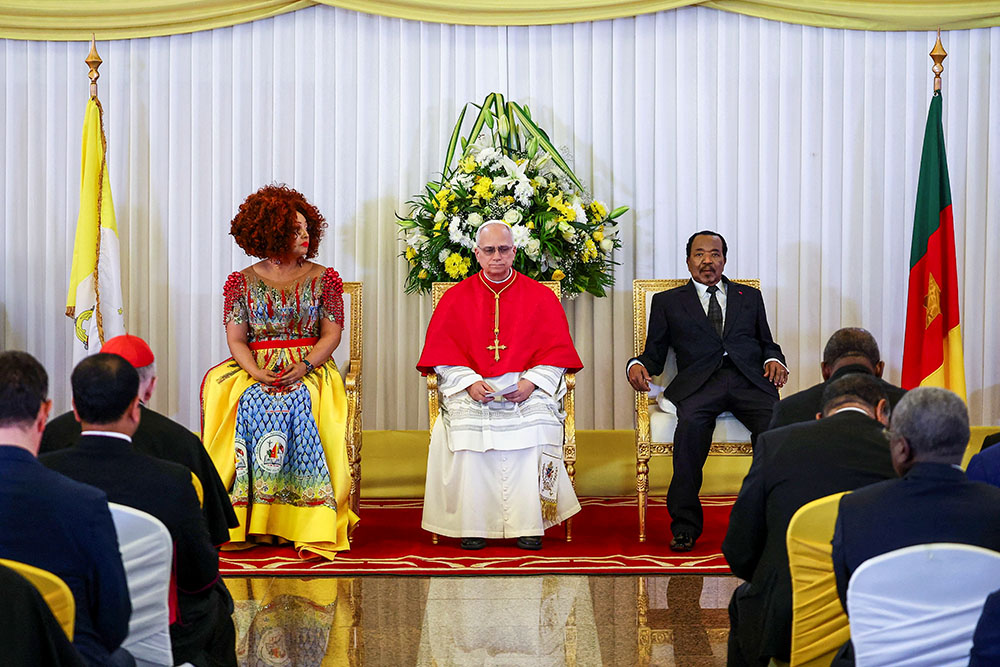
Pope Leo XIV meets with Cameroon President Paul Biya and his wife, Chantal Biya, after arriving at the Presidential Palace in Yaoundé April 15, 2026. (OSV News/Reuters/Guglielmo Mangiapane)
Meeting with the leader of a country long criticized for entrenched corruption, the pope called for Cameroon to break free from "the chains of corruption which disfigure authority and strip it of its credibility."
The force of his words echoed that of his address to the diplomatic corps accredited to the Holy See, in which he warned that "war is back in vogue" and decried the rise of a "diplomacy based on force" on the global stage.
Yet in Cameroon, Leo's words had a far more specific target. Standing beside President Paul Biya, the 93-year-old who is the world's oldest sitting head of state, the pope called for "transparency in the management of public resources and respect for the rule of law" in a country where Biya had just claimed an eighth term in a vote widely criticized as fraudulent.
Leo's stop in Cameroon provided him with a local stage to touch on issues of justice, governance and inequality applicable throughout the region and the world at large.
That was evident in Bamenda, in the heart of Cameroon's conflict-ridden Anglophone region, where Francophone government forces and English-speaking separatist groups have battled for years.There, Leo delivered perhaps the most impassioned appeal of the trip, lamenting a world "ravaged by a handful of tyrants" and presenting peace as a moral demand of the Gospel.
The pope would later tell journalists that the speech, prepared weeks before Trump's attack, could not be reduced to a response to the U.S. president. In doing so, the media-shy pope (who has given only one formal interview to date) showed his willingness to intervene in the narrative around his person and pontificate, insisting that his prophetic message not be reduced to political retaliation.
Angola: Pastor of a (growing) flock
Leo's messages in Cameroon appeared positioned to address the problems plaguing much of sub-Saharan Africa. In Angola, his words seemed more attuned to the reality immediately before him.
In a nation rich in oil and minerals but marked by staggering inequality, Leo railed against the hoarding of wealth and lambasted the "logic of extractivism" that robs resource-rich nations of their dignity while leaving much of its population in poverty.
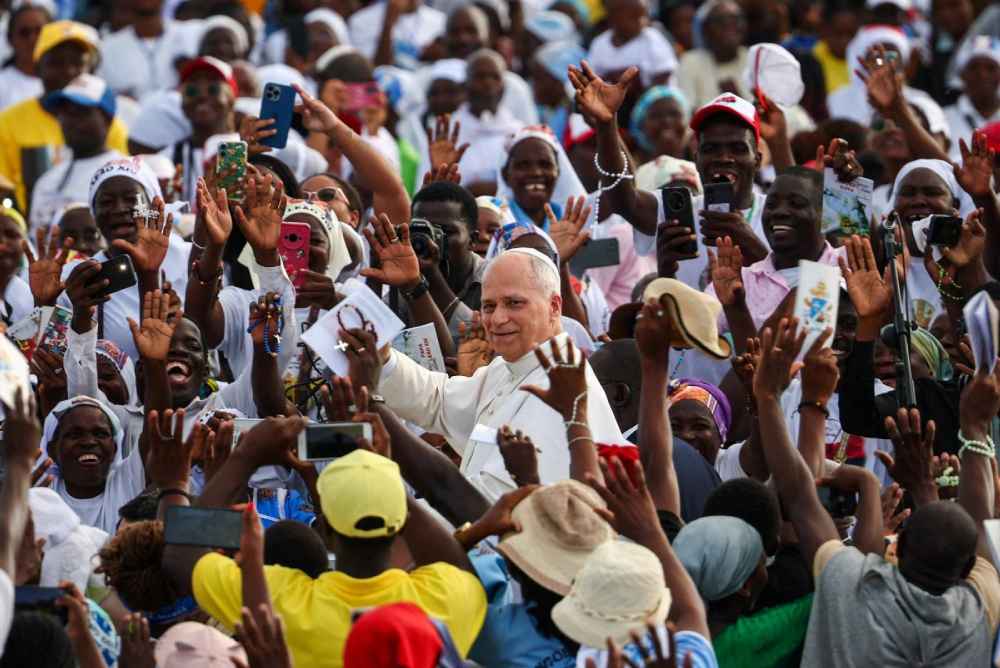
Pope Leo XIV amid faithful, on the day he led those gathered at the "Mama Muxima" Shrine in praying the rosary during his apostolic journey in Africa, in Muxima, Angola, April 19, 2026. (OSV News/Reuters/Guglielmo Mangiapane)
While the pope's preaching on social issues continued through Angola, his stop in the majority-Catholic country also brought out another register in Leo's voice: that of a pastor speaking to the spiritual life of a particular flock.
In various speeches, he did not mince words when pushing back on sorcery and other traditional religious practices that are widespread in the country and present a significant challenge to the church's outreach.
The pope warned against reducing Christ to "a guru or a good luck charm" in Angola's northeast, and celebrating Mass outside the capital, he said: "We must always be vigilant regarding those forms of traditional religiosity that certainly belong to the roots of your culture, but at the same time risk confusing and mixing magical and superstitious elements that do not aid your spiritual journey."
"Remain faithful to what the church teaches, trust your pastors, and keep your gaze fixed on Jesus, who reveals himself in the word and in the Eucharist," he said.
And speaking to the country's Catholic community, he encouraged the clergy to be solid in their formation so as to save the faithful "from the dangerous illusion of superstition."
Particularly in an area where the church is growing — some 58% of Angolans are Catholic and about half of the population is under 18 — Leo spoke to keep the faithful fixed on a path toward authentically living out the Gospel.
Advertisement
Though perhaps a less spectacular function of the papacy than calling out corruption before political leaders or denouncing neocolonialism on the global stage, in one of the fastest-growing regions of the Catholic Church the pope may see his role as a pastor and teacher as his most important.
Equatorial Guinea: The power of spectacle
Beyond the pope's role as a spiritual role model, a prophet and a pastor, the historic nature of the papacy combined with the modern media landscape have increasingly underscored the office's symbolic role.
In essence, the pope has become a sort of rock star.
Though Leo had seen much larger crowds throughout the first year of his pontificate, any observer of the papacy would be hard pressed to find more enthusiastic ones than those he met in Equatorial Guinea.
In Bata, the country's largest city, thousands of young people and families sang and danced ahead of the pope's arrival, undeterred by the downpour of rain that fell over the open-air stadium for a half hour before he appeared.
In response, Leo improvised brief opening remarks to great applause and, throughout the meeting, appeared to revel in the reception, donning a broad smile during the performances and testimonies.
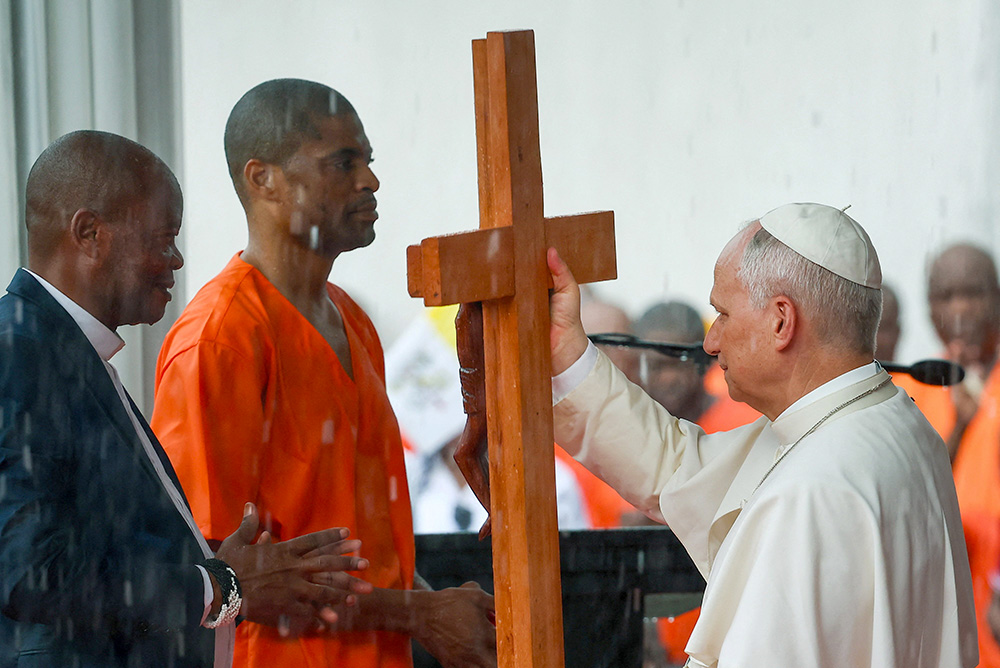
Pope Leo XIV receives a cross from an inmate during the pontiff's visit to Bata prison in Equatorial Guinea, April 22, 2026. (OSV News/Reuters/Guglielmo Mangiapane)
Earlier the pope visited a prison in Bata where, in a much more somber environment, he spoke to incarcerated people in a country criticized for taking political prisoners, torturing incarcerated persons and putting people in prison up without fair trials.
He was received with a choreographed song and dance, perhaps imposed on the prisoners to learn for the pope's visit, and for his part, he opted to speak to them as individuals rather than critique the system that may have landed them there.
"Life is not defined solely by one's mistakes," he said, insisting that the prisoners are "not alone."
The prisoners remained in the prison courtyard under heavy rainfall as the pope departed, breaking out in unchoreographed bouncing and chants of "¡Libertad!" ("Freedom!").
Though not particular to Leo himself, the symbolic power of the papacy was on full display even in one of the trip's most sober encounters, producing the kind of potent image the world has come to expect from a pope that is capable of moving people far beyond the scene itself.
Leo's Africa trip did not transform his papacy so much as transform how it could be seen, laying out in plain view the spiritual, prophetic, pastoral and symbolic dimensions of the office as he embodies them.
The National Catholic Reporter's Rome Bureau is made possible in part by the generosity of Joan and Bob McGrath.