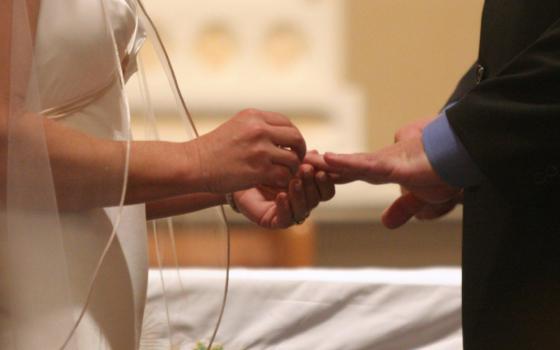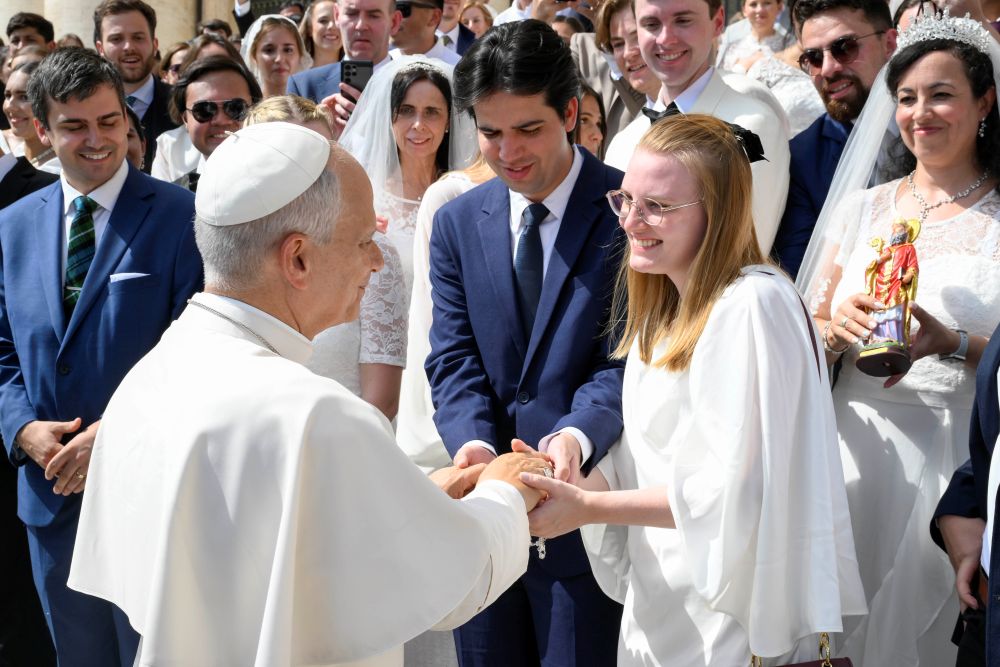
Pope Leo XIV greets a newlywed couple in St. Peter's Square at the Vatican after his weekly general audience Sept. 9, 2026. (CNS/Vatican Media)

Join the Conversation
Send your thoughts to Letters to the Editor. Learn more
Pope Leo XIV called on church leaders to address the "growing distance" between the "ways in which sex and intimacy are lived and the Christian vision of marriage."
Opening a major Vatican summit on Pope Francis' somewhat controversial document on the family, Leo told the heads of bishops' conferences around the world to confront the tough questions about Catholic teaching on sex and marriage "with courage."
"Young people continue to long for love, fidelity and belonging, yet many find it difficult to embrace how such a vision of love can take shape in their own lives or to believe that a lifelong commitment is the condition for reaching what they desire," the pope said on Wednesday (Oct. 7). "Economic insecurity, migration, violence, loneliness and other forms of emotional fragility also shape the choices people make and the possibilities they can imagine for their future."
Leo, who has said that matters of sexual morality should not be the church's priority, convened 152 church leaders and theological experts to assess the reception of Francis' Amoris Laetitia ("The Joy of Love") 10 years after its publication. The document, which emerged from two synods on the family in 2014 and 2015, drew controversy after one of its 391 footnotes seemingly opened the door for Catholics in "irregular" situations, such as people who have divorced and civilly remarried, to receive Communion.
Four cardinals, citing the "the lack of clarity or even the ambiguity" of passages within the document submitted formal questions, or dubia, to the Vatican's doctrine office seeking a more rigid interpretation of the text following its publication.
As a result of the stir it created, the document was only "tepidly received" throughout the United States, Jesuit Fr. James Keenan, a moral theologian at Boston College, told National Catholic Reporter ahead of the conference.
Whereas previous church documents on marriage "were basically about whether you could have contraception or not," Keenan said, "this was all about family life. How do you talk to one another? How do you get over problems? How do you work together?"
In the United States, however, "we decided to have a debate about one point rather than looking at the document and discussing the document."
With his decision to bring church leaders to Rome to discuss the document anew, Leo, it seems, is seeking a course correction.
The pope asked participants at the start of the seven-day summit to consider where the church's "pastoral language and practices succeed in opening a path, and where do they fail to touch people's hearts or assist their efforts to do what is good?"
Leo also drew attention to the question of human fragility, which he said "raises the question of whether we are able to remain close to one another when life no longer corresponds to what had been hoped for, and whether we can recognize the work of grace even in situations marked by limits, wounds and apparent failure."
"We all know the gap between the good we desire and what we are able to live," the pope told participants, seated at round tables in a scene reminiscent of the Vatican's 2023 and 2024 synod assemblies. "Recognizing this shared challenge should shape the way we accompany one another in the church."
The president of the U.S. bishops' conference, Archbishop Paul Coakley of Oklahoma City, was in attendance for the summit's opening; he and the conference's vice president, Bishop Daniel Flores of Brownsville, Texas, had met privately with Leo and other conference officials two days before the summit began.
Also participating in the gathering were Cardinals Robert McElroy of Washington; Joseph Tobin of Newark, New Jersey; and Blase Cupich of Chicago as the three U.S. cardinals currently leading dioceses.
Among the summit's focuses are young people and the vocation to marriage, the first years of married life, accompanying families and "Christian families as subjects of the Church's mission."
While a synthesis report is expected to be presented to the pope at the end of the summit and published publicly, the conversations will be held behind closed doors. Still, Leo made a point of noting that the program for the meeting "has been made public so that the People of God may accompany our work through prayer and synodal reflection."
"For our part, listening to one another, allowing what we hear to resonate within us, and remaining attentive to the promptings of the Holy Spirit can awaken the pastoral creativity we need in the face of new questions," he said.
[Abby Strelow contributed reporting from Rome.]
The National Catholic Reporter's Rome Bureau is made possible in part by the generosity of Joan and Bob McGrath.
Advertisement