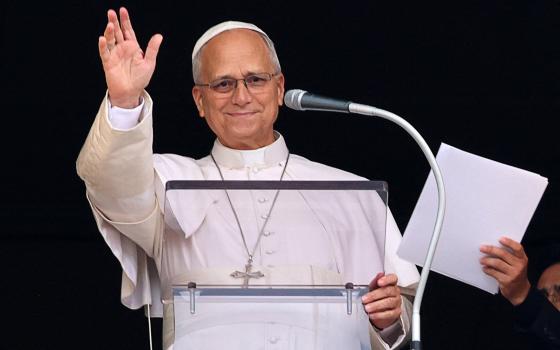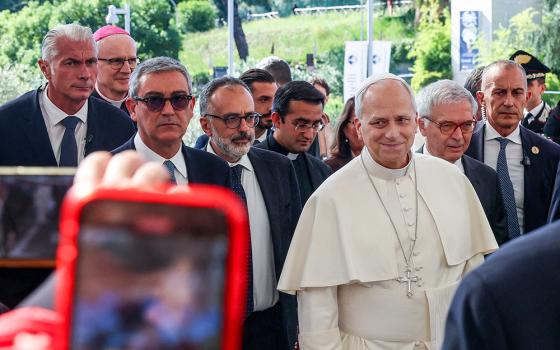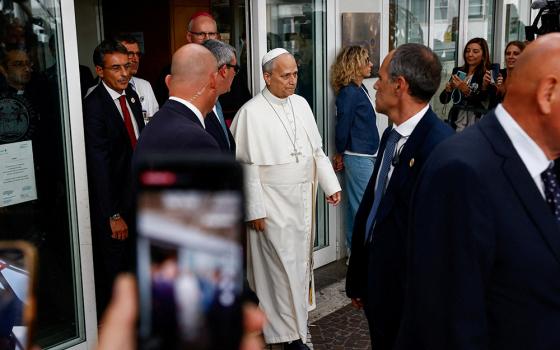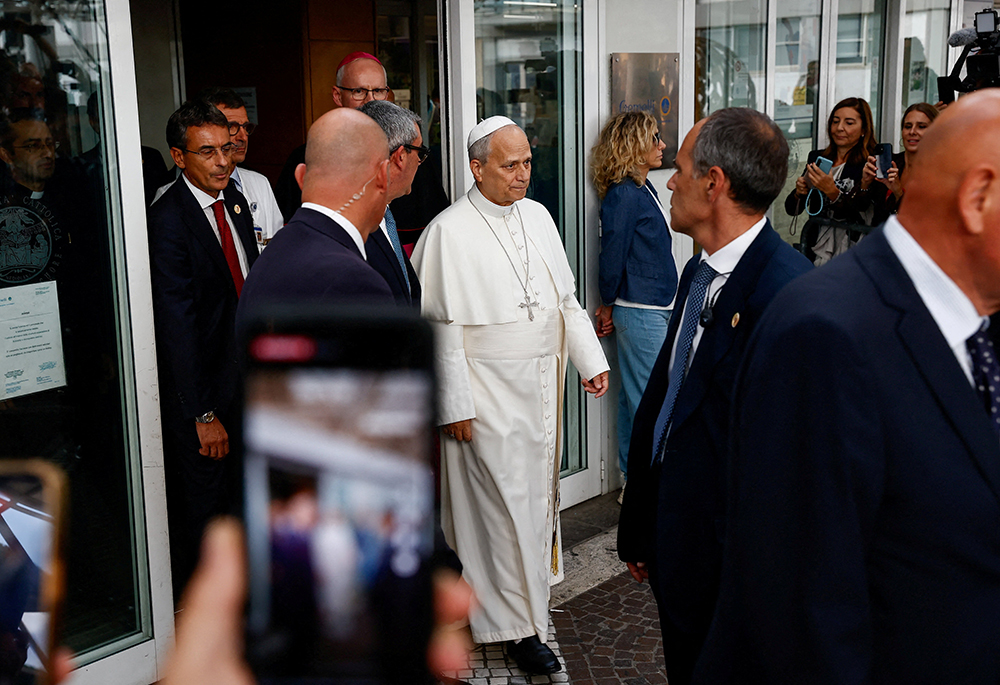
Pope Leo XIV leaves Rome's Gemelli Hospital Oct. 17, 2026, following his lung surgery and cancer diagnosis. (OSV News/Reuters/Vincenzo Livieri)

by Abby Strelow
Join the Conversation
Send your thoughts to Letters to the Editor. Learn more
Does the pope wear white puffer jackets? While the real answer is no, a viral photo of Pope Francis sporting a fashionable white designer coat in 2023 had the public convinced otherwise — that is, until it was shown to be a fake generated by artificial intelligence. Since then, creating AI images of the pope, for comedic or even devotional purposes, has become a favorite pastime of the internet.
But since Pope Leo's hospitalization on Oct. 13 for the removal of a cancerous lung nodule, the internet has exploded with AI-generated pictures of the pontiff in the hospital. Photos show a smiling Leo wearing blue pajamas or a hospital gown and recovering in his bed after surgery, often giving a thumbs up to the camera, or surrounded by medical staff and religious sisters.
While many of these images are easily identifiable as AI, others are harder to spot as fakes, leading to their widespread circulation among social media users. One image that shows Leo smiling from a hospital bed with a surgical bandage has gone particularly viral on Catholic social media.
Yet Catholics need not worry about figuring out which of these images is a fabrication. Any photo purporting to show the pope from his hospital bed is an AI-generated fake, because pictures and videos of the pope in that condition have been forbidden since John Paul II's 1996 apostolic constitution, which declared that "No one is permitted to use any means whatsoever in order to photograph or film the Supreme Pontiff either on his sickbed or after death, or to record his words for subsequent reproduction" (Universi Dominici Gregis, 30).
John Paul II, however, would be the exception to the rule he later established. After his assassination attempt in 1981, the Vatican released a photo of the pope seated upright in his hospital bed during his recovery. The image was a far cry from the first photos of Leo which the Vatican released following his hospitalization, which show him on his feet and celebrating Mass in the hospital.
Advertisement
While the rule, intended to prevent the public from sensationalizing the weakened condition of a pope and protect his privacy, may not seem necessary, history says otherwise: in 1958, Pope Pius XII's personal physician secretly photographed the dying pope and tried to sell the images, along with a play-by-play of the Holy Father's final moments, to the press.
Nearly 70 years later, AI-generated photos of Pope Leo in the hospital— while circulated with less sinister intent than those stolen by Pius XII's doctor — point to the same timeless phenomenon: the public's fascination with the pope in contexts of illness, weakness and even death.
It comes as no surprise, then, that similar photos and videos were generated of Pope Francis during his hospital stay in February 2025. While many were dangerously realistic, others were so clearly fake that they were criticized for their laughably questionable taste — such as the widely circulated clips of an artificial Jesus visiting Pope Francis in his hospital bed.
While many AI-generated images of the pope appear innocuous, some content verges on the morbid or gruesome, such as the AI-generated photos of Pope Francis' corpse in an open casket that were propagated online after his death.
The proliferation of such images raises questions about how AI should be used for devotional or informational purposes, as well as the role of social media in shaping the connections Catholics have with the pope.
Ironically, it was Pope Leo who warned Catholics about the dangers of AI in his May 2026 encyclical Magnifica Humanitas. And in an Oct. 2 post on X, he wrote:
In this era of artificial intelligence, it is becoming urgent to distinguish human art from what machines produce. There is an ontological difference, even before an aesthetic one, between art and what a machine can generate through statistical calculation based on millions of images created by others. Algorithms lack the spark of humanity.
Whether the "spark of humanity" is present in devotional fakes of Leo is a question up for debate.
While the medium for producing illicit papal pictures has shifted from surreptitiously snapping photos to producing machine-made images, the underlying desire for the world to be close to the pope in times of frailty clearly remains. Only eight days after lung surgery, though, Leo gave the world a chance for plenty of photo ops by keeping his Wednesday General Audience in St. Peter's Square, smiling and waving for the camera as he rode through St. Peter's Square in the popemobile.
The National Catholic Reporter's Rome Bureau is made possible in part by the generosity of Joan and Bob McGrath.