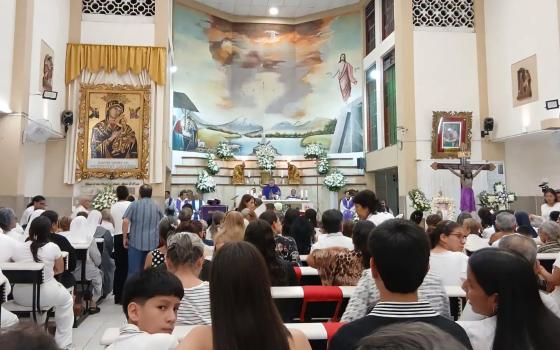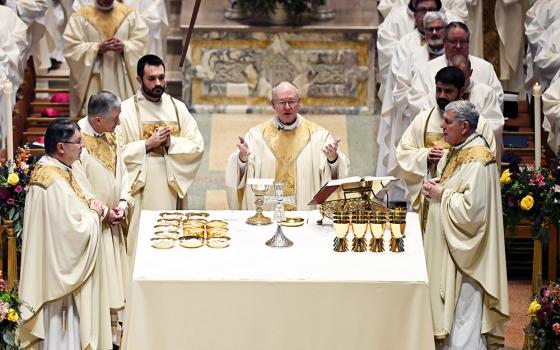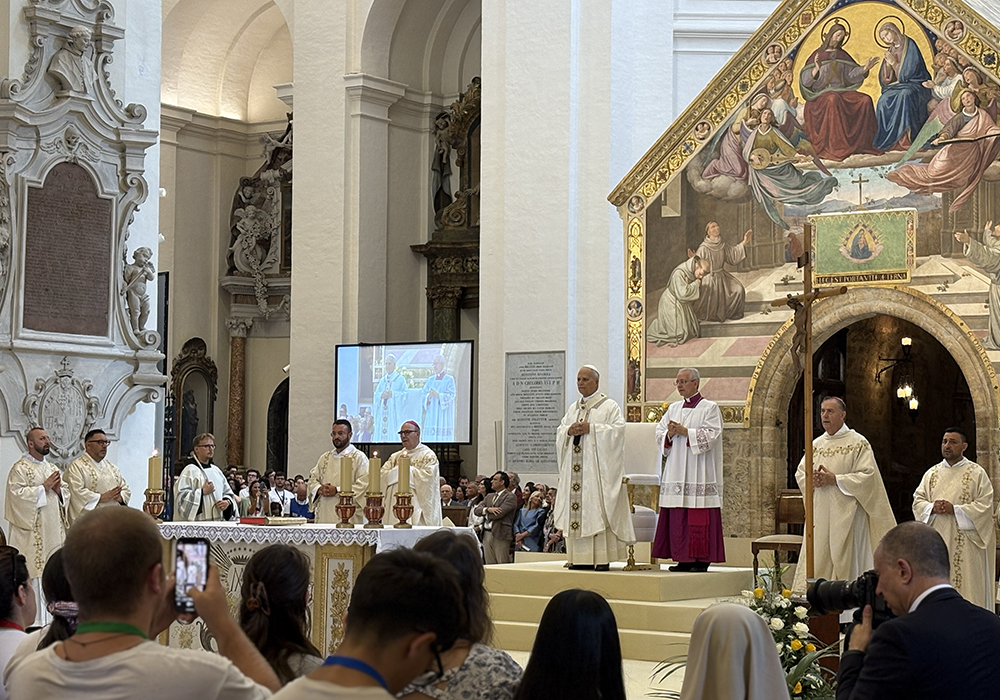
Pope Leo XIV celebrates Mass in the Basilica of Santa Maria degli Angeli in Assisi, Italy, which houses the Porziuncola, the small chapel closely associated with the life and early vocation of St. Francis, Aug. 6, 2026. (NCR photo/Camillo Barone)

Join the Conversation
Send your thoughts to Letters to the Editor. Learn more
Pope Leo XIV returned to Assisi on Thursday (Aug. 6) for the second time in his pontificate, addressing more than 2,000 young people gathered in the birthplace of St. Francis of Assisi, calling on them to become peacemakers, reject the pursuit of power and recover the courage to make lasting commitments.
On one of the hottest days on record for this region, with temperatures around 100 degrees, young adults representing more than 20 mostly European countries filled the town for the closing day of Go! — a Franciscan youth gathering attended by members of Franciscan associations, organizations and parishes.
National flags and banners filled the square outside the Basilica of Santa Maria degli Angeli, which houses the Porziuncola, the small chapel closely associated with the life and early vocation of St. Francis, where Francis first heard the voice of God asking him to "rebuild" his "house."
Leo had previously visited Assisi in November 2025, when he joined the concluding session of the general assembly of the Italian bishops' conference and held a closed-door meeting with the country's bishops.
Nine months later, the setting and purpose were markedly different. This time, the pope came to meet young people at the conclusion of a European gathering shaped by the 800th anniversary of the death of St. Francis.
The Vatican has proclaimed a special Jubilee Year of St. Francis, running from Jan. 10, 2026, until Jan. 10, 2027. The anniversary is being marked by pilgrimages and religious events in Assisi and elsewhere.
Participants began assembling outside the basilica from 6:30 a.m., many carrying flags or wearing scarves identifying their national and Franciscan groups. The square remained only partly full, with attendance appearing lower than expected as a severe, record heatwave reached its peak across much of Italy on Thursday.
At around 8:30 a.m., the crowd erupted in applause and chants as the papal helicopter passed over the square. Before celebrating Mass inside the basilica, Leo took part in a public question-and-answer session with the young gathered in the square, responding to three selected questions.
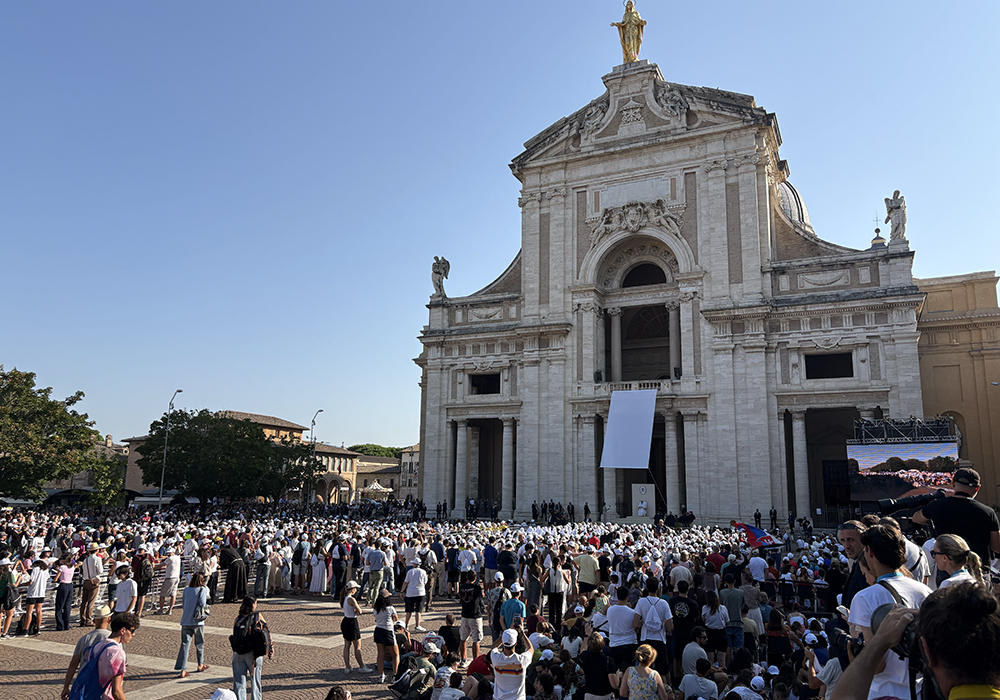
Pope Leo XIV speaks to young Franciscans gathered in the square outside the Basilica of Santa Maria degli Angeli in Assisi, Italy, Aug. 6, 2026. (NCR photo/Camillo Barone)
Responding to Karolina from Croatia, who asked how young Catholics formed in the Franciscan tradition could remain credible witnesses to the Gospel, the pope spoke about reconciliation, religious identity and the dangers of nationalism.
"Increasingly, Christians will be called to become artisans of peace within societies that are tempted to place religion at the service of competing identities," he said. "Being witnesses to Christ, therefore, is both captivating and demanding."
Leo said Franciscan spirituality required Christians to move beyond "artificial boundaries," misinformation and prejudice. He drew a distinction between religious radicalism and fundamentalism, arguing that the radical character of the Gospel should produce humility rather than violence.
"St. Francis, however, teaches that radicalism of the Gospel is the very opposite of fundamentalism," the pope said. "It does not make us blind or violent; instead, it makes us aware, attentive and always eager to follow Jesus, and therefore humble and welcoming towards everyone. It is not an easy path, but it brings much joy."
He invited those present to imagine the same area eight centuries earlier, when friars from across Europe gathered around Francis, sleeping on simple mats and devoting themselves to prayer and works of charity.
The pope also warned that technology was weakening habits of direct human contact and urged the young people to bear witness to a form of community based on face-to-face encounters. "More than words, it is this joy that evangelizes, and it cannot be hidden," he said.
Giovanni Mazzoli, from Bologna, Italy, asked how young people could make definitive vocational choices in a culture dominated by temporary commitments. Leo replied that the disappearance of the stability once offered by traditional societies had created a widespread fear of permanent decisions.
"Choosing 'for ever' does not imprison us within a cage; rather, it opens us to a greater dynamism. To love is an exodus. It is a path to be discovered, a journey that God himself walks with us," Leo said.
Referring to his own vocation, Leo said he had been sustained by people who accompanied him throughout his life as an Augustinian, priest and missionary.
Advertisement
In an interview with the National Catholic Reporter after the event, Mazzoli, who chose to teach mathematics and physics at a high school after studying energy engineering, said St. Francis' radical dependence on God remained relevant eight centuries later. "If St. Francis were alive today, he would set his sights entirely on God, knowing that God loves us especially when we are poor. St. Francis renounced everything, showing us God's great love for us.”
The third question came from Luigi, a 22-year-old from Paternò, Sicily, who asked how Catholics could remain faithful to the church despite its contradictions, crises and wounds.
Leo acknowledged that the behavior of Christians could cause suffering and become an obstacle to faith. He said the church should embody a different understanding of authority from the models of power found elsewhere in society.
The pope recalled the command said to be heard by St. Francis before the cross of San Damiano: "Francis, go and rebuild my house, which, as you see, is falling into ruin!"
"Each of us has a part to play in this work that is always underway," Leo said. "We have different responsibilities and different vocations, yet we walk together, encouraging one another, supporting one another and correcting one another along the way."
While the crowd outside was smaller than anticipated, the basilica was packed for the Mass, despite the heat inside the building.
In his homily, Leo presented Francis and Clare of Assisi as figures who broke with familiar expectations in order to follow the Gospel more freely. He said the continuing appeal of Francis, eight centuries after his death, lay in "the grandeur of humanity that led him to abandon familiar ways in order to find a new path that is more consistent with that of Jesus."
"Well then, dear young people, today Europe and the whole world are looking to you to be new saints," the pope said. "Dare to believe in the word of the Gospel; become fully human with the freedom of Jesus Christ; embrace Sister Poverty!"
"Go! Go! Better yet: Let us go!" he said. "Let's go to the margins, where the injustice and arrogance of a few deny the dignity and dreams of many, of far too many sons and daughters of God."
The pope urged young Christians to reject what he called a "culture of power" and to confront the walls separating individuals and communities.
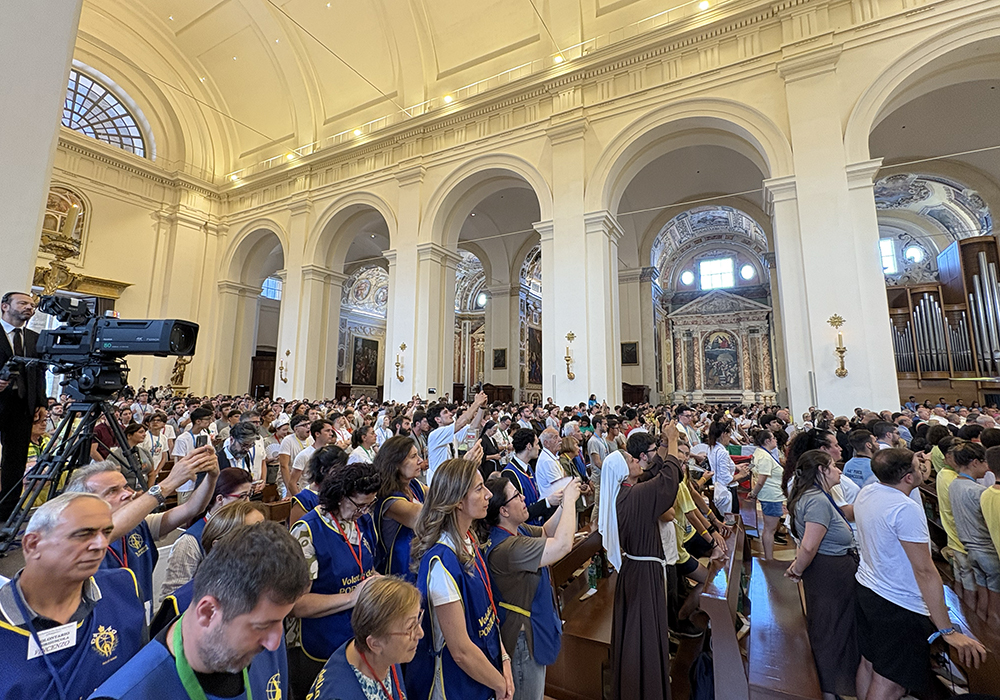
Young Franciscans and their leaders are gathered in the Basilica of Santa Maria degli Angeli in Assisi, Italy, for a Mass with Pope Leo XIV, Aug. 6, 2026. (NCR photo/Camillo Barone)
Among those inside the basilica was Gráinne Connelly, 20, from Galway, Ireland, a member of YouFra Ireland (Franciscan Youth Ireland) who had traveled with her group and completed part of the Franciscan Camino in central Italy.
Asked what St. Francis might say to young adults today, Connelly told NCR that "mistrust is just a very big thing in today's society. I think St. Francis of Assisi would say to trust and to not worry, not be lazy and get stuff done."
Pietro Facchinetti, 17, from Bergamo, had travelled to Assisi with friends involved in an exhibition at the Convent of Santa Maria degli Angeli titled "Prophecy of Peace." Facchinetti is a member of the Catholic movement Communion and Liberation, whose members Leo is expected to meet at the annual event "Rimini Meeting" on Aug. 22.
"The pope's call for unity is essential. One thing I've learned on this trip to Assisi is that I've always thought of St. Francis as a single individual, but here I realized just how much he needed the support and help of his friends," he said.
Giulia Bigoggia, 20, from Turin, Italy, also emphasized the importance of direct encounters.
"First of all, we have to look each other in the eyes. As Cardinal Pierbattista Pizzaballa told us, we never look at the person in front of us: Being united with one another is the most important thing."
Franciscan Fr. Emanuele Ferraresi, who accompanied a group from Florence, described the Assisi gathering as "a moment of great joy," but also as something that would propel the participants forward in their faith, emphasizing that the young adults received "a word that illuminates our path."
The National Catholic Reporter's Rome Bureau is made possible in part by the generosity of Joan and Bob McGrath.