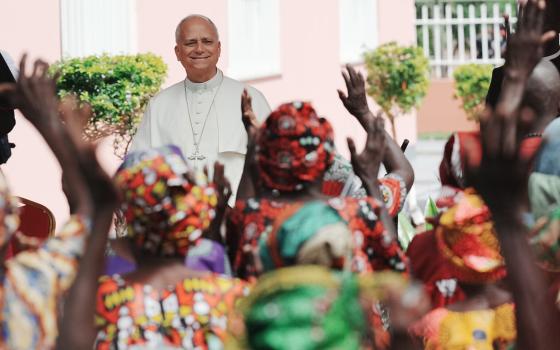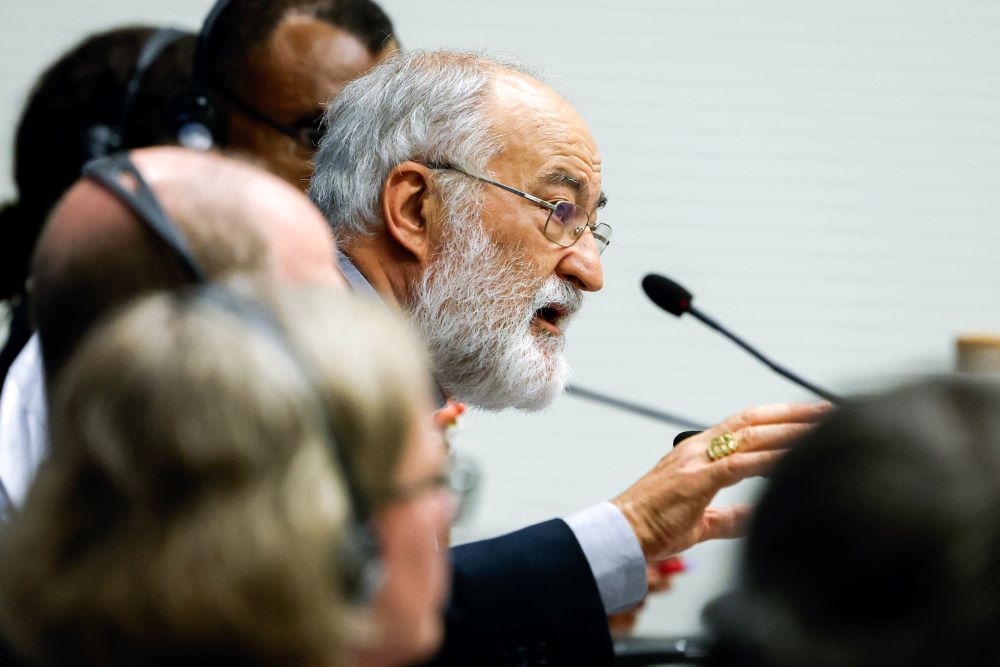
Cardinal Cristóbal López Romero of Rabat, Morocco, speaks during a briefing about the assembly of the Synod of Bishops at the Vatican Oct. 17, 2023. (CNS/Lola Gomez)

Join the Conversation
Send your thoughts to Letters to the Editor. Learn more
Pope Leo XIV's visit to overwhelmingly Muslim-majority Algeria cast a spotlight on what he described as the "small, but very significant Catholic church" in the country, offering a lesson for a global church confronting a decline in adherents.
"Everyone must learn how to be a minority," Cardinal Cristóbal López Romero of Rabat, Morocco, told the National Catholic Reporter and the French daily Le Monde during the pope's visit to Algeria. "To be small is not a disgrace; it is a grace. It is not a tragedy; it is a good fortune to be a small church in service of the kingdom of God."
In the city of Annaba, Leo visited the site of ancient Hippo, where the pope's spiritual father St. Augustine lived and served as a bishop for more than three decades. The Augustinian religious order, to which the pope belongs, maintains a small presence of only three friars in the city to tend to the Basilica of St. Augustine which overlooks the archeological site.
Meeting with the local Augustinian community later in Annaba, the pope said that the tiny Augustinian community there "is much more at the heart of what Augustinian life, and consecrated life in the church, should be."
"The world truly needs martyrdom, but martyrdom in the sense of testimony, giving testimony with your life," he said. "Your presence here truly means a lot."
More than 99% of Algeria's population is Muslim. Catholics number roughly 9,000 in a population of 46.7 million, according to Vatican statistics.
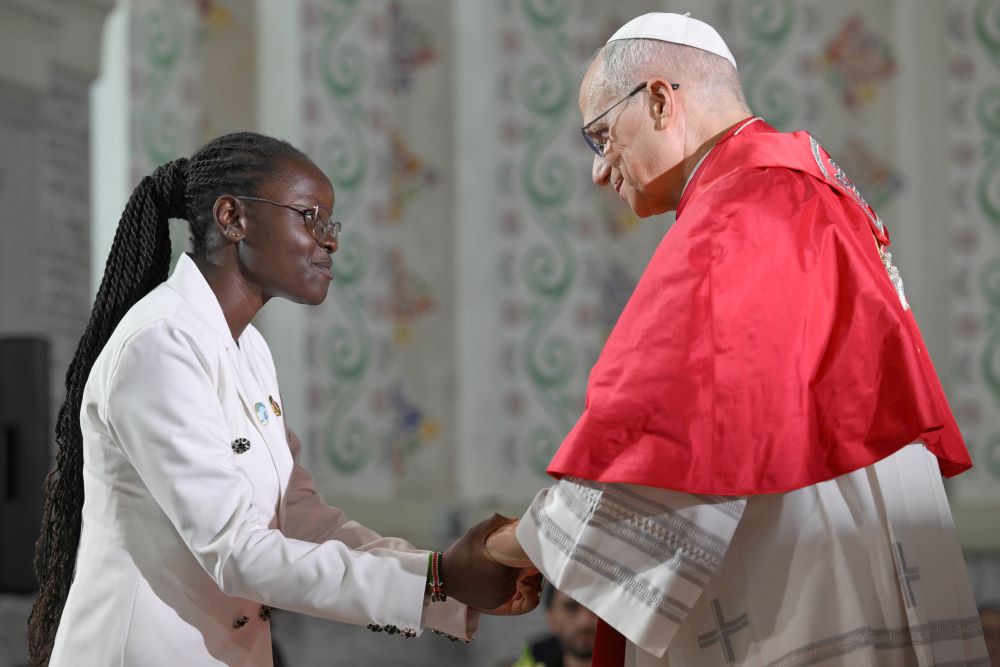
Pope Leo XIV greets a young woman as he attends a meeting with the Algerian community at the Basilica of Our Lady of Africa in Algiers, Algeria, April 13, 2026. Catholics are a significant minority in Muslim-majority Algeria. (OSV News/Vatican Media/Simone Risolutie)
López Romero said that Catholic communities in Christian-majority nations throughout Europe live in a state of "calamity, because there is a decline in those who adhere to the Catholic faith."
But the Catholic communities in North Africa, "we live it as the grace of being small, to be the 'little ones' of which Jesus speaks," the cardinal said. "We are happy to be small alongside a Muslim-majority population, and we live that with joy and with enthusiasm."
The cardinal said that beyond its spiritual value, the pope chose to visit North Africa "to say that he is not a politician, [but] he is bringing the message of the Gospel."
"What he wants to do is build bridges between Muslims and Christians and construct peace," he said.
In the Basilica of St. Augustine, built in homage of the North African saint who is a doctor of the church and revered by the Algerian people, some 1,500 people gathered from across the region for Mass with the pope.
Justin Nsavyimana, a 23-year-old student from Burundi, traveled four hours by bus from the city where he studies in Algeria for the "once-in-a-lifetime opportunity to be in the same place as the pope."
Moving to Algeria as a Catholic was a challenge due to the few churches around, he told NCR; the nearest Catholic church to where he lives is 90-minutes away by bus.
Nsavyimana said he doesn't know much about Pope Leo, but "I do love his ideas; he encourages friendliness and peace."
Advertisement
Ana Paula Soares traveled to Algeria from Tunisia, where she is a missionary with the Shalom Catholic community and traveled with some 30 other missionaries.
She told NCR that the pope's visit to North Africa "symbolizes the communion of the church" since Leo "forms part of that small but lively community where Christians are a minority."
In her native Brazil, the church has "no direct contact with people because there are many Catholics," Soares said. "Where Catholics are a minority, people know your name; the church is truly a family."
"That the pope chose to come here shows that he is a missionary and wants to know the missionary reality," she continued.
The same day Leo celebrated Mass in Annaba, the Vatican published a letter he had sent to the world's cardinals where he wrote that the church must reassess how it communicates "from a more explicitly missionary perspective."
The pope, who spent more than two decades of his priestly life as a missionary in Peru, will spend the rest of his trip through Africa in Christian-majority nations with significant Catholic communities: Cameroon, Angola and Equatorial Guinea.
He arrived in Yaoundé, Cameroon on April 15 and was received with great fanfare, a striking contrast from the muted and intimate atmosphere surrounding the pope's visit in Algeria.
The National Catholic Reporter's Rome Bureau is made possible in part by the generosity of Joan and Bob McGrath.