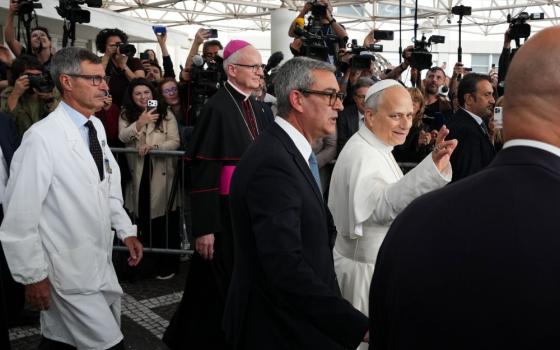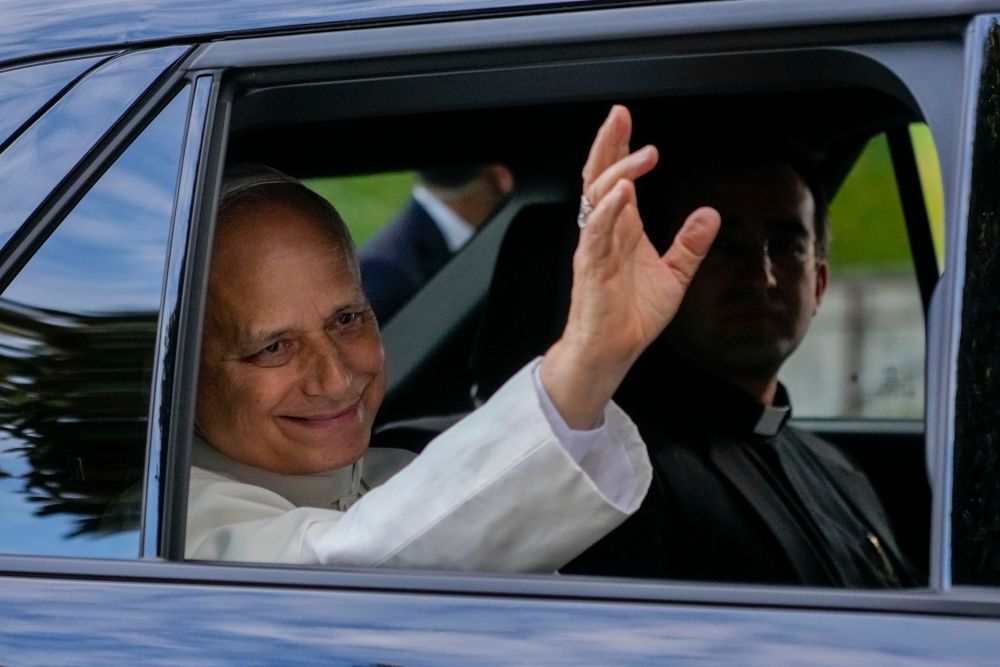
Pope Leo XIV leaves Rome's Gemelli hospital Oct. 17, 2026, four days after surgery to remove lung cancer. (AP/Gregorio Borgia)
As Pope Leo XIV returned to the Vatican Oct. 17, four days after lung cancer surgery, his surgeon said there are "no clinical reasons" to prevent his planned trip to Latin America next month.
"The Holy Father has put his heart and soul into his recovery," Dr. Stefano Margaritora told Vatican News, adding that he expected the pope to recover fully from surgery "in another 10 days or so."
Leo, 71, is scheduled to make an ambitious Nov. 6-17 trip to Uruguay, Peru and Argentina, including a dozen flights and two helicopter rides to high altitudes.
"As for a long trip involving air travel in about three weeks, I would say there are no clinical reasons why it should not take place," Margaritora said.
Leo had the lower lobe of his right lung removed Oct. 13 in the first major health event of his 17-month pontificate. The surgery confirmed he had adenocarcinoma, the most common type of lung cancer. He left the hospital Oct. 17, well ahead of the weeklong hospital stay the Vatican had initially anticipated.
"I am much better, thank you," the pope said when asked how he was as he was driven away in a black SUV.
Leo greeted patients inside the hospital accompanied by his surgeon, before waving to well-wishers outside who cried out "Holiness" as he walked to a waiting vehicle.
He paused when a 13-year-old Ukrainian girl presented him with a homemade papal doll that she said had helped her through successful cancer treatment. She had briefly met Leo at an audience in St. Peter's Square last December — an encounter she told reporters "gave her the strength to overcome the illness."
Leo will take on his first official duty on Oct. 18, delivering the traditional Sunday Angelus blessing to the faithful in St. Peter's Square. It comes exactly one week after the pontiff revealed to throngs in the square that the nodule had been found and would be surgically removed — an unusually candid revelation for the Vatican.
Margaritora, the chief thoracic surgeon at Rome's Gemelli hospital, also confirmed that the nodule was discovered by chance during routine abdominal examinations. It appeared as "a small spot" at the base of the lung, which extends down to the diaphragm, he said.
He added that if the spot had been higher up, "it certainly would not have been seen."
The cancer was in its early stages, and the pope had "no respiratory symptoms, and felt perfectly well," Margaritora said.
He described the procedure to remove the lobe as "routine" and "without complications," but acknowledged that it "stirred deep feelings ... to operate on a pope, who for the first time — at least in modern history — is undergoing surgery for a malignant tumor."
Margaritora said the pope's recovery so far had required "very little assistance from us."
"His determination to recover quickly has been effective in every respect. It was truly commendable," the surgeon said.
Advertisement