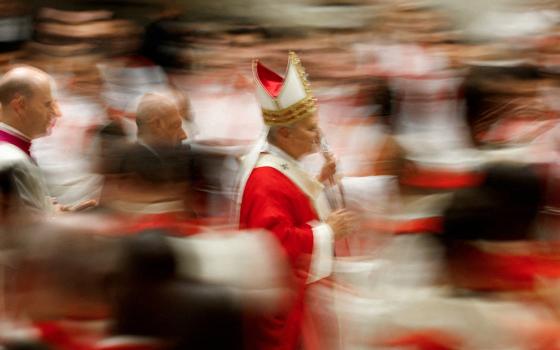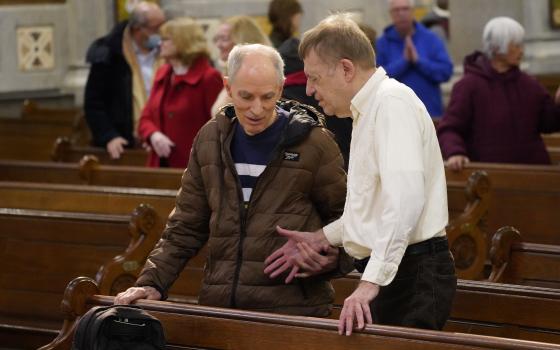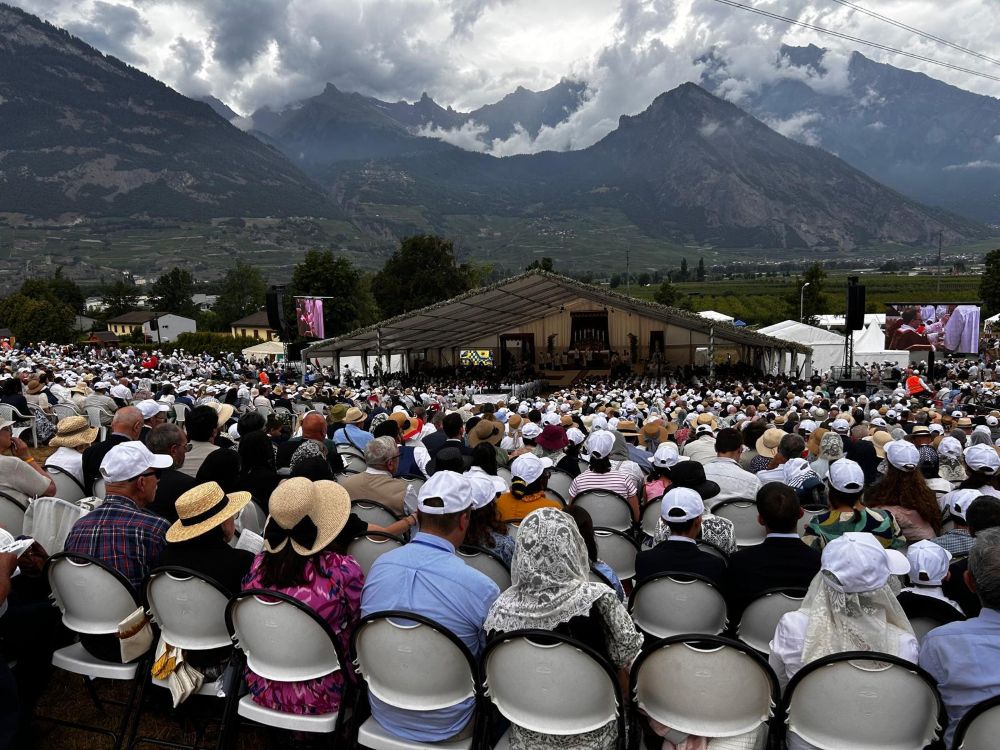
People attend a Mass for illicit bishop consecrations held at the international seminary for the Society of St. Pius X in Écône, Switzerland, July 1, 2026. Organizers said more than 16,000 people attended the Mass. (NCR photo/Justin McLellan)
Join the Conversation
Send your thoughts to Letters to the Editor. Learn more
More than a rupture, the scene surrounding the most significant schism in the Catholic Church's recent memory felt like a reunion.
That was what I kept feeling on the hillside grounds of the Society of St. Pius X's international seminary in Écône, Switzerland, where 16,000+ traditionalist Catholics gathered July 1 to witness the illicit consecration of four new bishops in open defiance of Pope Leo XIV.
From Rome, the countdown to the consecrations had felt like watching a storm gather overhead, prompting speculation over what would descend from the darkening clouds upon these "rebel" Catholics threatening to break from the church. But beneath the Swiss Alps, the atmosphere was not one of grim defiance, rather it was a festive scene tinged with relief and charged with righteousness.
Already on the way to Écône, it felt like I was gravitating toward the center of something significant.
On the bus from the northern Italian border into Switzerland, a priest in a full cassock sat immediately behind me. Across the aisle, a young woman carried a hiking backpack with sewn-on crosses and the dual-hearted logo of the SSPX. I knew we were headed to the same place.
Just before I boarded the bus, the Vatican had published a letter Pope Leo sent the previous day to the SSPX's superior general urging him not to proceed with the consecrations. As the bus wound through the mountains, I opened my laptop and began writing an article on the pope's last-minute appeal, wondering whether the priest behind me could see my screen through the crack between the seats.
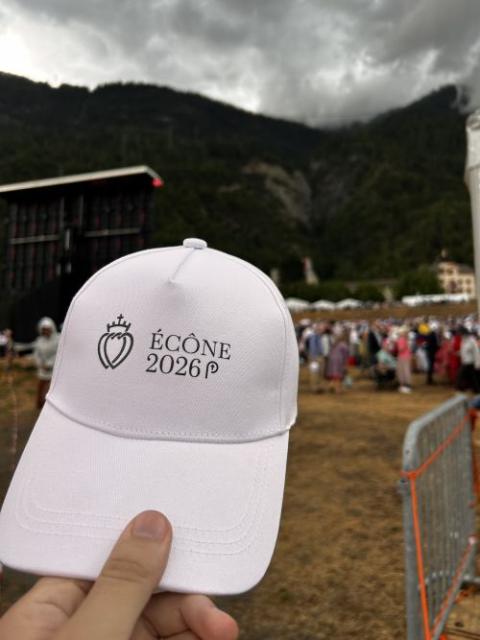
A cap distributed to Mass attendees is pictured ahead of the illicit bishop consecrations held at the international seminary for the Society of St. Pius X in Écône, Switzerland, July 1, 2026. (NCR photo/Justin McLellan)
I spent the night in a town near Écône which drove home how rural my surroundings were: There was one restaurant and no supermarket, but the cool mountain air blowing through vineyards and fields of apricot trees was a relief from Rome, which by late June had already become a boiling, air conditioning-averse furnace.
Early the next morning, the train to Saxon, the nearest station to Écône, was a mixed bag of ordinary commuters and large traditionalist Catholic families. Some passengers were clearly headed to offices, while the more formal crowd wore suits, ties, long skirts and chapel veils. A group of women wore large devotional scapulars bearing the SSPX logo.
At the station, two smiling Swiss men in orange safety vests, the society's emblem printed across their backs, directed pilgrims toward shuttles for the seminary.
I detoured to a supermarket to buy a sandwich for lunch and, seeing the clouds gathering overhead, an umbrella. I stopped for coffee and asked the barista, who had noticed my suit, whether she knew much about the seminary down the road.
"We don't really see them much — sometimes they come into town to play on the soccer field," she told me. "I am not religious, but of course everyone should be able to believe what they want."
The image of SSPX priests and seminarians, cast as a constant menace in Rome and threat to the unity of the church, being known in town as the guys who sometimes play soccer on the local pitch amused me.
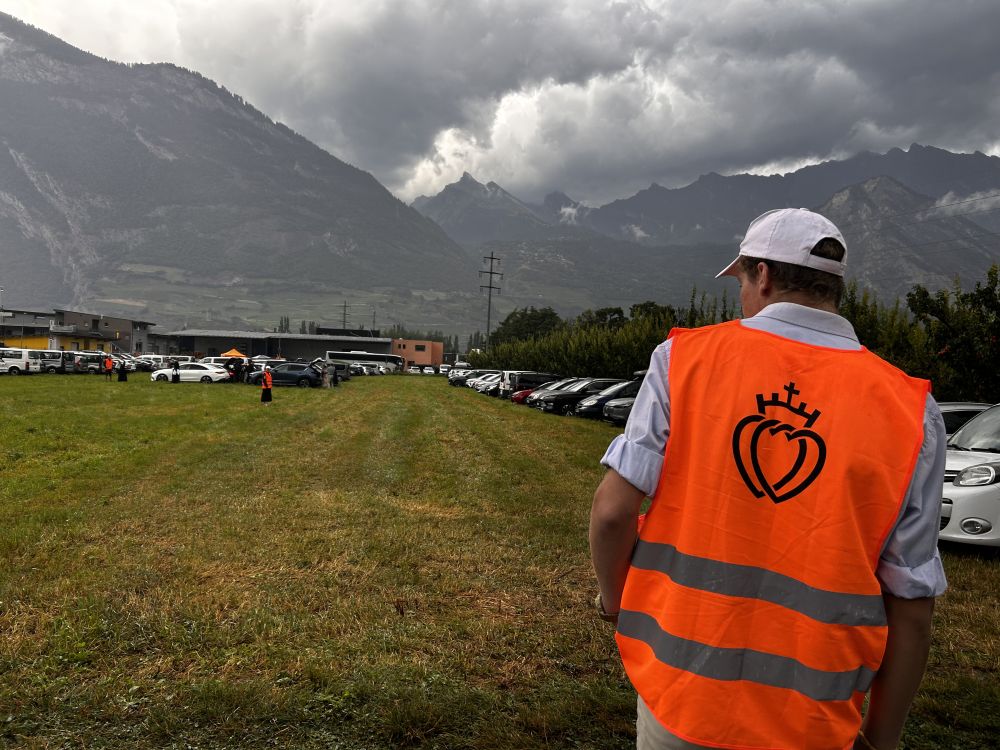
A volunteer directs parking in Écône, Switzerland, before a Mass for illicit bishop consecrations at the international seminary for the Society of St. Pius X July 1, 2026. (NCR photo/Justin McLellan)
As I returned to the shuttles, rain began to fall gently.
But the mood among the pilgrims remained light and sociable. A family from St. Marys, Kansas, became a small sensation when European attendees recognized their town — touted as the largest SSPX community in the world — and said they hoped to visit someday. Other families swapped travel stories and compared the logistics of bringing children from across the globe to rural Switzerland. Two groups from different continents discovered the same SSPX priest had served as their pastor.
I remembered something a theology professor of mine once said in a history of Christianity class: "To understand a heresy you must understand why it is attractive."
I immediately saw what was attractive among this group of Catholic dissidents: the built-in community and the instant warmth they offered one another once they learned that someone else, too, was part of their tribe.
One young woman who attended the consecration told me, only half-jokingly, "my friends and I thought we could find husbands here."
Of course, the backdrop for that instant connection is support for the society that has been constantly accused of open antisemitism, promoting misogyny and sexual abuse cover-ups.
But at idyllic Écône, the society's adherents, free from natural predators, were able to bask in one another's presence, blissfully ignorant of the canonical consequences that were due to come crashing down from Rome the following day.
After receiving a musical festival-style wristband and entering the hillside compound, I was told that an escort would accompany each member of the press around the grounds and that selected SSPX clergy and lay faithful would speak to the press after the event. Despite this directive, I managed to slip out the back of the tent and talk to some laypeople before Mass got underway.
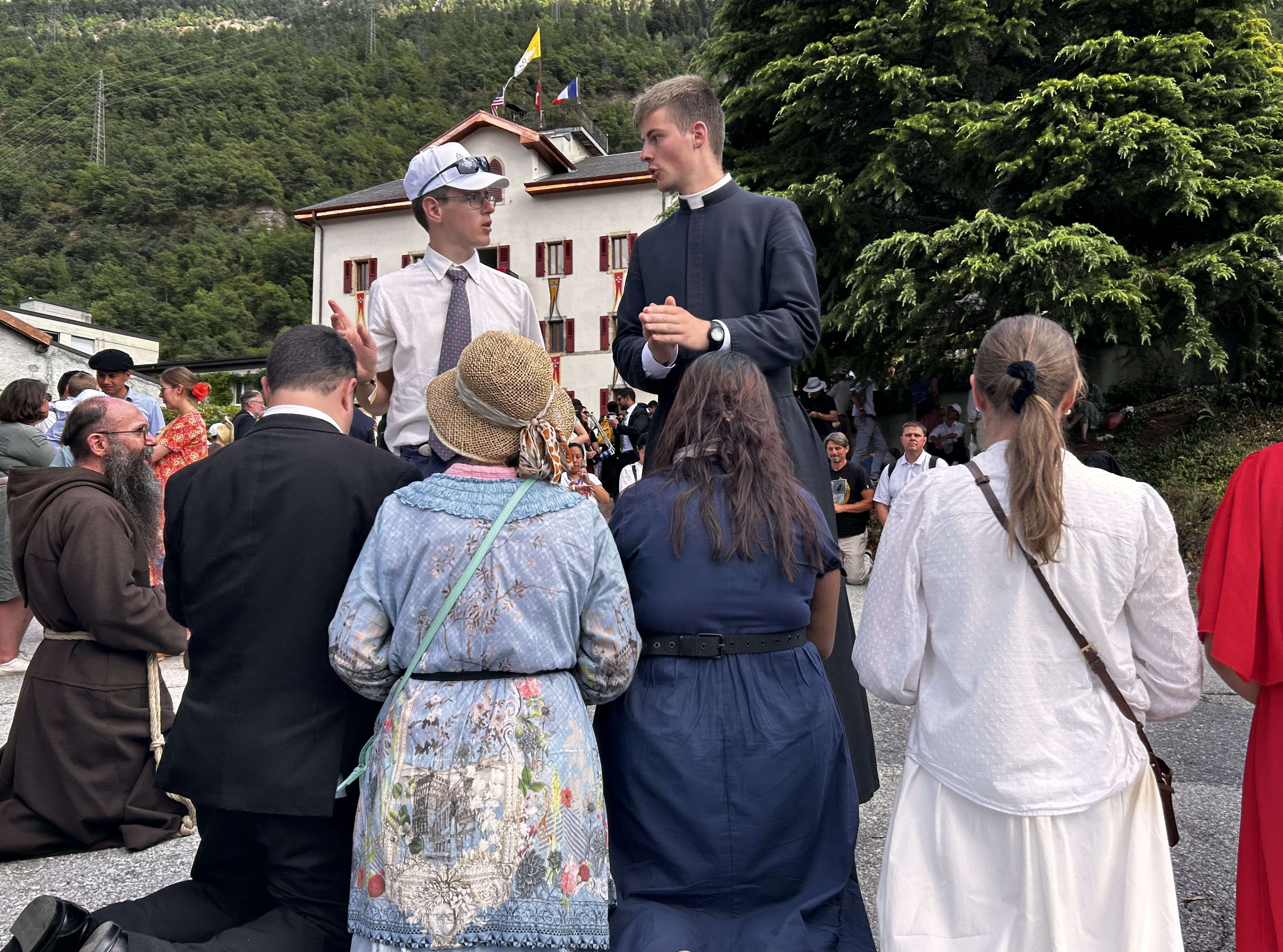
People kneel for a blessing after attending Mass for illicit bishop consecrations held at the international seminary for the Society of St. Pius X in Écône, Switzerland, July 1, 2026. (NCR photo/Justin McLellan)
I quickly realized that the looming threat of excommunication, which had framed the whole event for me, was almost a passing afterthought for most of the attendees. Many were eager to speak to the press, and amid smiles, talked about the beauty of the event and its affirmation of traditional Catholicism's vitality. Questions about the threat of excommunication prompted talk of sadness, but less for themselves, this "small army of loyal sons," as the society's superior had described them, than for the Catholic Church itself, which they saw as adrift and failing to grasp onto the lifeline that could pull it back to stability — namely, the traditional brand of Catholicism embodied by the SSPX.
Several Massgoers told me that whatever Rome declared, their lives and their faith would not change. As professed adherents to a religion characterized by its rigid hierarchy, several lay faithful outright rejected the validity of its pronouncements, insisting that when authority butts heads with the "truth," the truth triumphs each time.
Others accepted the impending excommunications, but suggested that any such decision would eventually be lifted, just as Pope Benedict XVI lifted the excommunications of the four SSPX bishops consecrated without papal approval in 1988 by the society's founder, Archbishop Marcel Lefebvre
To many people at Écône, that precedent functioned as a historical reassurance that while penalties may come, they can be reversed once the wayward Vatican comes to its senses. In the minds of many, conflict with the Vatican may be a necessary or painful cross to bear, but one that would eventually result in vindication.
But for many of the under-40 crowd present, that historical precedent was merely legend. Since 1988, generations have been brought up within the global, burgeoning SSPX infrastructure of parishes and schools, 103 and 26 respectively in the United States. To leave adherence to the SSPX now would mean to leave the only faith communities they have ever known.
Advertisement
Even if the mood was celebratory amid the drizzle during Mass, a message soon appeared on the screens that displayed the ceremony for the 16,000+ spectators: "Beware imminent thunderstorm."
While I huddled inside the press tent during the Mass, thunder could be heard and lightning flashed through the cracks of the tent just as the presiding bishop consecrated the host. I had to pick up my backpack resting on the dirt ground which quickly turned into mud when the water flooded inside the tent.
Journalists inside joked that the storm was evidently the wrath of God manifesting itself at what the pope had called "a sin of extreme gravity." It seemed too poetic to be true.
But after Mass, and once again slipping out from the SSPX security apparatus, I spoke to pilgrims in muddied footwear who prayed through the downpour and came out of it with a very different interpretation.
"It allowed everyone to show their support, to pray the rosary and to ask the Virgin Mary to protect us," said one SSPX priest after the Mass. "It was the gracious God who planned it that way."
The National Catholic Reporter's Rome Bureau is made possible in part by the generosity of Joan and Bob McGrath.