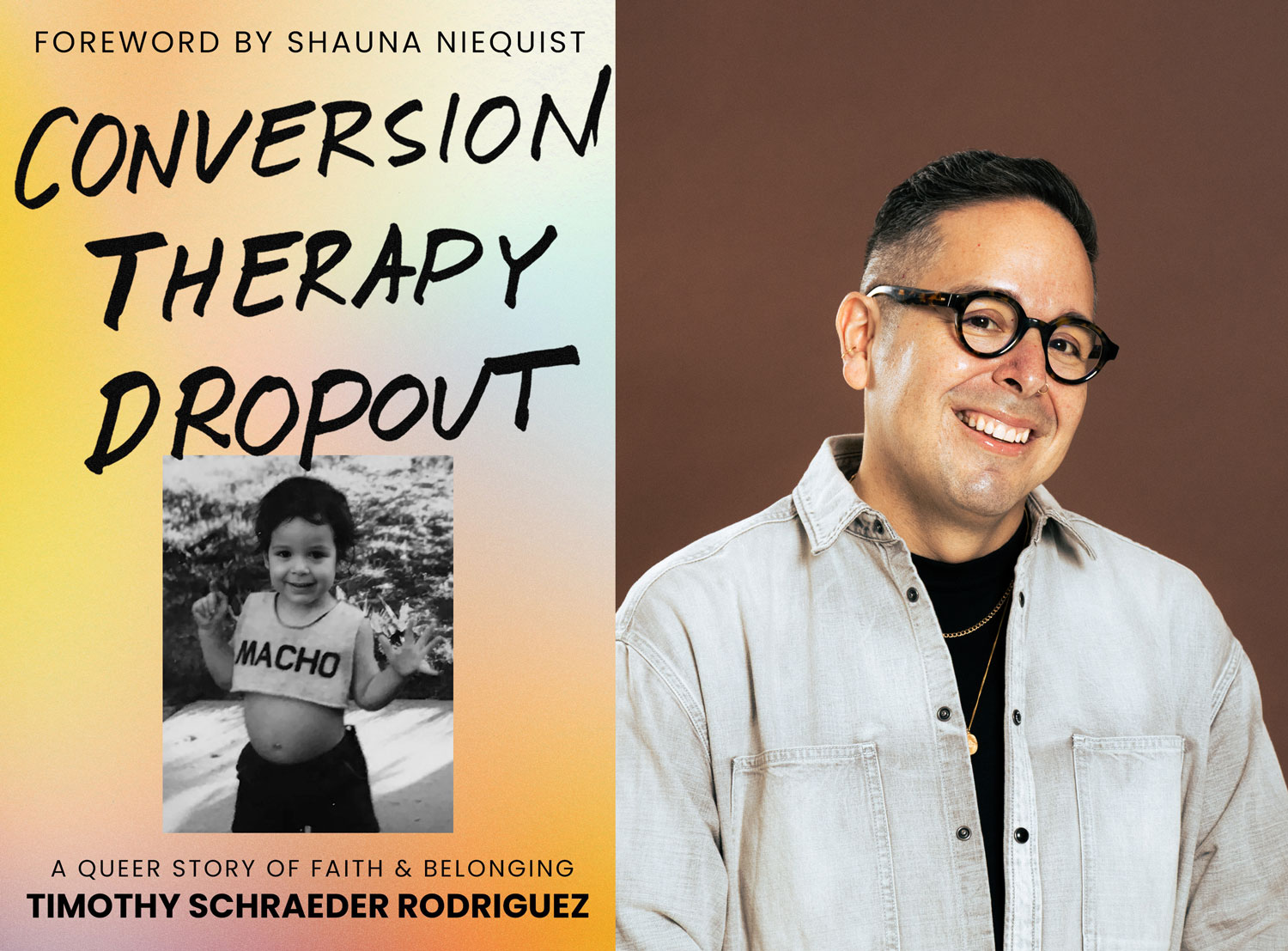
'Conversion Therapy Dropout' by Timothy Schraeder Rodriguez. (RNS)

Religion News Service
Join the Conversation
Send your thoughts to Letters to the Editor. Learn more
When the U.S. Supreme Court passed down its 8-1 decision against Colorado’s ban on conversion therapy last month, Timothy Schraeder Rodriguez knew exactly what was at stake.
That’s because he spent eight years in conversion therapy, inundated with messages about the need to change himself to be accepted by his evangelical Christian faith community. Even after his exit from the “ex-gay” organization Exodus International, Schraeder Rodriguez continued to work behind the scenes for evangelical powerhouses like Hillsong Church, Willow Creek Community Church and Elevation Church — but soon grew weary of being accepted for what he could contribute to these groups, but not for who he was.
In his debut book, Conversion Therapy Dropout: A Queer Story of Faith & Belonging, Schraeder Rodriguez gives an inside look at his attempt to “pray the gay away.”
RNS spoke to Schraeder Rodriguez about his journey through conversion therapy and how the practice persists today. This interview has been edited for length and clarity.
How do you define conversion therapy?
Conversion therapy is a mix of pseudo-psychology and spirituality. In the 1950s and 1960s, therapists were trying to help people overcome homosexual tendencies. The premise is that sexual disorientation is the result of early childhood trauma, and through behavior modification and psychotherapy, it’s possible to change sexual orientation. In the extreme cases, there was electroshock therapy and lobotomies. The American Psychiatric Association removed homosexuality from the Diagnostic and Statistical Manual of Mental Disorders in 1973, essentially disavowing the whole idea of conversion therapy. But the church picked up the ideas of conversion therapy and applied a spiritual layer to suggest that it would be possible for someone to become straight through an intimate relationship with God. In 1973, a group of people had the first gathering of Exodus International.
What did those methods look like for you?
There was a big emphasis on behavior modification, learning to lower the tone of your voice, to do away with female or flamboyant mannerisms, to watch what clothing you wear and to monitor what media you consume. The idea was, you do what you can to change the outside. You pray for God to change your inside. They also taught that men struggling with homosexuality didn’t have the right kind of male relationships early on, and through puberty, that need was sexualized. Their solution was to develop relationships with men who can model a “normal” relationship.
What does the research show us about the efficacy of conversion therapy?
In 2013 Exodus International publicly admitted that in their nearly four-decade history, they don’t believe that they had seen anyone successfully change their sexual orientation. Since the 1970s, the psychological and medical community has said that conversion practices are harmful. Recent research found that folks who have gone through conversion practices are more than twice as likely to commit suicide. They have higher rates of alcohol and substance abuse, and because of those traumatic encounters, are less likely to be engaged with organized religion and are untrusting of therapeutic settings. It’s been proven time and again to be more harmful than it was ever helpful.
What was the tipping point for you? When did you decide to walk away?
I had been at some major Christian conferences with some of the leading evangelical Christian mega church pastors, realizing that if they knew the truth of who I was, my whole career would implode. After that realization, I didn’t get out of bed for five days. I had a nervous breakdown, and I emerged from that knowing that I couldn’t keep doing what I was doing. Rather than ending my life, I just decided I needed to end the way I had been living it and try to imagine what life could look like outside of conversion therapy.
What does the relationship between your spirituality and sexuality look like today?
After I moved to New York City in 2018, I realized I was still needing to heal from conversion therapy. I came to realize that I was struggling with alcoholism and addiction. So I found my way back into church basements, only this time, I wasn’t praying for God to change my sexuality. I was believing that with God’s help, I could become sober. Twelve-step recovery is a spiritual program of action, and it’s all about defining a God of your own understanding. Recovery gave me God back. The God that I serve today is a God of love and compassion that cares about everyone. The biggest lesson I had to learn is that God’s lack of an answer to my prayers to change me was an answer, because there was nothing about me that needed to change.
Where is conversion therapy persisting today?
As of this moment, there are 27 states that have conversion therapy bans that ban the practice for minors in therapeutic settings. But the practice has only continued to grow, mainly in religious contexts, because there is a blanket exemption for anyone that’s seeking conversion therapy under religious grounds.
The Trevor Project last year released data that showed the number of LGBTQ youth exposed to conversion therapy doubled in a year’s time. Social media is enabling a lot of these organizations that wouldn’t call themselves conversion therapy ministries, but if you look at the core of what they are doing, it is just a repackaging of everything I heard when I was in conversion therapy: that who you are is a result of trauma, the gay identity is broken, that God can heal you. It’s very insidious. It’s sad to see a whole new generation of young people being taught to believe those things are true.
Advertisement