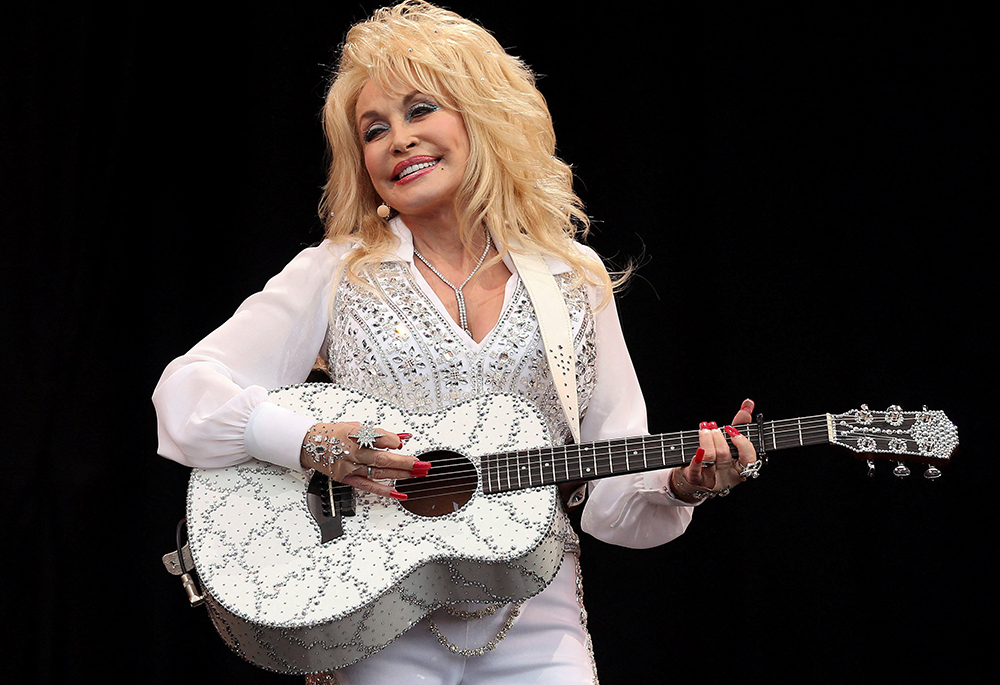
American country music star Dolly Parton performs on the Pyramid Stage at Worthy Farm in Somerset, England, during the Glastonbury Festival June 29, 2014. Parton, 80, died Aug. 25, 2026, after a brief battle with cancer. (OSV News/Reuters/Cathal McNaughton)

by Michael J. O'Loughlin
NCR executive editor
Join the Conversation
Send your thoughts to Letters to the Editor. Learn more
The days before Christmas in 2020 weren't so bright. The pandemic was still in its infancy and a prominent scientist warned that we faced the "darkest winter in modern history." Hope seemed far off.
Around the same time, vaccines for COVID-19, which promised a return to normalcy and an end to isolation and loneliness, were just becoming available to first responders, including my husband, who worked in a busy Chicago emergency room. The morning of his vaccine appointment arrived and I joined him on the ride to suburban Chicago. Finally, a glimmer of hope. Sporting a blue and pink "Pro-Dolly, Pro-Science" T-shirt, my husband blasted one of Parton's songs as we drove up to the hospital:
'Cause I can see the light of a clear blue morning
I can see the light of a brand new day
I can see the light of a clear blue morning
Oh, and everything's gonna be all right
It's gonna be okay.
Parton died Aug. 25 at age 80. I'm not much of a country music fan, but Parton's songs are among my most played. Among my favorites were some of her moodier hits, including her slightly melancholy "I Will Always Love You," the mournful "Jolene" and her mystical rendition of "Turn, Turn, Turn."
In addition to singing along to her music, I always enjoyed reading about her many acts of charity. She donated more than 300 million books to children, raised money for hospitals and even donated $1 million to research that led to a COVID-19 vaccine.
Parton didn't take herself too seriously. She made others laugh, urged people to be kinder and more accepting; and at the same time, she was a shrewd businesswoman who sought to appeal to as many people as possible.
"I don't like to get involved in politics, because first of all, I have as many Republican fans as I do Democrats," Parton told USA Today in 2020. "I don't want to offend anybody, I have a right to myself."
Since her death was announced Aug. 25, I've wondered what was it about Parton that drew so many to her? It seemed that something more than her music, her movies or her charity was at work. Maybe a combination of all three? Or was there something more?
Jesuit Fr. James Martin thinks it could have been hints of "holiness."
"When you read even cursorily about her life, what becomes obvious is a Christian faith that led to a lifetime of kindness and charity, often behind the scenes," Martin wrote. "We saw in Dolly Parton something more than talent, something more than wit and something more than even charity; we saw holiness."
Tributes to Parton are almost too numerous to list. The president ordered that U.S. flags fly at half mast for a full week, the Buckingham Palace guards played her music and even a Catholic diocese in Parton's beloved Tennessee paid homage.
"I am very sorry to hear of her passing, and I am praying for those who are mourning her loss," said Knoxville Bishop Mark Beckman. "She made a wonderful contribution to our world and our community, and she will be greatly missed."
It's not everyday that an entertainer known as much for her over-the-top appearance as her music is praised by a Catholic bishop. (Parton was always in on the joke. "It costs a lot of money to look this cheap," she quipped.)
Parton's humor was infectious. I loved her in "9 to 5." This week I've been laughing at her self-deprecating jokes in old late-night interviews, and reading about the joy she brought others has been a balm. But for me, the beautifully sad essence of some of her work is what sticks with me most.
Back in that difficult year of 2020, Parton's music had been something of a soundtrack in our home. It seemed like one of her albums was always spinning while making dinner or enjoying drinks with our small circle of pandemic bubble friends. There were Christmas albums. 1980s rock duets. Famous covers. And a particularly bittersweet CBS special in early December, "A Holly Dolly Christmas."
Advertisement
Parton had flown in musicians and spent lavishly to ensure everyone remained safe in the weeks leading up to the taping. The stage was bare bones and many feet separated everyone on stage. There was a slightly eerie quality to some of it, what should have been escapism from the troubles around us. Our family's big Christmas party, a staple since childhood, would take place virtually. Attending Advent Masses felt too risky. Christmas gatherings were canceled. All that, combined with the bitter fallout from the 2020 election, felt like we were doomed.
But Parton offered hope, something in short supply that winter. Her song, "I Still Believe" still gets me:
I believe to my very core
We'll walk again in the sunshine by the seashore
That we'll dance and we'll sing and be happy again
Don't know how or when, but we will again, you'll see
I believe.
Parton certainly believed. Her version of Christianity sticks out for being radically inclusive, full of laughter and love and never taking itself too seriously.
"Every single day, before I do anything, I wake up and I thank God for the night and ask him to bless the day and to bring all the right things," Parton once said in an interview, according to a recent piece published in The New Yorker. "And just to guide me, lead me. And I always pray that he’ll let me uplift mankind and glorify him."
Though Parton's death is a moment of sadness for her many fans, looking back at her life provides opportunities to remember she was a person of hope. That's the message her family provided when announcing her death, saying she "lived in the light, and is in the arms of Jesus."
Months after we blasted "Light of a Clear Blue Morning" in the car on the way to a vaccine appointment, my husband and I were on vacation with friends. We were at a piano bar (still outdoors) and requested the same song. The piano player, a big fan of Parton's, was happy to oblige. Those same lyrics, which in that dark winter promised of a far-off hope, were sung this time with jubilation, an answered prayer that no matter how bleak things may seem now, we're called to live believing in the promise of the light of a clear blue morning.