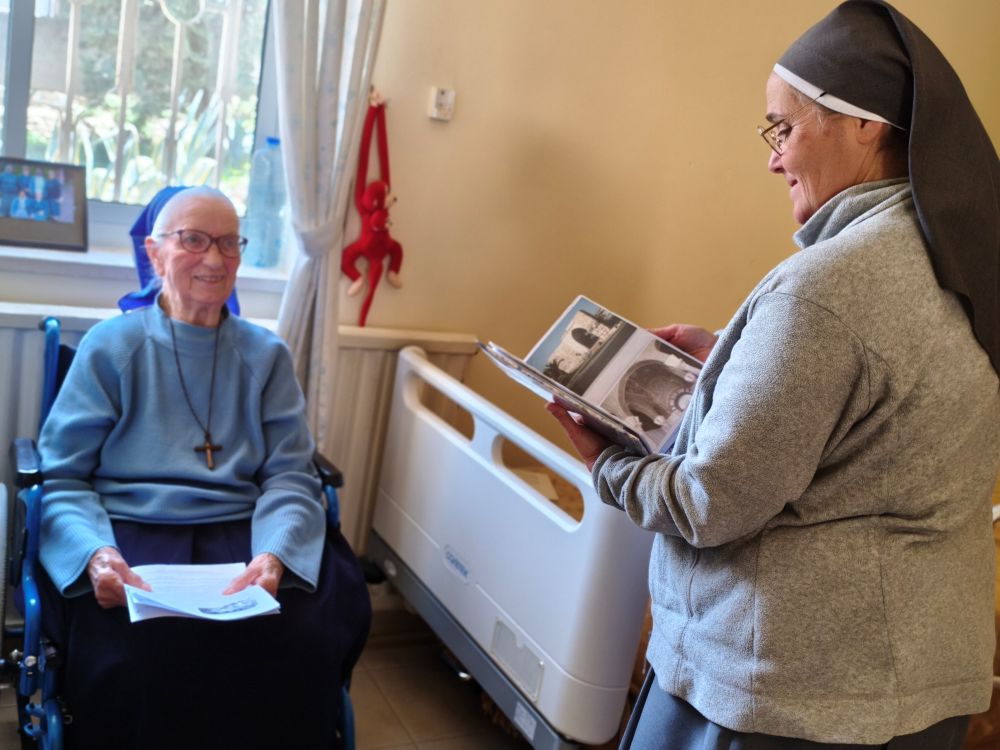
Home Notre Dame des Douleurs resident Sr. Rose Veplad (left), a member of the Little Sisters of Jesus congregation originally from Germany who has spent 60 years in Israel, enjoys a visit with home assistant manager Sisters of Daughters of Our Lady of Sorrows Sr. Claire-Emmanuel Pontroué. (Judith Sudilovsky)

by Judith Sudilovsky
Join the Conversation
Send your thoughts to Letters to the Editor. Learn more
In the early morning of April 8, just hours before the two-week ceasefire in the U.S. and Israel war with Iran was officially announced, an Iranian-launched missile landed in East Jerusalem, not far from the Home Notre Dame des Douleurs.
Awoken by the red alert air raid alarm warning, the four sisters of Daughters of Our Lady of Sorrows who run the retirement home, along with the home's night employees steadily moved around the rooms of the 26 residents to check on them. This reassurance had become common practice at all hours during the six-week war as Jerusalem was targeted by the Iranian missiles.
"I woke up very quickly and (when I heard the explosion) I thought, it's our house. It was so close," said home assistant manager Sr. Claire-Emmanuel Pontroué, 55, who arrived at the home just 11 months ago. "We went and we saw every resident. Some of them were woken up because they heard and they were afraid and I told them, 'No, everything is safe.' And then they went back to sleep."
Though the sounds of war have accompanied most of the residents during many moments of their lives here, the fear is still present for some, especially as they age, Pontroué said.
"We went and we saw every resident. Some of them were woken up because they heard and they were afraid and I told them, 'No, everything is safe.' And then they went back to sleep."
—Sr. Claire-Emmanuel Pontroué
"With the elderly, sometimes they don't realize what happened. Some of them are able to hear the noise and they (feel) threatened. They don't understand everything, but they hear and they understand that it is a war," she said. "But the ones who are able to understand … they are able to watch television or they know the situation. They are always saying, 'Thank God we are alive. Alhamdulillah' ('praise be to God.') "
Sr. Camille Fermina Herraiz Martinez, 80, who is from Spain, has been at the home since 2014, and is the superior; Sr. Marie-André Ata, 80, originally from Lebanon, has been at the home for one-and-a-half years and Sr. Yvette Falanka, 51, originally from Congo, came to the home four years ago after working in Lebanon.
The Home Notre Dame des Douleurs, which serves both Christians and Muslims, is the only non-private nongovernmental nursing home in East Jerusalem. Many of the elderly residents are poor and lack family, making the sisters like their family, said Pontroué. She said that the home is in the process of gaining official recognition by the Israeli Ministry of Health, which will help financially and organizationally.
Resident Diana Safieh, 85, who has been at the home for three years, said all her family members live abroad and she has found a caring home with the sisters. She struggles to breathe with an oxygen machine but her brain is sharp and she is eager to discuss the political situation, saying that unfortunately she does not believe the ceasefire will hold. Very "bad things" are happening in Lebanon, she said and the war was "stupid of Trump" who "pretends to be the biggest man."
"I am not afraid," she said. "Ever since I was born I have been living with war. Men will never learn. War will never bring peace. Peace comes from negotiations. And if there is love among human beings there would be no war."
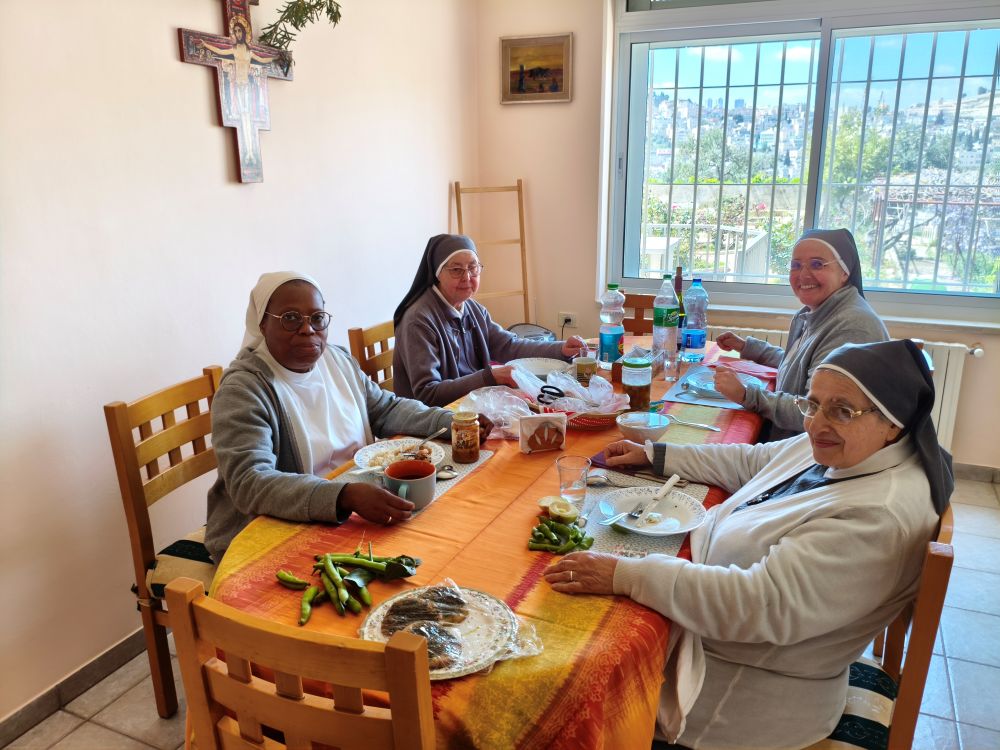
During the U.S. and Israel war with Iran, Daughters of Our Lady of Sorrows Srs. (from left) Yvette Falanka, 51, from Congo; Camille Fermina Herraiz Martinez, 80, from Spain; home assistant manager Sr. Claire-Emmanuel Pontroué, 55, from France; and Sr. Marie-André Ata, 80, originally from Lebanon, "put their lives in the hands of God" and trusted in prayer as they cared for their 26 charges at the Home Notre Dame des Douleurs senior care home in Jerusalem. (Judith Sudilovsky)
During this recent war, family members who live nearby have been unable to visit because of safety reasons, noted Pontroué. The home struggles financially to meet daily needs, requiring constant prayer for assistance and often families help the sisters with donations to cover monthly expenses and necessities.
All 14 of the Home Notre Dame des Douleurs' Palestinian employees are from the West Bank, facing severe challenges commuting due to closed checkpoints and lack of public transportation. Pontroué sometimes has to drive employees to checkpoints when normal routes are inexplicably closed, forcing detours of up to an hour, she said. Some employees have slept at the facility to ensure they could work. Two of the three volunteers who were working at the home at the outbreak of the war chose to return to their home countries, she added.
Israeli-Jewish volunteer Joelle Benda, 73, who met the sisters two years ago, has returned to volunteer making the two-hour bus ride once a month from her home in Northern Israel, which has been under bombardment from Hezbollah during the war.
"The sisters are always giving a good word to everybody, they are always there with an open heart and a desire to help, not just when they are needed," she said.
Pontroué said she finds peace and a "fullness of life" in the elderly, even at their end of life, and feels she is serving Jesus directly by caring for them. Despite being far from her family in France, where her mother has Alzheimer's, she views her placement in the Holy Land as a divine grace and a blessing.
"For me it's a grace from God, a blessing from God to be here, because I feel so poor and when I'm poor, I'm living the sentence of the Bible: When you are poor, you are rich," she said. "Here the house needs so much money to live everyday life. So I have to pray to God to help us."
For Ata and Falanka, the six weeks of war have been especially difficult as they cared for the elderly under the daily threat of missiles from Iran, while also worrying about their loved ones in Lebanon under attack from Israel.
The sisters are hopeful that peace will prevail and the tenuous 10-day ceasefire between the U.S., Israel and Iran will be extended. But with U.S. President Donald Trump's naval blockade of the Strait of Hormuz, the only thing they can do is pray, and put their lives in the hands of God, said Herraiz Martinez.
As they cannot know what the future will bring, the sisters endeavor to live their lives and project a sense of confidence and faith in God, she said, in order to help their elderly charges surpass the difficult moments through prayer and togetherness.
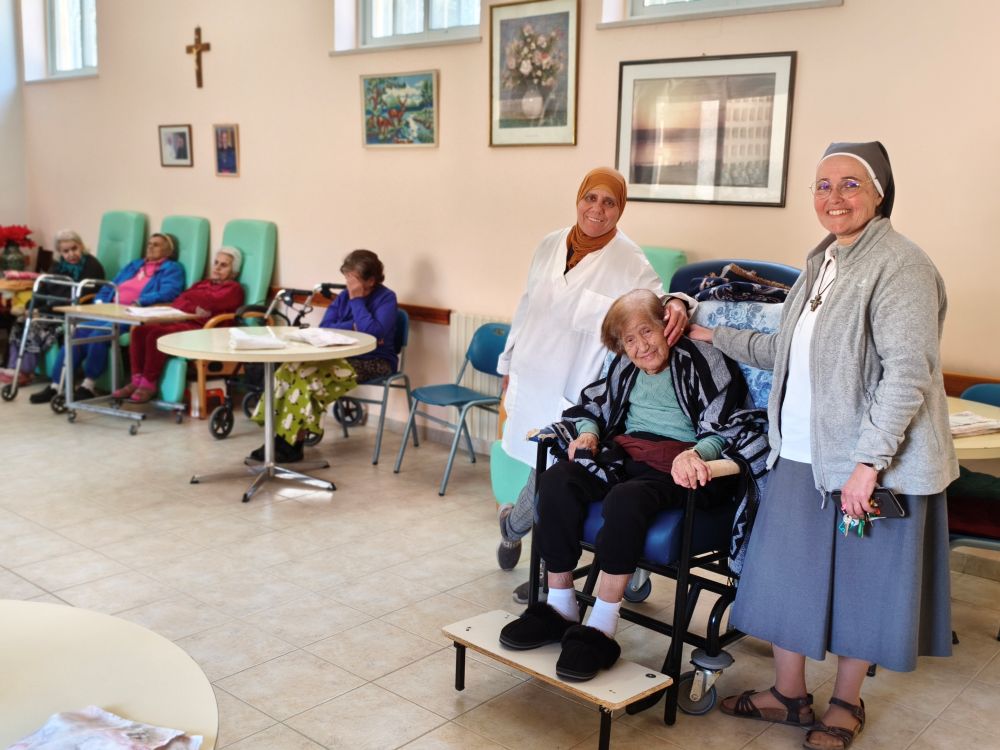
Home Notre Dame des Douleurs caretaker Amreh Kourd and home assistant manager Sr. Claire-Emmanuel Pontroué share a moment with a resident of the home in the communal dining room where the residents spent most of their daytime doing activities during the war. (Judith Sudilovsky)
"We hope with all our hearts that the war will end," Herraiz Martinez said. "We have to continue to live and to give war its own meaning. Life does not stop because of the war. God always works in all hearts and we must always have hope that life is stronger than war, that life will be stronger than war."
The Times of Israel reported in 2025 on a severe lack of public bomb shelters in East Jerusalem, with just about 60 of the some 700 public bomb shelters in Jerusalem located in East Jerusalem. Most of those shelters are in schools which are not always open during war. According to the report, there is only one dedicated public shelter in East Jerusalem.
Like many older homes in East Jerusalem, the Home Notre Dame des Douleurs does not have a safe room — and even if it did, it would be impossible to move all of the elderly residents to the room in time even with an early warning, Pontroué said.
The home is nearing the end of a 36-month rehabilitation project funded by the European Union East Jerusalem program and implemented by CNEWA-Pontifical Mission which is intended to improve services and double the number of residents and staff. In addition to the Pontifical Mission, the home also receives financial assistance from the Knights of the Holy Sepulcher.
Advertisement
For now, residents spend most of their daytime doing activities in the communal dining room, which has an external wall and windows facing an internal courtyard. Everyone prayed together in that room during missile attacks, Pontroué said. At night, they were only able to provide assurances to the residents who remained in their beds.
As she makes her rounds, Pontroué pays a visit to retired Sr. Rose Veplad, a member of the Little Sisters of Jesus congregation, in her room with a window view to the West Bank separation wall. Originally from Germany and living in Israel for 60 years, Veplad has seen many wars and lived through much violence. Now, at this stage she is not afraid, she said.
"I put myself in God's hands. Even if I don't understand the situation — it is difficult to understand this situation — I know I am in his hands," she said. “God gave us the freedom to choose what we want to do, and look what we are doing with that freedom. War is not good for human beings. War is never good. Even before the days of Jesus there was war in this land. Maybe we will understand why only when we are in heaven, not now."