Unions march in the annual Labor Day parade in Milwaukee on Sept. 4, 2023. (Dreamstime/Aaron Lemay)

by Brian Fraga
Staff Reporter
Join the Conversation
Send your thoughts to Letters to the Editor. Learn more
Focusing on young people and vulnerable communities facing uncertainty in a rapidly-changing world, Archbishop Shelton Fabre of Louisville, Kentucky, is calling on U.S. Catholics to foster an economy "that values the God-given dignity of each person."
"We must listen to the experiences of workers, families, young people, and communities of color as they struggle to find stability," Fabre said in a statement released ahead of Labor Day.
Speaking in his capacity as chairman of the U.S. Conference of Catholic Bishops' Committee on Domestic Justice and Human Development, Fabre offered the church's commitment to human dignity as a hopeful sign amid an economy that is being challenged by the rise of artificial intelligence.
"There is widespread concern that artificial intelligence (AI) will lead to higher unemployment and to fewer jobs that can support a family. Young people have been the most impacted so far and also experience the most anxiety about AI's impact on their work," Fabre said.
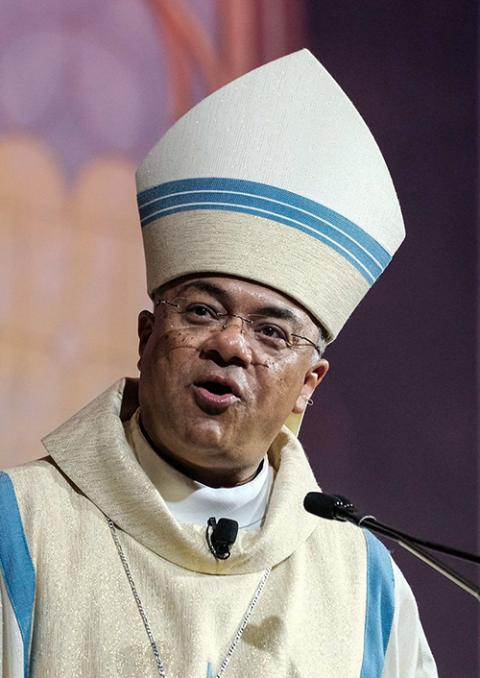
Archbishop Shelton Fabre of Louisville, Ky. (OSV News/CNS file/Tennessee Register/Rick Musacchio)
Citing Magnifica Humanitas, Pope Leo XIV's recent encyclical on artificial intelligence and the challenges it poses to humanity, Fabre noted the risks that AI poses for workers, which include job insecurity, mass unemployment, reduced agency and increased inequalities.
"Furthermore, AI relies on low-wage workers, who are often hidden and who endure harsh conditions, caught in an exploitative supply chain," Fabre said.
While artificial intelligence presents new opportunities for humanity, Fabre said it also risks "normalizing a vision that is anti-human." He said AI systems "can imitate but never replace human intelligence."
"AI cannot feel, love, discern, or receive God's grace and wisdom," Fabre said. "It is not morally neutral and risks creating new forms of exclusion."
While traditional indicators point to a growing economy, Fabre highlighted data showing that hiring has slowed, especially for unemployed workers, while also noting that unemployment remains high for Black workers, according to an analysis by the Joint Center for Political and Economic Studies.
Roughly one-quarter of the labor force are low-wage workers, according to the Center for Social Development at Washington University in St. Louis. Among low-wage workers, 72% lack stable and secure jobs, and more than half are people of color.
More than 70% of Americans believe having children is unaffordable, an increase of 13 points in just the last year, according to a study by the College of Family, Home, and Social Sciences at Brigham Young University.
"AI must be carefully developed to ensure it serves the common good and humanity itself," said Fabre, who added that dignified work "is not merely about productivity, but also participation in God's creation."
Advertisement
Said Fabre, "A just economy is not judged on profit alone, but on inclusive growth and protection for the most vulnerable."
Ensuring just development of AI systems, protecting good jobs and correcting power imbalances exacerbated by technology seem daunting, but Fabre said, "We have been here before." He cited Rerum Novarum, Pope Leo XIII's landmark 1891 encyclical that Fabre said "has brought the sacredness of the human person to the questions of work and labor for these last 135 years."
And on the 40th anniversary of "Economic Justice for All," the U.S. bishops' landmark 1986 document on the economy, Fabre said much of its teaching remains relevant.
"As we confront this latest challenge," Fabre said, "we invite all to be partners in this work. The Church, the government, labor unions, civil society groups, corporations, and others all have a shared responsibility to protect the human person and the dignity of work."
As new technology reshapes the economy and work, Fabre called on all to be "builders of communion," to ensure that technological innovation and development "is for the benefit of all, not just a few, and that each person can contribute to the Kingdom of God through their work."