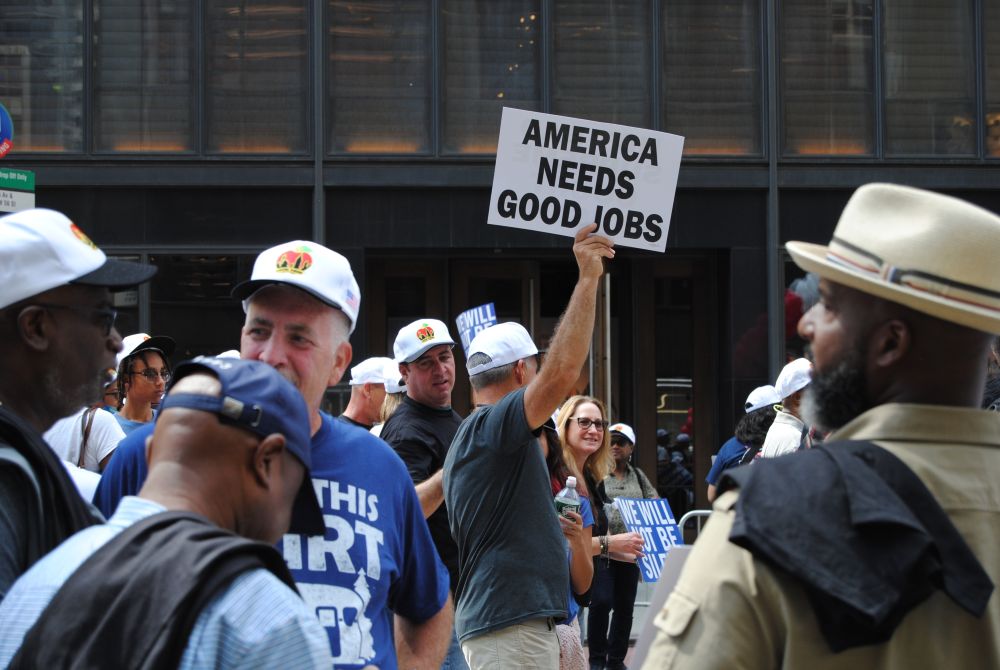
A participant holds up a sign during the Sept. 10, 2022, Labor Day parade in New York City. (Dreamstime/Erin Alexis Randolph)

Join the Conversation
Send your thoughts to Letters to the Editor. Learn more
Happy Labor Day! As regular readers know, very few causes are nearer or dearer to me than the rebuilding of the once vibrant relationship between the Catholic Church and organized labor in this country.
The relationship that grew up between the Catholic Church and organized labor in the late 19th century was entirely organic. Immigrant workers in the factories of New York City or the brownstone quarries of Portland, Connecticut, or of the railroads nationwide, were often Catholic and often exploited. The Knights of Labor, the proto-union for the country's workers, included many Catholics. When a Canadian archbishop condemned them as a "secret society" in 1884, U.S. prelates appealed to Rome not to condemn the union. They noted that secrecy was imposed on the workers for fear they would lose their jobs and that many of the leaders of the Knights were loyal Catholics. Pope Leo XIII sided with the U.S. bishops and his focus on the issues led him to conclude he needed to write an encyclical on the subject of work, what would become Rerum Novarum.
Throughout the first half of the 20th century, unions and the Catholic Church grew in influence. In certain cities like Boston, New York and Chicago, the local archbishop was as important as the local mayor. Union leaders could make or break many candidacies. When ecclesiastical leaders wanted to assess public opinion, they would call on one or two union leaders they knew for advice. Many church buildings were built with volunteer labor but never with nonunion labor.
The relationship atrophied in the last half of the 20th century. The GI bill sent many Catholics to college first and then to the suburbs where their identity was shaped increasingly by the emerging consumer society and less by religious or union affiliation. The gradual decline in union membership gave labor leaders less of a claim on the public's attention, a fact exacerbated by divisions within organized labor between the aims of the leadership and the desires of the members. Many bishops also retreated from the public square except on abortion, an issue on which the AFL-CIO never took a position. And frequent efforts to get tax credits for parochial schools resulted in conflict with public school teachers' unions.
Most of all, the atrophy of the relationship was, like the earlier strengthening, organic. After the Second Vatican Council, the Catholic Church recommitted itself to service to the poor, the homeless, the destitute. Bishops and priests began working with middle-class lay teachers and parish secretaries. Wealthy Catholics were solicited for donations, especially as church attendance began to drop off. There was no item on a bishop's schedule that would require him to interact with working-class Catholics.
Some noble souls have kept the Catholic labor fires burning. The Kalmanovitz Initiative for Labor and the Working Poor at Georgetown University brings scholarly focus to the church's teaching on work and workers. The three "Erroneous Autonomy" conferences in 2014, 2015 and 2016 brought labor and church leaders together with academics and the 2015 gathering was held at the AFL-CIO headquarters. Full disclosure: I was lucky to work for Professor Stephen Schneck, director of Catholic University's Institute for Policy Research and Catholic Studies, who organized those conferences. Fr. Clete Kiley is a force of supernature in his tireless work to train labor priests, advise unions on immigration issues and renew the once vibrant relationship between workers and the Catholic Church.
Advertisement
In our polarized society, rebuilding the relationship between the Catholic Church and organized labor will not be organic; it must be intentional and some bishops are exhibiting that intent.
The U.S. bishops' conference statement on Labor Day was issued by Archbishop Shelton Fabre, chair of the Committee on Domestic Justice and Human Development, and it was excellent. The statement was thorough in scope and precise in its analysis of the unique problems posed by artificial intelligence. It demonstrated how the bishops' concern for workers is part of an ecclesial tradition of statements on labor, both papal and from the U.S. bishops' conference.
Cardinal Robert McElroy will celebrate a special Labor Day Mass at St. Matthew's Cathedral in Washington, D.C., on Sept. 6. The Mass has been organized by the Catholic Labor Network and the Washington Archdiocese and a reception will follow that is co-sponsored by the local D.C. labor federation. The network also lists other cities having special Masses to mark the day.
Notably, in Detroit, Archbishop Edward Weisenburger will celebrate a Labor Day Mass at Most Holy Trinity parish. The archbishop will then join the parade which begins nearby. "Archbishop Weisenburger presiding at a Mass for the sanctification of human labor prior to Detroit's Annual Labor Day Parade is a visible witness to Catholic Social Teaching reflected in St. John Paul II's encyclical Laborem Exercens," Msgr. Chuck Kosanke, episcopal vicar for the Northwest Region told NCR in an email. "It also expresses the Church's solidarity with the labor movement."
I do not see how the country can dig itself out of the many holes it is in without a strong labor movement. The church recognized long ago — and still recognizes — that work and workers are the key to social questions, not technology per se. It is persons and their cooperation with God's care for creation that should be the starting point for addressing the ills and the hopes of any society. Labor gets it. Catholics get it. Let's get them together more and more.