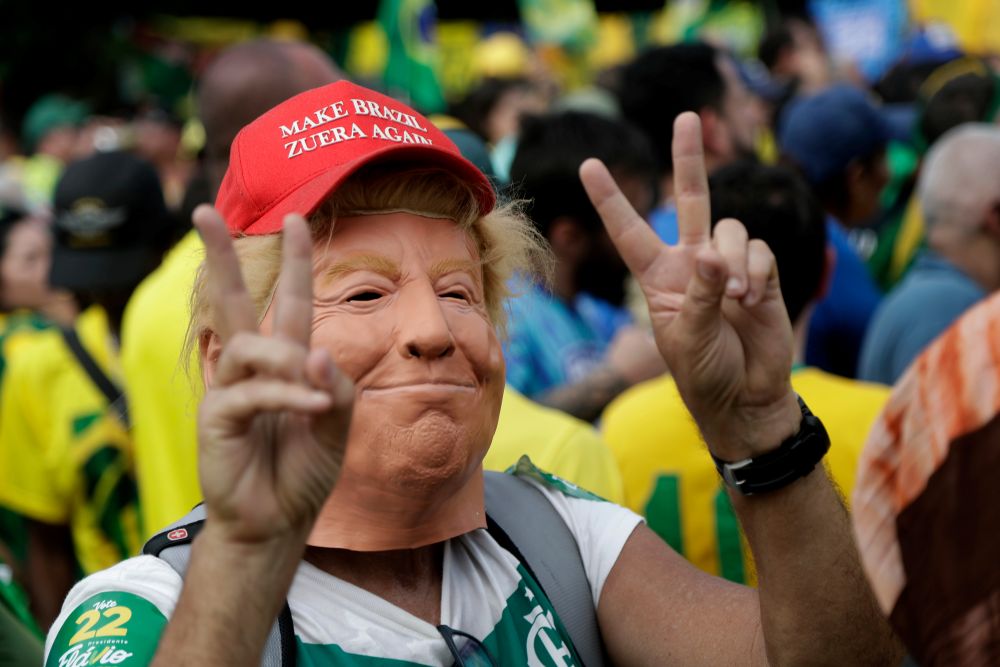
A supporter wears a mask depicting U.S. President Donald Trump during opposition presidential candidate Sen. Flávio Bolsonaro's final campaign rally ahead of Brazil's presidential runoff election in Rio de Janeiro, Brazil, Oct. 24, 2026. (AP/Bruna Prado)
by Eduardo Campos Lima
Join the Conversation
Send your thoughts to Letters to the Editor. Learn more
A group of bishops released a letter on Oct. 22 urging Catholics not to vote for presidential candidate Flávio Bolsonaro, the son of former President Jair Bolsonaro, who is facing incumbent Luiz Inácio Lula da Silva in the second round of Brazil's presidential election, scheduled for Oct. 25.
The unusual initiative, initially launched by 35 bishops and later backed by another 12 prelates, was motivated, the group said, by the gravity of the current situation.
Flávio's candidacy, which has received the backing of U.S. President Donald Trump and Secretary of State Marco Rubio, "directly threatens several major tenets of the Church's social doctrine, the existence of democracy, national sovereignty, and the pursuit of the common good," the bishops said.
The authors say they "cannot remain neutral" if they are to ensure that their "conscience or history will not condemn" them in the future.
"Those who remained silent in the face of the totalitarian threats that became reality in 20th-century Europe left a shameful legacy for future generations," the letter reads.
Under a Flávio Bolsonaro presidency, "We would be entirely at the mercy of the U.S.," Bishop Luiz Fernando Lisboa of the Diocese of Cachoeiro de Itapemirim, one of the signatories, told the National Catholic Reporter.
Lisboa fears that a Flávio Bolsonaro administration would allow Trump to expand the U.S. presence in South America through military bases and give U.S. companies a dominant position in the exploitation of the region's natural resources.
"Given Brazil's importance in the region, neighboring nations would face even greater pressure from [Trump's] expansionist policy," he added.
The letter mentions neither candidate by name. But the signatories outline seven reasons why Flávio Bolsonaro's platform runs counter to Catholic principles.
The prelates point out that Flávio Bolsonaro opposed ending the six-day workweek, under which workers have only one day off. Earlier in October, Lula's administration enacted a law reducing the standard workweek from 44 to 40 hours and providing for two days off.
Flávio repeatedly criticized the measure, arguing that companies would be financially "asphyxiated." He eventually changed his position and voted in favor of the reduction, but he advocates direct negotiations between employers and employees and an hourly wage system.
The bishops also cite the Bolsonaros' longstanding support for loosening gun-control laws in Brazil, their defense of the military dictatorship (1964-1985) and the torture of dissidents during that period, their disregard for integral ecology and the risk of another attempted coup.
After losing his reelection bid in 2022, Jair Bolsonaro conspired with political allies and Armed Forces commanders to stage a coup against President-elect Lula. The plan was never carried out, in part because the Army and Air Force commanders opposed it, while the Navy commander took part in the plot. Many Brazilians fear that Flávio could eventually encourage a similar attempt.
One of the letter's main concerns, however, is Flávio's relationship with the Trump administration.
"One of the candidates promises to subordinate Brazil to the United States, took part in a conspiracy to impose tariffs on Brazilian products, advocates foreign interference in our elections, and pledges to hand over our rare-earth resources for exploitation by the U.S.," the document says.
Advertisement
In this section, the bishops quote Pope Leo XIV's encyclical Magnifica Humanitas, which states that "any attempt or plan to eliminate or subjugate a nation is gravely immoral and therefore unacceptable."
Flávio's ties to Trumpism are not new. During his father's administration, aligning Brazil with the U.S. was a central ideological and political objective. Members of the government repeatedly signaled their preference for Washington over Beijing in matters of international trade and geopolitics.
Over the years, Eduardo Bolsonaro, Flávio's brother, became a regular presence at far-right forums associated with Trump, both in the U.S. and abroad, including in Hungary. After his father was convicted in connection with the 2022 coup plot, Eduardo moved to the U.S. in February 2025, ostensibly to fight for Jair Bolsonaro’'s rights and for Brazilian democracy.
In the U.S., Eduardo Bolsonaro and his allies allegedly influenced the Trump administration to take measures against Brazil, including the imposition of steep trade tariffs announced in July 2025.
The Bolsonaros also allegedly lobbied for the application of the Magnitsky Act against Supreme Court justices who convicted Jair Bolsonaro. The law provides for economic sanctions and travel bans against foreign individuals deemed responsible for human rights abuses or major corruption. The main target was Justice Alexandre de Moraes, who oversaw the investigation into Bolsonaro.
Brazilian diplomats managed to renegotiate the tariffs and secure exemptions for several products. The Magnitsky Act sanctions against de Moraes and his family were lifted in December, but travel bans affecting several members of the judiciary and politicians remain in place.
In May 2026, following meetings with Eduardo Bolsonaro and his allies, Rubio announced that two major Brazilian criminal organizations, Primeiro Comando da Capital (First Capital Command) and Comando Vermelho (Red Command), had been added to the U.S. State Department's list of Foreign Terrorist Organizations.
While the move was widely applauded by Bolsonaro supporters, the Lula administration lamented that months of efforts to persuade the Trump administration not to take that step had been in vain. Experts fear the decision could be used by Trump to expand the U.S. military presence in Brazil, ostensibly to launch strikes against drug traffickers.
Flávio Bolsonaro himself has cultivated ties with the Trump administration. In March, he attended the Conservative Political Action Conference in Dallas, Texas. He called on Washington to monitor Brazil's upcoming elections, compared his father to Trump, described Lula as "anti-American," and said that, under his leadership, Brazil would be a strategic U.S. partner in supplying critical minerals and rare earths.
In a letter Rubio sent him in June, the secretary of state thanked Flávio for his "generous offer to place a transition team at" the U.S. government's "disposal" if he were elected.
Italian-born Bishop Emeritus Adriano Ciocca Vasino of the Prelature of São Félix do Araguaia, another signatory, told NCR that Lula had never said he would refuse to work with the U.S. on the exploitation of natural resources, particularly rare earth minerals. Rather, he had "required that part of the technologies developed with such resources could remain in Brazil and contribute to our own development."
"Flávio's statements give us the impression that he would provide the U.S. with natural resources without any restrictions," Vasino said.
Despite growing demand for minerals used in the ongoing technological transition, the U.S. remains interested in gaining access to oil reserves and other natural resources, U.S.-born Sr. Jean Ann Bellini of the Sisters of St. Joseph of Rochester told NCR.
"Several foreign companies have been prospecting for mineral resources in Brazil. Monitoring their exploitation is the responsibility of those governing the country. We can imagine a scenario similar to that in Argentina, where ultra-libertarian President Javier Milei promoted legislative changes to facilitate mining," Bellini said.
She added that it is difficult to determine how firmly Trump supported the Bolsonaros, given "his erratic and egocentric personality."
"But Rubio has a well-known anti-leftist stance and surely wants to settle a score with Lula [who has longstanding ties to Cuba]," Bellini added. Rubio is a Cuban American whose parents immigrated to the United States.
She noted that neighboring countries had already joined the Shield of the Americas initiative, a U.S.-led alliance focused on illegal immigration and international drug-trafficking.
"Bringing Brazil into it would be an important step toward that renewed Monroe Doctrine," Bellini said.
Days ahead of the election, polls put Flavio Bolsonaro and Lula in a tight contest. About 60% of Brazilians identify themselves as Roman Catholic, according to the 2022 census
Francisco Borba Ribeiro Neto, a sociologist and expert on Brazil's religious dynamics, told NCR that the outcome of the U.S. midterm elections Nov. 3 would determine the significance of a Flávio Bolsonaro victory in Brazil's presidential race.
"A crushing defeat for Trump would mean that his policies toward Latin America would be revised," he said. "If he manages to retain his power, Flávio's victory would be much more significant for him and would have a broader impact across Latin America."
In Ribeiro Neto's view, Trump would like to revive the kind of hard power the U.S. wielded over Latin America between the 1960s and the 1980s, when Washington exercised considerable influence over right-wing dictatorships throughout the region.
"That will no longer happen," he said. "But by exerting political control over most Latin American governments, he can pave the way for U.S. companies to exploit raw materials and do business."