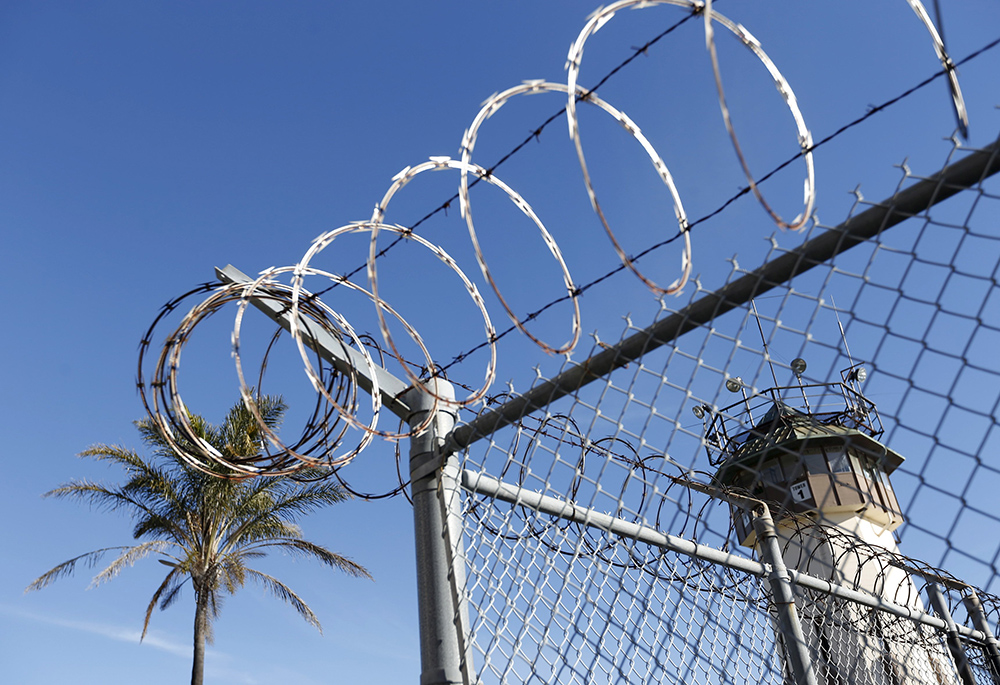
A file photo shows a guard tower at the former San Quentin State Prison in California, which is now called San Quentin Rehabilitation Center. (OSV News/Reuters/Stephen Lam)

by Brian Fraga
Staff Reporter
Join the Conversation
Send your thoughts to Letters to the Editor. Learn more
Catholic advocates for abolishing the death penalty praised California Gov. Gavin Newsom's announcement Thursday (Nov. 5) that he is commuting all 548 death sentences in the state to life in prison without parole.
Krisanne Vaillancourt Murphy, the executive director of Catholic Mobilizing Network, an organization that advocates to end capital punishment, said Newsom's decision "demonstrates how justice can be rooted in mercy and restoration instead of death and retribution."
"It is an incredibly encouraging and historic witness for life and advances human dignity," Murphy said in a statement where she commended Newsom for signing the "largest commutation in world history."
"He has given each of these individuals a tangible sign of hope and a chance for rehabilitation," Murphy said.
Kathleen Domingo, executive director of the California Catholic Conference, said in a statement that the commutations are "consistent with the dignity of every human person, demanding accountability, extending mercy, and allowing for redemption."
Sr. Helen Prejean, a Sister of St. Joseph, and longtime leading advocate against the death penalty, also praised the decision.
"I have seen the horrors of the death penalty first hand having accompanied eight human beings to their tortured deaths at the hands of the state. I am joined by hundreds of California faith leaders – from all faiths – who have added their voice to the call for the governor to choose justice through mercy and to commute all death sentences. We are so thankful that our prayers have been answered," Prejean said in a statement.
Newsom, a Democrat who is preparing to leave office after eight years, said he took the action after three decades of openly opposing state-sanctioned executions as an elected official. In 2019, he placed a moratorium on executions in the state, though hundreds of people remained on death row.
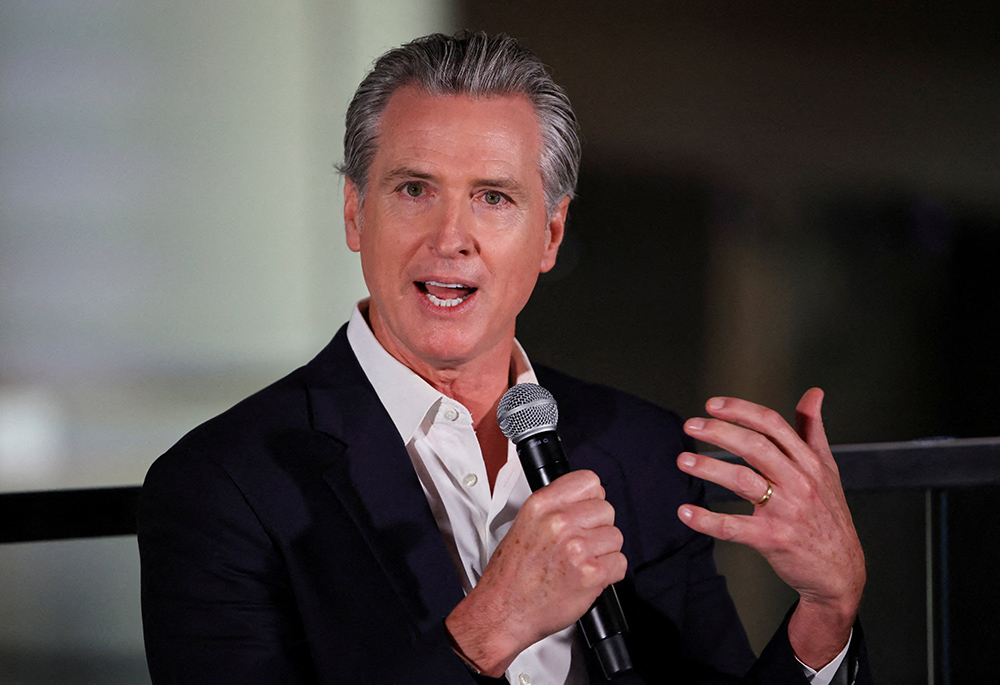
California Gov. Gavin Newsom speaks during a media preview day at the California Science Center for its new Samuel Oschin Air and Space Center in Los Angeles Oct. 28, 2026. (OSV News/Reuters/Daniel Cole)
"I take this action because I firmly believe that state-sanctioned killing is incompatible with California's values, undermines the foundations of our legal system, and diminishes each of us," Newsom said in a three-page public letter.
Newsom, who is Catholic, added that the decision was "among the most difficult" of his career, adding that he knew it would surface "excruciating" memories for crime victims' families.
"The people sentenced to death in California caused indescribable suffering to victims, their families, communities and our state as a whole. The harm they inflicted persists across generations," said Newsom, who acknowledged that "many Californians" believe that those who commit brutal offenses deserve to die.
"But as Governor, I have concluded the state cannot morally kill them," Newsom said.
Days before he granted clemency, 50 murder victims' family members had signed on to a letter urging Newsom to grant universal clemency.
Catholic leaders and advocates against the death penalty had previously called on Newsom to end the death sentences in California.
In September 2025, Prejean traveled to San Francisco, where she urged Newsom to "commute all the sentences on death row so that they’ll never be in danger of death again and the people will stand behind you."
In April, San Jose Bishop Oscar Cantú wrote an op-ed where called for Newsom to take a "decisive step" and commute all death sentences within his authority and to petition the state's Supreme Court to approve the commutation of the remaining sentences "so that California's progress toward a more just system cannot easily be reversed."
The American Civil Liberties Union, which has also been urging for clemency in California's death row, applauded the announcement.
"These commutations reflect what justice demands: an end to a racist, error-prone, and inhumane punishment that has burdened California for far too long," ACLU executive director Anthony Romero said in a statement.
The ACLU is involved in a legal challenge to California's death penalty law, alleging it is racially discriminatory and unconstitutional. According to the Death Penalty Information Center, California's death row inmates are 33% Black; 32% white; 29% Latino; 4.2% Asian; and 1.2% Native American.
Eight people have been exonerated from death row in California, all of them men of color, according to the Death Penalty Information Center.
Newsom is not the first governor to empty a state's death row; more than a half dozen U.S. governors have granted mass clemency in their states in recent years. California has also not executed anyone in 20 years. The state was not likely to execute anyone in the near future given that Newsom's successor, Xavier Becerra, who is also Catholic, has committed to maintaining a moratorium on capital punishment.
California has more death row inmates than any other state and Newsom's action cancels close to 30% of all death sentences nationwide, according to the Death Penalty Information Center, which reports that 1,388 people now remain sentenced to death throughout the country, the lowest number since 1984.
Advertisement
Robin Maher, the group's executive director, said in prepared remarks that Newsom's announcement marked a "decisive moment" in the history of the death penalty in the United States.
"Though other governors have granted universal clemencies, none have been at this scale," Maher said. "By bookending his time as governor first with a moratorium and now this mass clemency, Governor Newsom has irrevocably changed California's relationship with the death penalty."
California spent an estimated $6 billion on the death penalty since it was reinstated in 1978 and carried out just 13 executions during that time, according to the Death Penalty Information Center.
Considered a potential candidate for the 2028 presidential election, Newsom's move could endear him to liberal voters in a Democratic primary, though it could raise hurdles in a general election. The New York Times reported that a group opposing the commutations plan to file a legal challenge arguing that Newsom violated the law and that each case must be judged on its own merits.
The Catholic League, a conservative organization, contrasted Newsom's commutations with his support of abortion rights and physician-assisted suicide, posting on social media that Newsom's ethics direct him to "kill the innocent and save the guilty."
Meanwhile, death penalty opponents have planned a national ad campaign praising him for the move. The commercial, paid for by the U.S. Campaign to End the Death Penalty, casts Newsom's decision as an act of courage and leadership inspired by the likes of Rev. Martin Luther King Jr., Dolores Huerta, Robert F. Kennedy and Harvey Milk.
"It may be politically expedient to support the death penalty, but it is always morally repugnant," author and human rights activist Kerry Kennedy, daughter of Robert F. Kennedy, said in a social media post.
Murphy, of Catholic Mobilizing Network, said Newsom demonstrated moral clarity and political courage "that defines lasting leadership" and sets "a national standard we pray will be emulated by other governors."