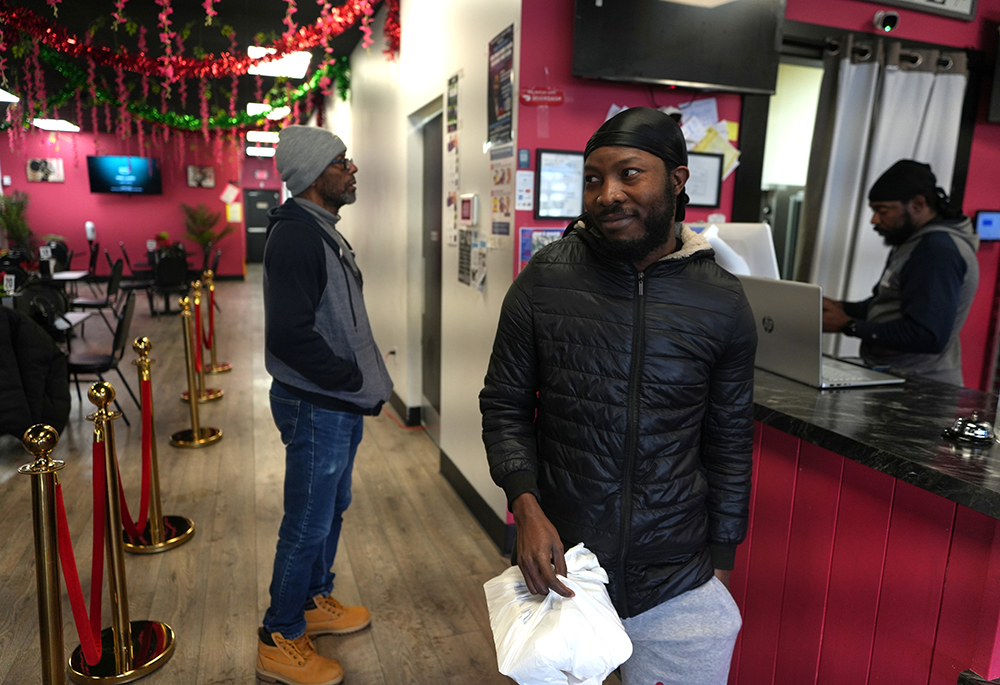
Roudechel Charpentier, a Haitian migrant who lives and works legally in the U.S. under Temporary Protected Status, walks out of the Rose Goute Creole restaurant, Feb. 3, 2026, in Springfield, Ohio. (AP photo/Luis Henao)

Join the Conversation
Send your thoughts to Letters to the Editor. Learn more
As the United States approaches the 250th anniversary of its founding, Catholic leaders in Ohio and Florida have issued separate appeals calling for continued protection for Haitian migrants living legally in the country under temporary protected status (TPS). While framed in different contexts, both statements argue that ending protections for Haitians would carry serious humanitarian, social and economic consequences.
The statement from the Catholic bishops of Ohio, titled "America at 250: Freedom and the Common Good," links the immigration debate to broader reflections on the nation's founding principles. The bishops described the anniversary as an opportunity to consider "the promises of "life, liberty, and the pursuit of happiness, and to worship God free from government intervention." contained in the country's founding documents. They argued that these principles impose responsibilities as well as confer rights, particularly toward vulnerable people seeking safety and stability.
Against that backdrop, the bishops expressed particular concern for Haitians living in Ohio and elsewhere in the U.S. whose legal status may be affected by changes to TPS policies. They noted that many parts of Haiti continue to experience violence and instability, making return potentially dangerous.
"We find no moral justification for terminating their Temporary Protected Status without an alternative way to adjust their immigration status," the bishops wrote. Citing conditions in Haiti and accounts from multiple sources, they said that "it is neither safe to return, nor reasonable to expect families not to desperately search for another option."
Advertisement
The bishops described Haitian families in Ohio as active members of local communities who work, raise families and participate in religious life. They warned that many now face uncertainty while awaiting legal and political decisions that could determine their future in the United States.
According to the statement, parents could be confronted with painful choices about whether to remain separated from their children or bring them back to an uncertain situation in Haiti. The bishops characterize the prospect as "a moral and social failure unfolding before our eyes."
At the same time, they reject claims that migrants and refugees do not contribute to society, pointing instead to the experiences of Catholic parishes and communities throughout Ohio.
"Claims that those seeking refuge in our country do not want to contribute to the common good are simply unfounded in regard to those attending our parishes or in the success stories of refugees in Ohio," they said. "We must do our best to ensure both citizens and newcomers can flourish in our communities."
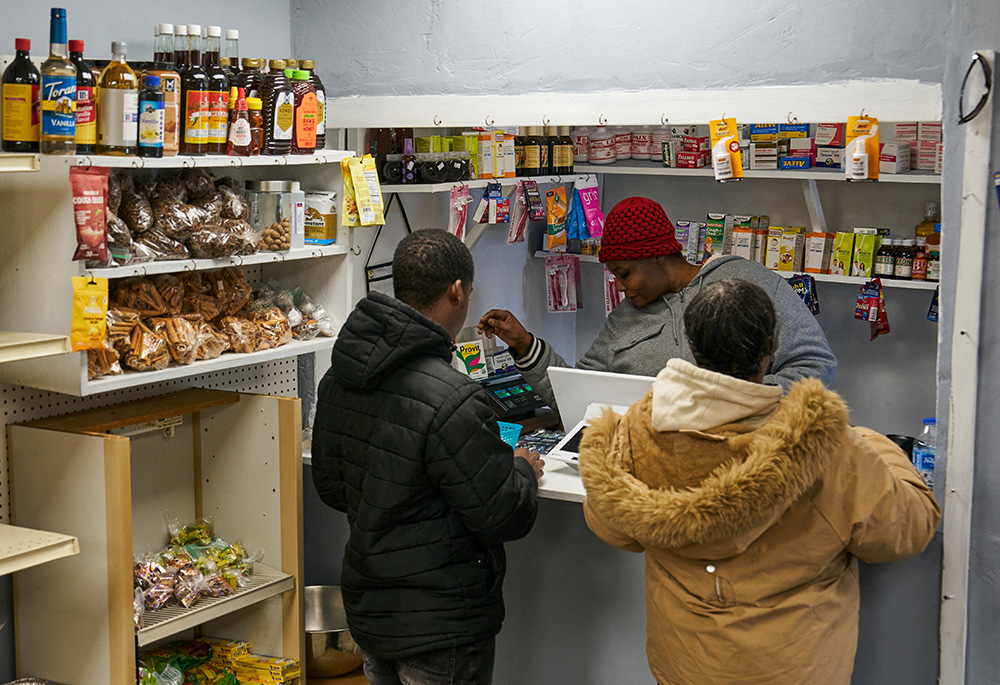
Bamilia Delcine Olistin assists customers at Bon Samaritain Food Store, her Haitian grocery store in Springfield, Ohio, Feb. 3, 2026. Olistin, formerly of Port-au-Prince, Haiti, has lived in Springfield for six years. (OSV News/Reuters/Bing Guan)
The bishops also addressed broader immigration policy, emphasizing that support for migrants does not conflict with border security or law enforcement. They affirmed what they describe as the nation's right and responsibility to regulate immigration and maintain public order. Individuals who commit violent crimes, they said, should not expect to remain in the country, and known criminals should not be admitted.
However, they argued that the current immigration system is excessively complicated and often fails to provide timely or predictable outcomes. In their view, the lack of clear pathways and due process leaves many people trapped in uncertainty despite efforts to comply with the law.
"A confident nation," they wrote, "should seek to integrate those who strive to work and raise their families in peace."
A similar message appeared in a note published by Archbishop Thomas Wenski of Miami, whose archdiocese serves one of the largest Haitian communities in the U.S. Writing after the House of Representatives approved legislation that would extend TPS protections for Haitians by three years, Wenski urged the Senate to pass the measure.
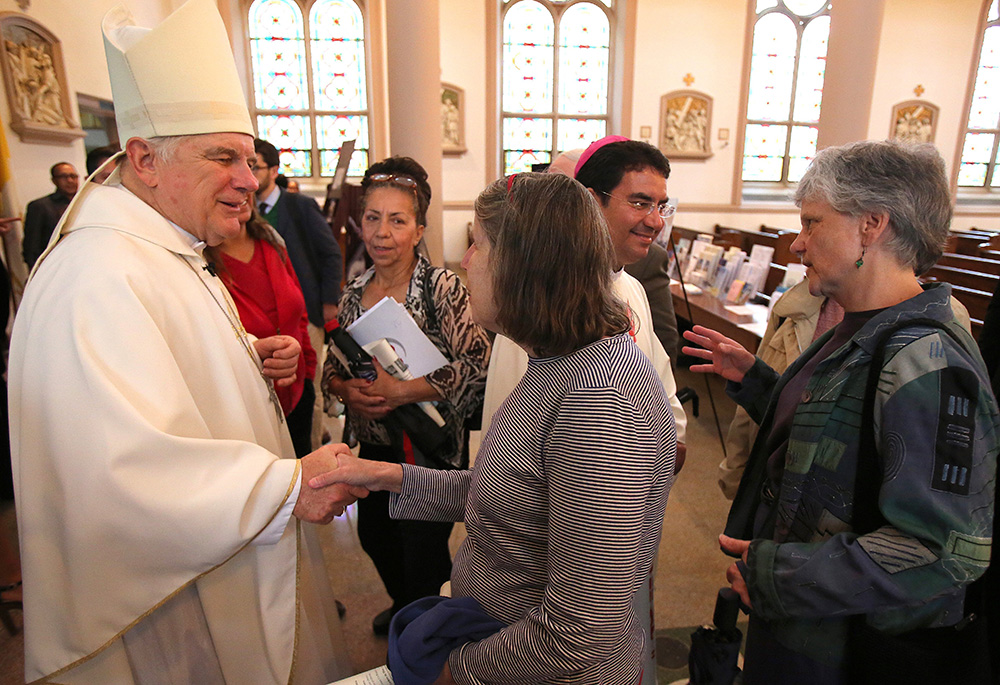
Miami Archbishop Thomas G. Wenski and Bishop Oscar Cantu, then head of the Diocese of Las Cruces, New Mexico, are pictured in a 2014 file photo greeting people after celebrating a "Mission for Migrants" Mass at St. Peter's Catholic Church on Capitol Hill in Washington. (OSV News/Bob Roller)
The archbishop described Haiti as a nation facing persistent crises more than a decade after the devastating 2010 earthquake. He pointed to widespread gang violence, kidnappings, disease outbreaks, food insecurity and the weakness of public institutions as evidence that the country remains unsafe for large-scale returns.
Wenski said that TPS would soon end because the administration had determined "inexplicably" that conditions have improved sufficiently for Haitians to be sent home.
Wenski argued that forcing Haitians to return under current circumstances would be "an act of abject cruelty."
"To do so would only exacerbate Haiti's ongoing humanitarian crisis," he said.
Like the Ohio bishops, Wenski emphasized the contributions Haitian migrants make to American society. TPS holders, he argued, have become established members of communities across the country and are active participants in the workforce.
"Haitians in this country are not 'on the dole'; they are not 'public charges.' They are hard workers filling jobs that, were it not for them, would go unfilled. The sudden expulsion of Haitian TPS holders would have devastating consequences for our nation's economy," he wrote.
The archbishop pointed particularly to healthcare facilities, including nursing homes, where Haitian workers play an important role. He also referenced communities such as Springfield, Ohio, where Haitian migrants became the subject of false allegations during the 2024 presidential campaign. According to Wenski, local business leaders and elected officials from both parties have acknowledged that losing Haitian workers would harm local economies.