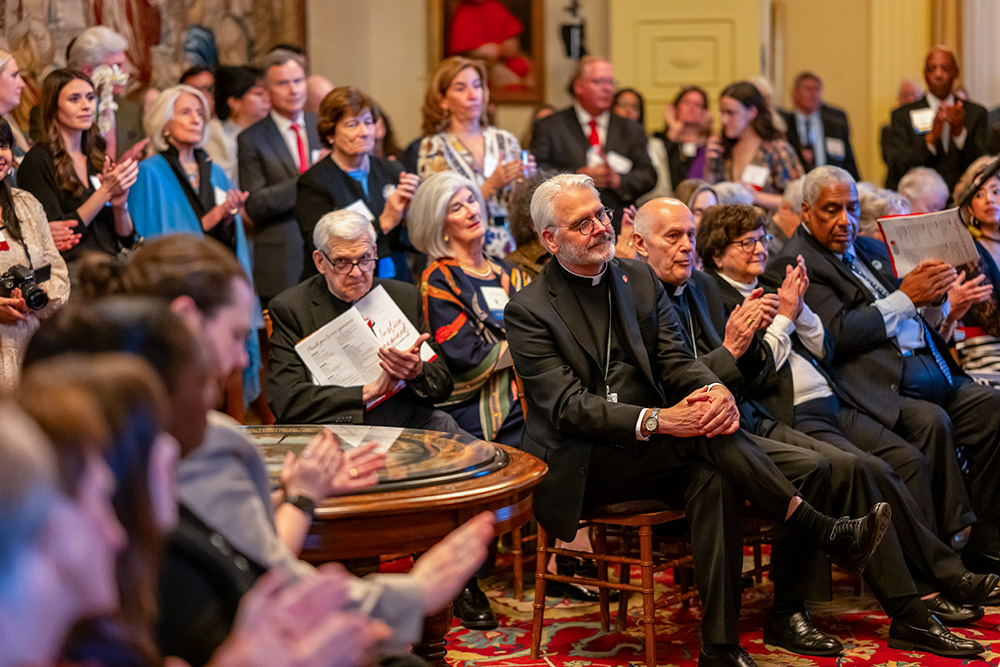
Attendees applaud at the Vatican embassy Oct. 21, 2026, during the Justice Reimagined Awards and Celebration, a Catholic Mobilizing Network event honoring capital punishment opponents. (Courtesy of of Catholic Mobilizing Network/Maximilian Franz Photography)

by Jack Kiyonaga
Join the Conversation
Send your thoughts to Letters to the Editor. Learn more
Three weeks after walking out of prison, Justin Wolfe stood in the apostolic nunciature in Washington, D.C., alongside his mother, Terri Steinberg.
"I can't believe you're here," Steinberg said, looking at her 45-year-old son.
Wolfe had been on death row in Virginia for more than a decade, imprisoned for 25 years, for a crime he maintains he didn't commit.
"I've always kept the faith and tried to keep a positive outlook on everything," Wolfe, a practicing Catholic, told National Catholic Reporter. He was released from prison Sept. 28.
"I can't hear you say it," his mom said, turning her face away at the mention of his execution date. Wolfe's legal team was able to save his life by demonstrating prosecutorial misconduct. Later, a key witness recantation ultimately secured his release this September.
Wolfe joined about 200 others at the Vatican embassy Oct. 21 for a Catholic Mobilizing Network event honoring capital punishment opponents.
The event took place in the wake of recent failed attempts by the state of Tennessee to execute Christa Pike and an announcement by Defense Secretary Pete Hegseth proposing to livestream the execution of Fort Hood shooter Nidal Hasan. President Donald Trump has since said the livestream would not happen.
Advertisement
The ultimate goal of Catholic Mobilizing Network, said Krisanne Vaillancourt Murphy, its executive director, is "to reimagine a justice worthy of the dignity God has bestowed on every human life."
As she sees it, much of that work is accomplished by promoting and sharing Catholic teaching on the death penalty. Even though the Catholic Church has long opposed the death penalty and explicitly revised the catechism in 2018 to say the practice is inadmissible in all cases, a Pew Research Center study conducted in 2025 found that 60% of U.S. Catholics say the death penalty is not morally wrong.
Such attitudes are why it's so important to starkly amplify the church's teaching on the death penalty in this current context where capital punishment has a spotlight on it, she said.
This is "a tremendous moment to take stock of what the Catholic Church can bring," she said.
"We have something to say, and it's a compelling argument," she told NCR days before the Washington event.
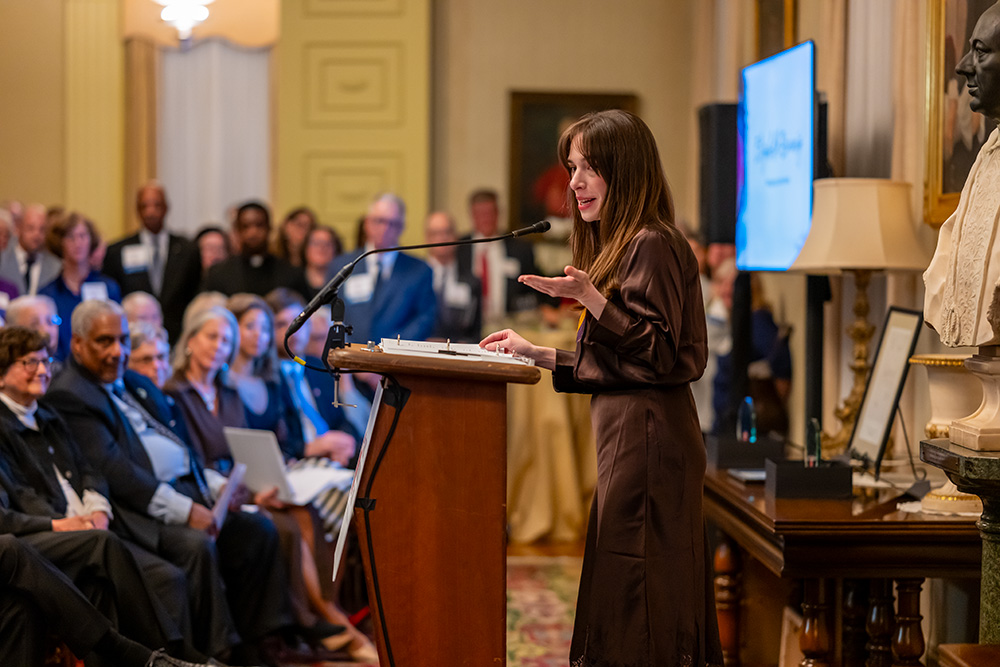
Elizabeth Bruenig, staff writer at The Atlantic, and Catholic Mobilizing Network honoree for her writings against capital punishment, addresses participants at the Vatican embassy event Oct. 21, 2026. (Courtesy of of Catholic Mobilizing Network/Maximilian Franz Photography)
This year, the Justice Reimagined Awards and Celebration honored journalist Elizabeth Bruenig from The Atlantic and Oklahoma City Archbishop Paul Coakley, president of the U.S. Conference of Catholic Bishops, for their anti-death-penalty advocacy.
Bruenig, who was acknowledged for writing about the death penalty, said, "every execution is a tragedy."
Bruenig has a personal understanding of the need for justice. Her sister-in-law was murdered in 2016. She said watching her husband and family deal with their pain while rejecting the idea of seeking retribution through the death penalty sparked her vocation as a writer and advocate. It was through this experience that she learned the death penalty doesn't offer real peace for victims or real justice for perpetrators.
"It makes you think a little differently about what victims' families are going through and what could actually help," she said. With capital punishment, "there's never really closure. There's always lingering pain."
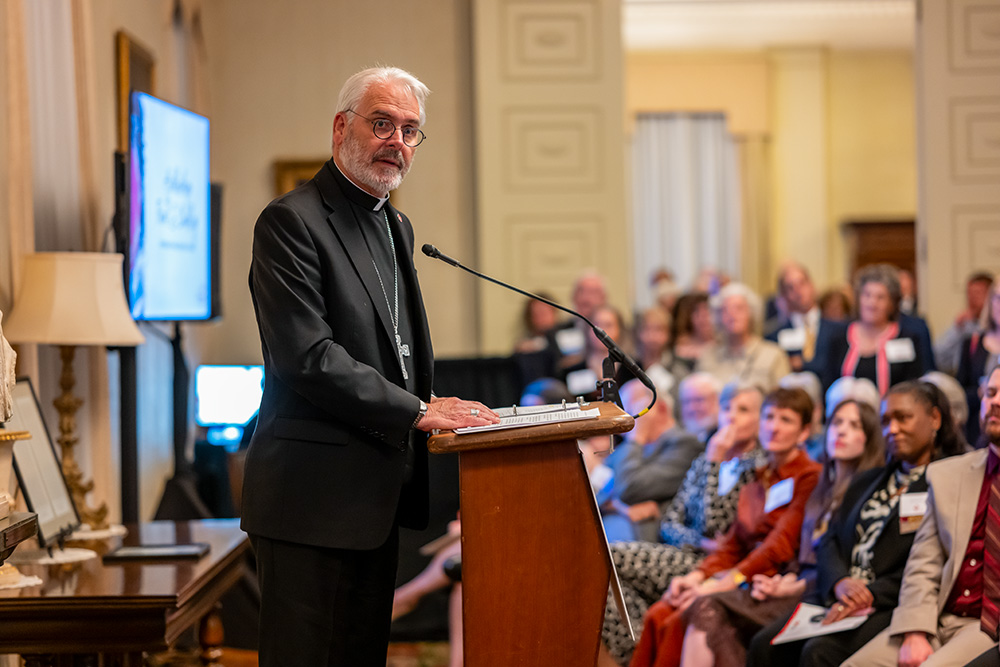
Oklahoma City Archbishop Paul Coakley, president of the U.S. Conference of Catholic Bishops, received the Archbishop Fiorenza Dignity and Life Award from the Catholic Mobilizing Network Oct. 21, 2026. (Courtesy of of Catholic Mobilizing Network/Maximilian Franz Photography)
Coakley, likewise, has been very outspoken against the death penalty. After Hegseth's comments about a proposed streaming event for Hasan's execution, the archbishop, in a statement, rebuked the idea as "a barbaric promotion of a culture of death."
At the Vatican embassy event, Coakley urged attendees to "recognize the injustice and the inhumanity of what is being done in our name" through the death penalty and urged members of the organization to continue their advocacy.
He said he was humbled and encouraged by the work of Catholic Mobilizing Network.
Another honoree at the event was Kate Letterman Conway, from Jasper, Indiana, winner of the group's annual young adult poetry contest.
Conway's poem, which she read aloud, explored the day of an execution from the perspective of the mother of the condemned, something that Terri Steinberg, standing just across the room with her son, had been spared.