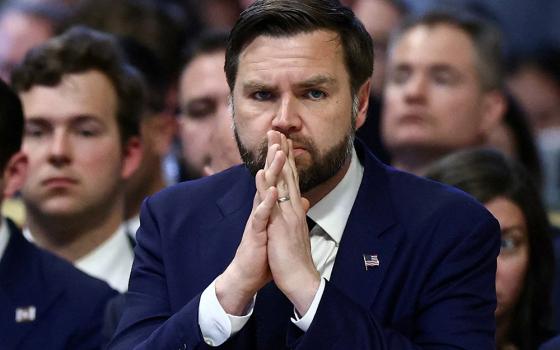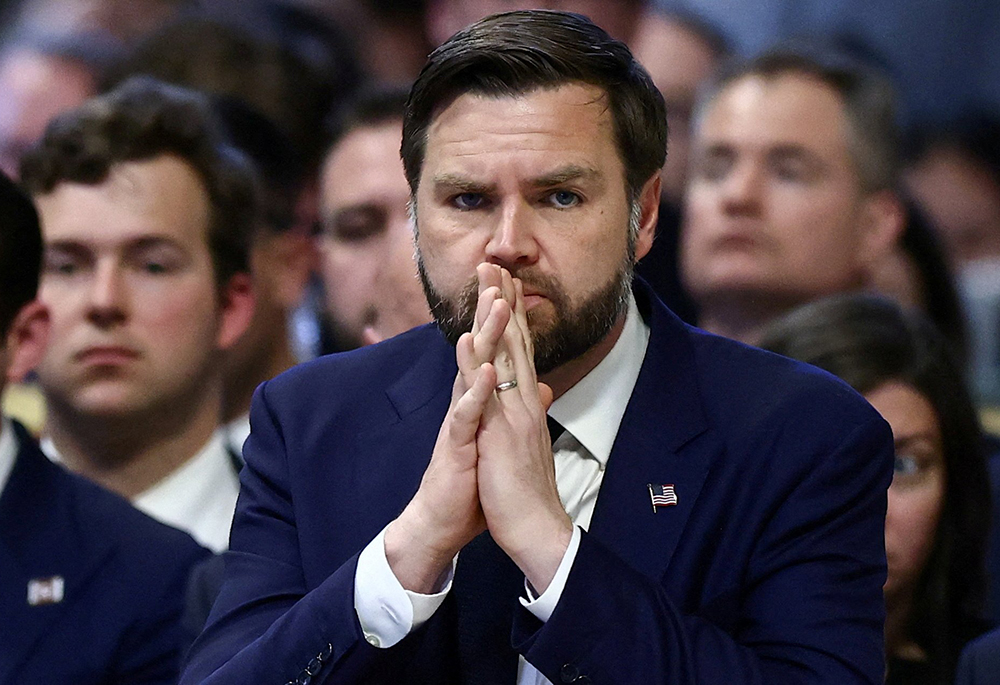
U.S. Vice President JD Vance prays during the Good Friday Passion of the Lord liturgy in St. Peter's Basilica at the Vatican, April 18, 2025. Vance's book Communion: Finding My Way Back to Faith was released June 16, 2026. (OSV News/Reuters/Yara Nardi)

Join the Conversation
Send your thoughts to Letters to the Editor. Learn more
Vice President JD Vance's views on immigration were the subject of criticism from Pope Francis, and he serves alongside a president who has clashed repeatedly with Pope Leo XIV about the war in Iran, but the Catholic vice president this week defended his relationship with both popes.
Vance was one of the last people to have met with Pope Francis before the late pope's death in 2025. Though few details were released about the meeting at the time, the likely 2028 presidential contender writes in his new faith memoir about that papal encounter, clashes with Vatican diplomats and how, despite their differences, he did not share in the negative views of Francis held by some fellow conservatives.
And despite the criticism of the U.S. war in Iran by Pope Leo XIV, Vance said on June 18 that the pair have spoken recently and that he believes they share a positive relationship.
"Have I spoken to the pope in the last few months? Yes,” Vance told New York Times columnist Ross Douthat on his podcast "Interesting Times" on June 18. "Do I have what I would characterize — I don't know what he would say — but do I have what I would characterize as a positive relationship with the pope? I think so. But fundamentally, we just have different jobs.”
President Donald Trump and Leo went back and forth over Iran in April, with the pope urging peace and Trump falsely claiming that Leo supported Iran acquiring a nuclear weapon. Speaking to the Times this week, Vance said conflict between the pope and the vice president is to be expected because of the different natures of their positions.
Vance said that Leo is "an important moral voice, but he also does have a different role from the vice president of the United States.”
"His role, I think, is to preach the Gospel and to offer his opinions on how he thinks we're doing. And, fundamentally, that will inevitably lead to some conflict," he said.

Pope Francis meets briefly with U.S. Vice President JD Vance, and his translator, in the papal residence, the Domus Sanctae Marthae, at the Vatican April 20, 2025. The Vatican said the meeting was an opportunity to exchange best wishes for Easter. (CNS /Vatican Media)
Vance's new book published June 16, Communion: Finding My Way Back to Faith, chronicles his conversion to Catholicism and his Easter 2025 meeting with Pope Francis is featured prominently. The Catholic vice president uses the story to open up his reflections on the perceived tensions between his views on migration and the Vatican's moral teaching. The pope died the following day of a stroke and cardiovascular collapse.
But while details of that meeting are sparse, the vice president is sharply critical of his meeting the previous day with Cardinal Pietro Parolin, Vatican secretary of state, and other Vatican diplomats, describing their discussion of migration as "too abstract to be helpful."
After what he described as a "substantive" conversation on the wars in Ukraine and Gaza, Vance said the subsequent discussion on migration was "unsettling" because Vatican officials did not make any specific requests.
"Here I was, the most senior Catholic in the United States government, and the Vatican seemed unwilling to move its moral guidance past the point of trite platitudes," he wrote.
By contrast, Vance wrote that he appreciated Francis' "specific exhortations" in contrast to "the vagueness I encountered in our Vatican meeting." And while acknowledging the skepticism with which many conservative Catholics viewed the pope, Vance said he "never shared this view."
"Whatever our disagreements on policy, he had helped keep me focused on the Church's social teaching," he wrote.
Francis' own criticism of the Trump administration's immigration policies had, by 2025, placed Vance at the center of a broader debate over Catholic teaching and mass deportations. In a sweeping letter to the U.S. bishops, Francis explicitly rejected the theological framework Vance had publicly invoked to defend the administration's push for mass deportations.
Advertisement
Reflecting on Francis' legacy in the book, Vance cited conservative Catholic commentators Sohrab Ahmari and George Weigel, but argued in light of claims that Francis was a radical progressive that neither the Catholic Church nor the late pope could "fit neatly into twenty-first-century political debates."
Vance also wrote about the U.S. bishops' November 2025 special pastoral message on immigration, widely viewed as a direct rebuke of the Trump administration's mass deportation policies.
In that message, the bishops said they were "disturbed" by a "climate of fear and anxiety around questions of profiling and immigration enforcement."
Yet Vance wrote that "the document was admirably measured. Or almost too measured."
The immigration question, Vance said, "calls out for engagement from the bishops and the clergy," but he said that his role as a Christian politician "is to preserve the very social cohesion that makes charity and generosity possible."
The vice president then proceeded to argue that immigration can threaten Catholic values by eroding the social cohesion necessary to sustain institutions such as labor unions, which have been championed by Catholic social teaching since Pope Leo XIII's 1891 encyclical Rerum Novarum.
Therefore, he wrote, "Christians inadvertently serve a pernicious master when they sign up for large-scale immigration."
The National Catholic Reporter's Rome Bureau is made possible in part by the generosity of Joan and Bob McGrath.