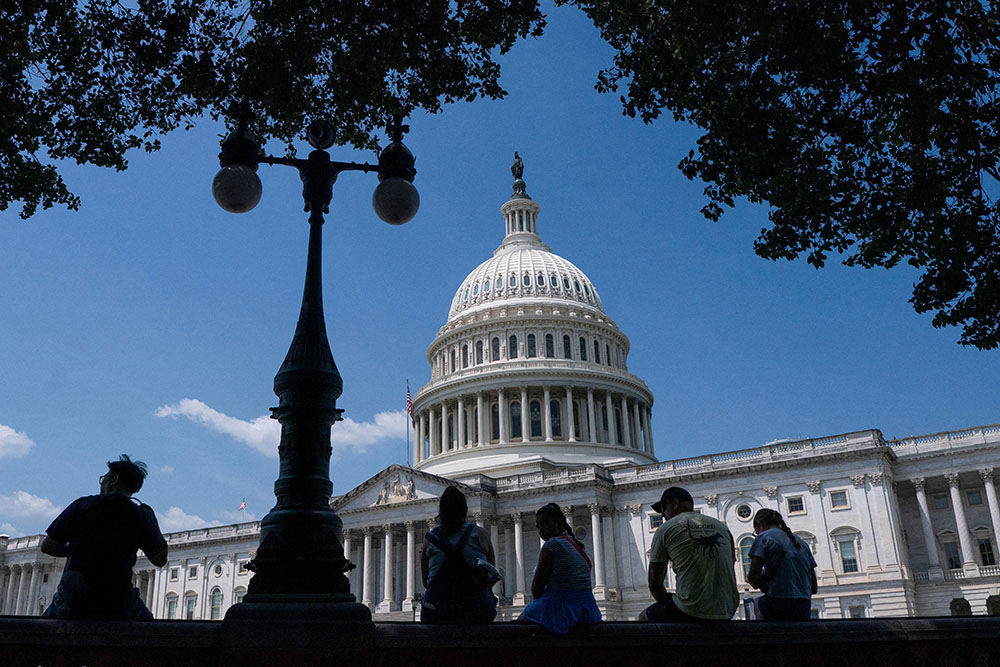
Visitors to the U.S. Capitol rest in the shade on Capitol Hill in Washington June 25, 2025. (OSV News/Reuters/Nathan Howard)

Join the Conversation
Send your thoughts to Letters to the Editor. Learn more
A bipartisan immigration proposal in the U.S. House of Representatives is drawing significant backing from Catholic lawmakers, who make up more than half of its current supporters, underscoring the role of faith in shaping one of the country's most contentious policy debates.
The measure, known as the Dignity Act, has 40 co-sponsors evenly divided between Republicans and Democrats. Of those, 22 identify as Catholic — 11 from each party — giving the group a notable presence in a legislative effort that seeks to bridge long-standing partisan divides on immigration reform.
The bill aims to combine stricter enforcement measures with a pathway to legal status for certain undocumented immigrants, while also addressing labor shortages and economic concerns. It is co-authored by Democratic Rep. Veronica Escobar of Texas and Republican Rep. Maria Salazar of Florida, who first collaborated on an earlier version of the legislation in 2023.
Escobar, a Catholic from El Paso, told the National Catholic Reporter that her decision to help lead the effort was shaped by both policy frustrations and broader concerns about the current immigration system.
"I was very frustrated because our immigration system is so broken, and there are millions of residents in our country who have raised families in America, who have contributed to our economy, who built businesses, who are part of our neighborhoods, our churches, our schools, who don't have legal status and that is wrong," she said.
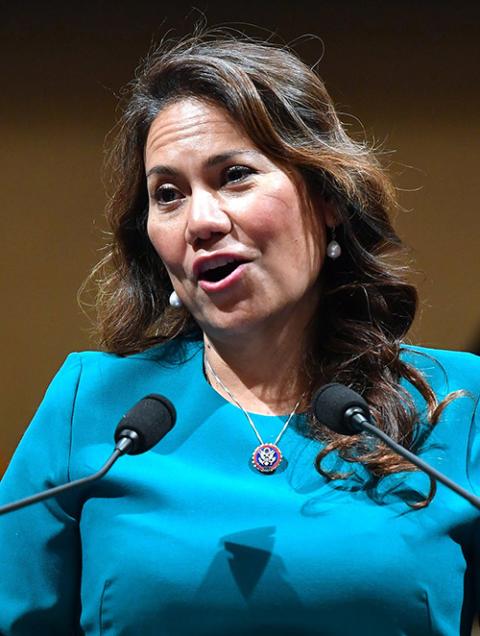
Rep. Veronica Escobar, D-Texas (OSV News/Mandel Ngan pool via Reuters)
"It's immoral; it's unjust, and it's not in our interest as a country who have that many people, that many residents without any legal status. It's just not good."
The legislation would create a structured process allowing certain undocumented immigrants to obtain legal status over time, while maintaining employment requirements and penalties they might have incurred for working without documents. It also proposes changes aimed at strengthening border security and ensuring compliance with immigration laws.
Supporters argue the bill reflects a compromise approach that addresses humanitarian concerns alongside enforcement priorities.
New York Rep. Mike Lawler, one of the Republican Catholic co-sponsors, said the issue has emerged frequently in conversations with constituents.
"I've heard a lot of frustration, both from employers struggling to fill jobs and families looking to reunite with their loved ones," Lawler said in a statement. "We must do this by fixing our broken legal immigration system, securing our borders, and creating a fair, earned process for those who are already here and contributing. The Dignity Act honors America's legacy of being a nation of immigrants, and that's why I'm proud to support it."
Rep. Brian Fitzpatrick, another Republican Catholic co-sponsor of the bill and co-chair of the Problem Solvers Caucus, said, "For far too long, our immigration system has been a glaring failure, and Americans are suffering as a result."
"The Dignity Act stands as a historic, bipartisan solution that decisively ends illegal immigration, secures our borders, and drives economic prosperity in the United States," he added.
The bill's Catholic backing reflects longstanding positions within the church on immigration. Catholic social teaching emphasizes the dignity of the human person and the responsibility to care for immigrants, while also recognizing the role of governments in regulating borders.
Advertisement
Escobar said those principles have influenced her work on the legislation.
"My Catholic faith influences almost everything that I do when it comes to policy," she said.
"When I was growing up, my values from my family and from my church, I learned that we have to take care of one another, that we are responsible for the people around us, and that we need to care for others the way we would hope to be cared for, and whatever we do to the least among us, that is, in effect, what we would do to Jesus."
U.S. Catholic leaders have also highlighted concerns about the human consequences of the current system. El Paso Bishop Mark Seitz, a former chair of the U.S. Bishops' Committee on Migration, said in July 2025 that "under our current system, families across our nation are living in fear," while expressing support for reforms aligned with those proposed in the Dignity Act.
Beyond faith-based arguments, business groups have pointed to economic factors driving interest in the legislation. Rebecca Shi, CEO of the American Business Immigration Coalition Action, said the measure addresses both labor shortages and worker protections.
"The Dignity Act is tough, and it ensures that both long-term law-abiding immigrant workers can have a legal path forward, but also ensures that everyone follows the same rules, so it prevents bad-faith employers from undercutting wages, because currently the status quo is an unregulated shadow workforce," Shi said.
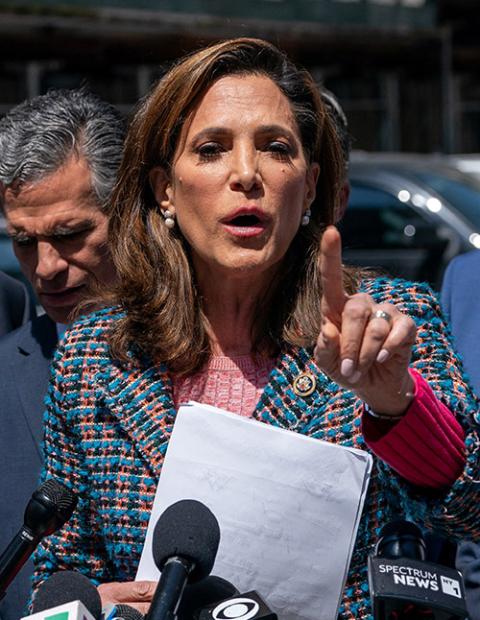
Rep. Maria Salazar, R-Fla. (OSV News/Reuters/David "Dee" Delgado)
She said the current system has created instability for both workers and employers, particularly in industries reliant on immigrant labor. She added that labor shortages have had broader economic effects.
"What this means for employers, the restaurant owners, hotel owners, farmers, construction, your mom-and-pops, your corner store, your favorite coffee shop, it makes sure that they have adequate labor," Shi said.
"Right now we're seeing food prices, housing prices, elder care prices just surging through the roof, and the reason is because we don't have labor. Labor is extremely low, and that pushes prices up, because the demand is still there for food, for housing, for healthcare."
Despite the bipartisan support, the bill's prospects remain uncertain. Immigration legislation has repeatedly stalled in Congress in recent years, even when backed by members of both parties.
Escobar said additional Republican support will likely be necessary for the measure to advance to a vote in the House.
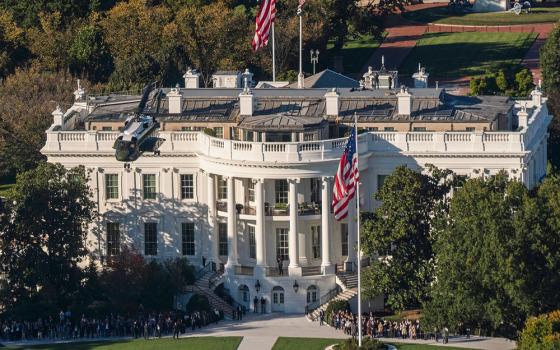
"We have momentum, but we need more Republicans to join us so that we can demonstrate to the White House that this is a bill that has enough interest that it can pass if it were brought to the floor of the House," she said.
Timing may also play a role. Lawmakers face a narrowing legislative window before shifting focus to campaign activities this summer, ahead of the upcoming midterm elections in November.
"This is one of the few opportunities we have, and we will have in the near future to get a bill across the finish line," Escobar said. "So I would encourage Catholics across the country for whom this is a priority, who believe that we should create opportunities for immigrants and that we should provide legal protections. I need their help," she said.